A Water Purifier with No Electricity Bill: The CU3040 for Power-Conscious Households
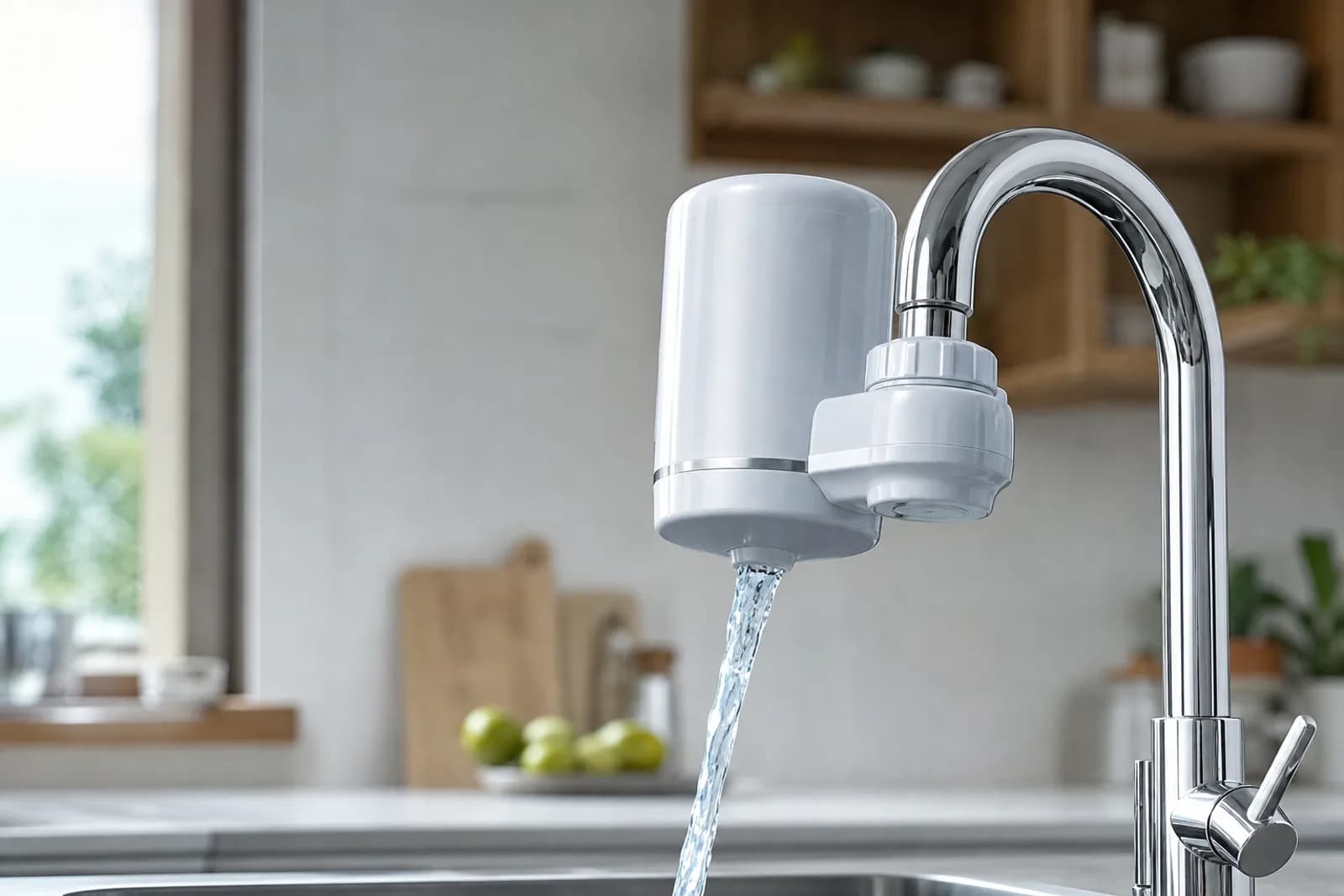
Rising PLN tariffs make the electricity cost of a water purifier worth calculating. The Truliva CU3040 ultrafiltration unit runs on tap pressure alone — no motor, no compressor, zero watts — and that is a real advantage for households on PDAM supply watching the monthly bill.
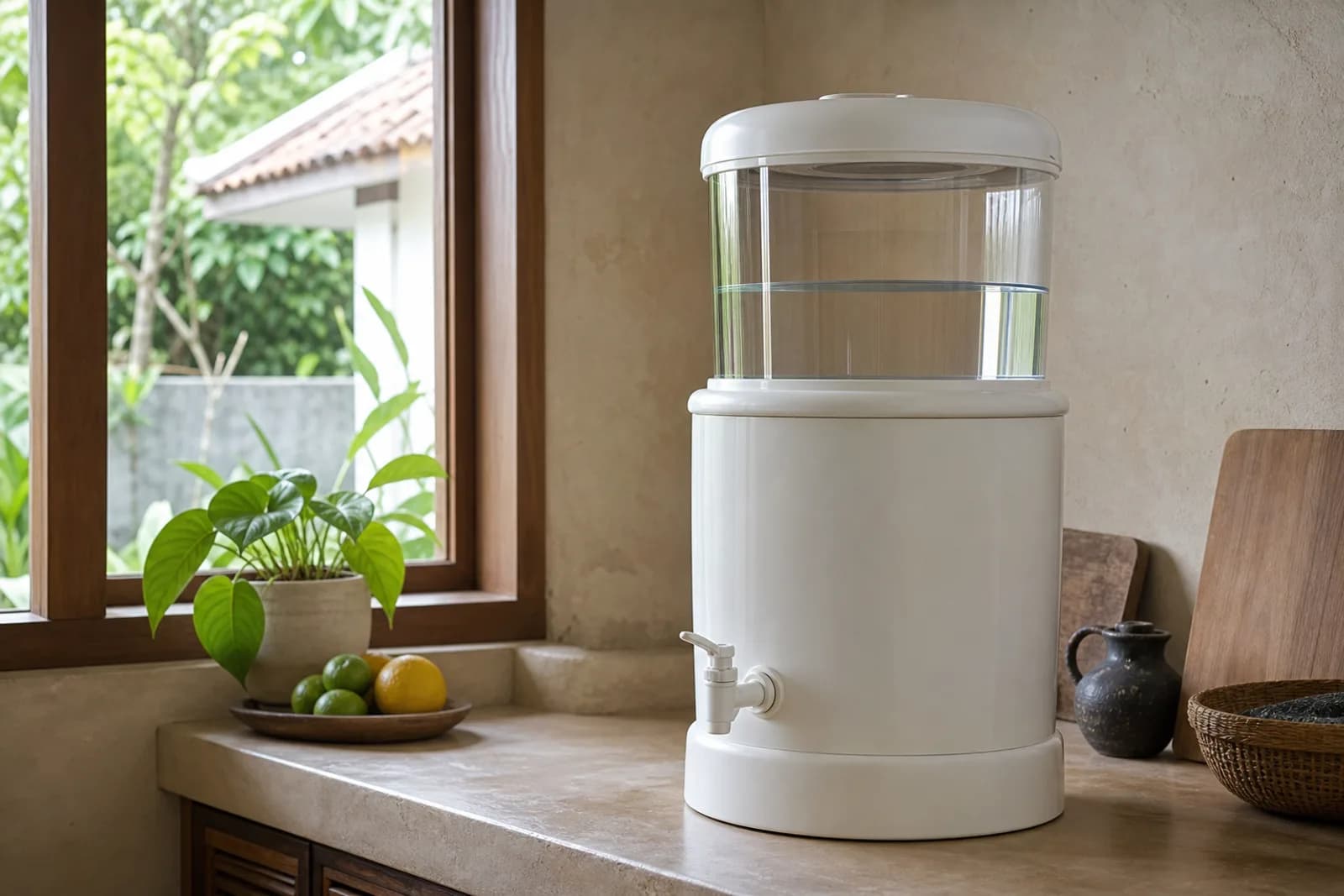
Every appliance in an Indonesian kitchen that draws power shows up on the PLN bill. The rice cooker, the refrigerator, the water dispenser if you have one — each contributes a watt-hour figure that, on a subsidised household tariff, matters more than on a higher bracket. A water purifier that needs no electricity at all is not a stripped-down product. It is, for the right household and water source, the smarter choice.
The Truliva CU3040 is that unit. Two filtration stages, 99.9% bacterial removal, 2 litres per minute, and a monthly electricity cost of exactly zero. This article explains who it is right for — and where it reaches its limits.
What running a powered purifier actually costs
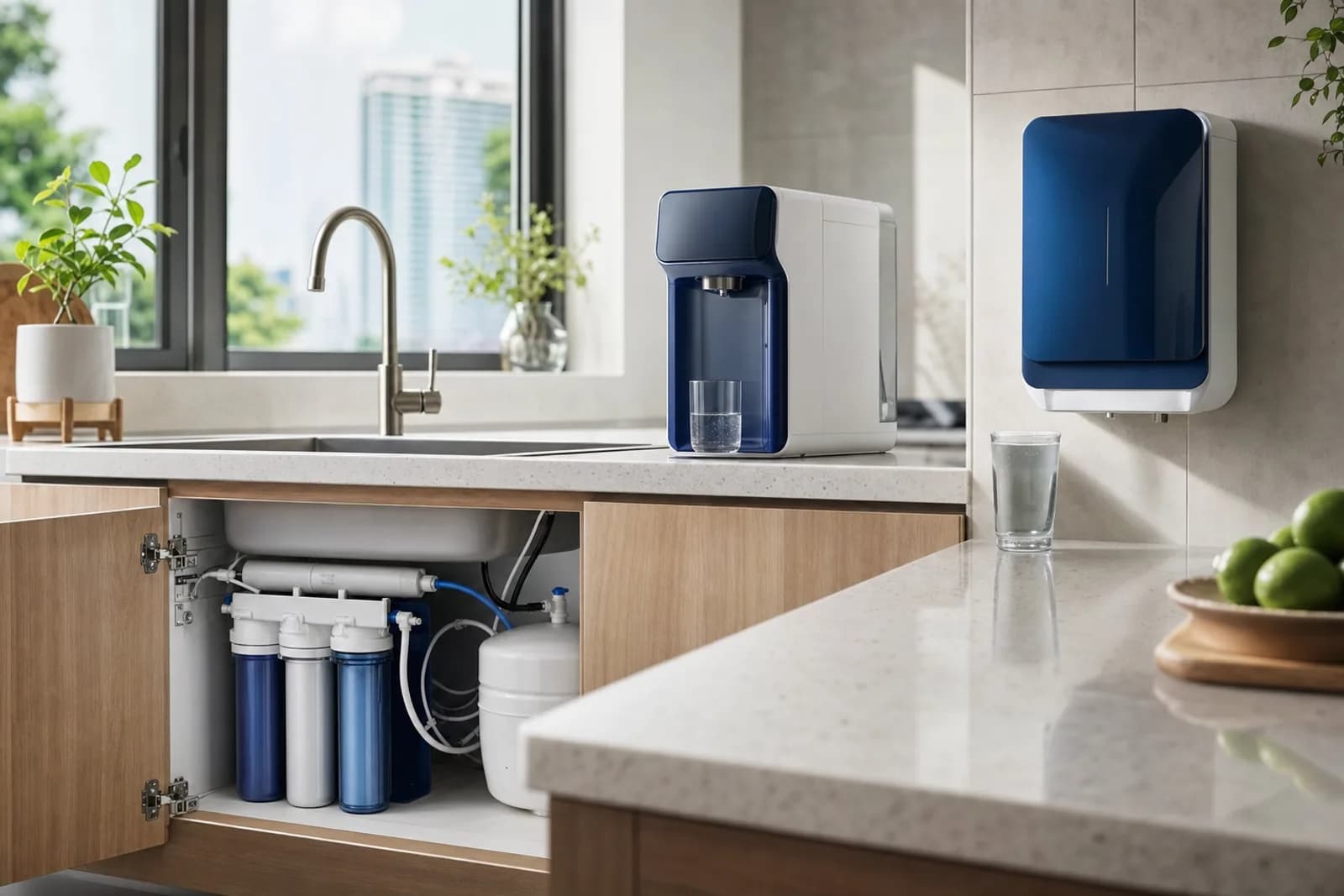
Most water purifiers in Indonesian homes are either air galon dispensers with a heating element, countertop RO units, or under-sink RO systems. The last two categories need a pump to push water across the RO membrane — typically a motor drawing somewhere between 25 and 75 watts, depending on the model. That figure alone does not sound large. But over a full month, it adds up.
As a rule of thumb, a pump motor running at roughly 50 watts for eight hours a day — a reasonable estimate for a household that draws water regularly through the day — consumes around 12 kilowatt-hours a month. At Indonesia's subsidised household tariff rates for Golongan 900 VA and below (the bracket many urban renters and lower-income households fall into), approximately Rp 1,000–1,400 per kWh is commonly reported. That puts the rough monthly electricity cost of an RO pump in the range of Rp 12,000–17,000. It is not a household-breaking figure, but it is a real and recurring one — and it sits on top of whatever the dispenser's heating or cooling element adds separately.
These tariff and usage figures are indicative assumptions — check the current PLN tariff schedule for your connection type; your actual cost will differ.
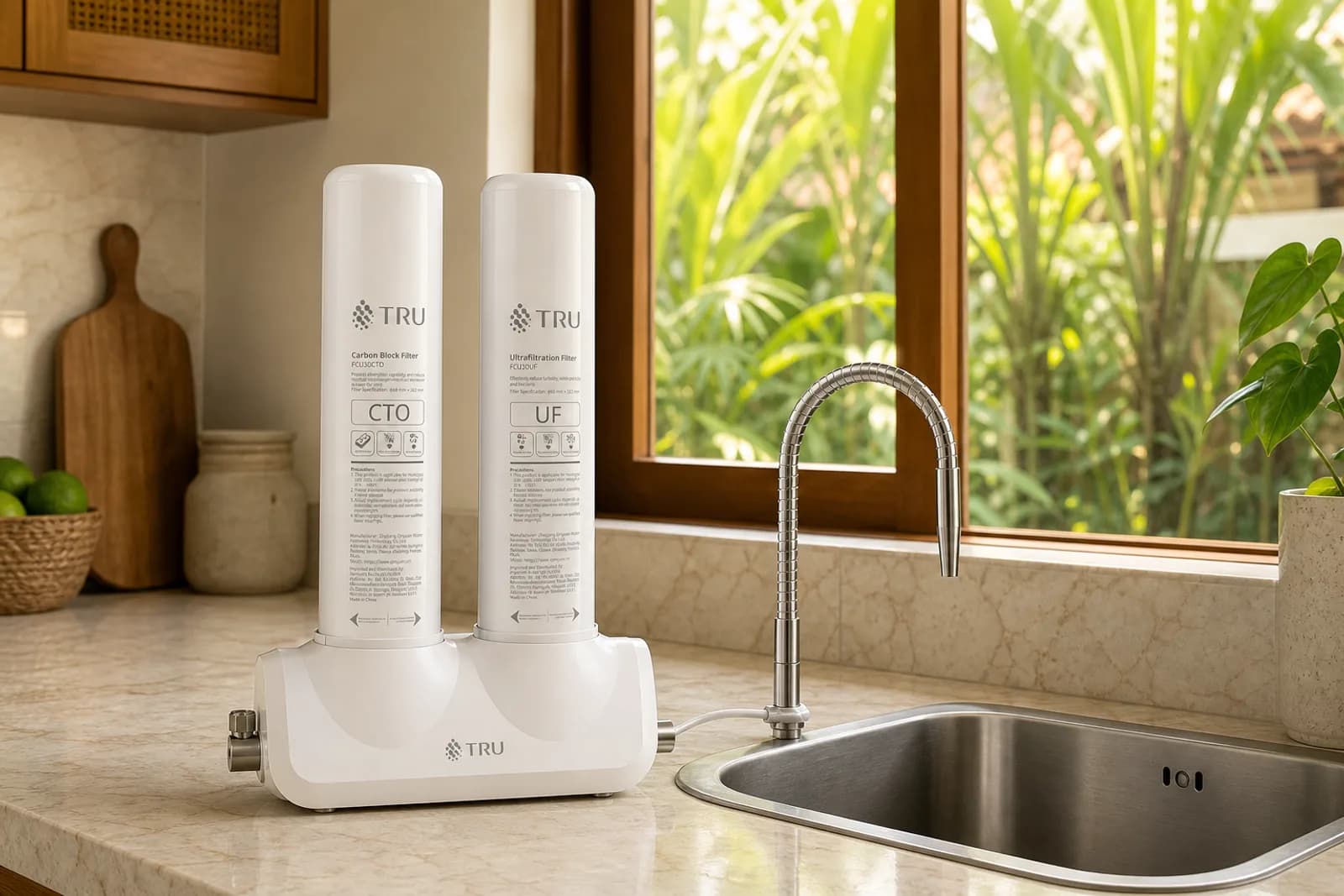
The CU3040 adds Rp 0 to that bill. It runs entirely on the water pressure from your tap. No motor, no heating element, no standby draw. Plug the diverter onto the faucet, turn on the tap, and filtered water comes out. The mains socket nearest your sink stays free.
How the filtration works
The CU3040 uses two stages that work in sequence.
Stage 1 — CTO carbon block. Water enters through a compressed activated-carbon cartridge (CTO: carbon block + taste + odour). This stage strips residual chlorine, chloramine, and the organic compounds that give piped water its chemical smell. PDAM water in most Indonesian cities is chlorinated at source — necessary for distribution safety, but not pleasant to drink or taste. The CTO block handles that.
Stage 2 — UF membrane. Water then passes through a hollow-fibre ultrafiltration membrane with pore sizes around 0.01 micron. At that scale, bacteria, E. coli, coliform, protozoa, and cysts are physically blocked. The removal rate is 99.9%. Dissolved minerals — calcium, magnesium, potassium — pass through because their molecular size is far smaller than the membrane's pore. The water that comes out is microbiologically clean and still tastes like natural water, not flat or stripped.
No electricity is involved at any stage. Water pressure from the tap is sufficient to push the flow through both cartridges at a steady 2 litres per minute.
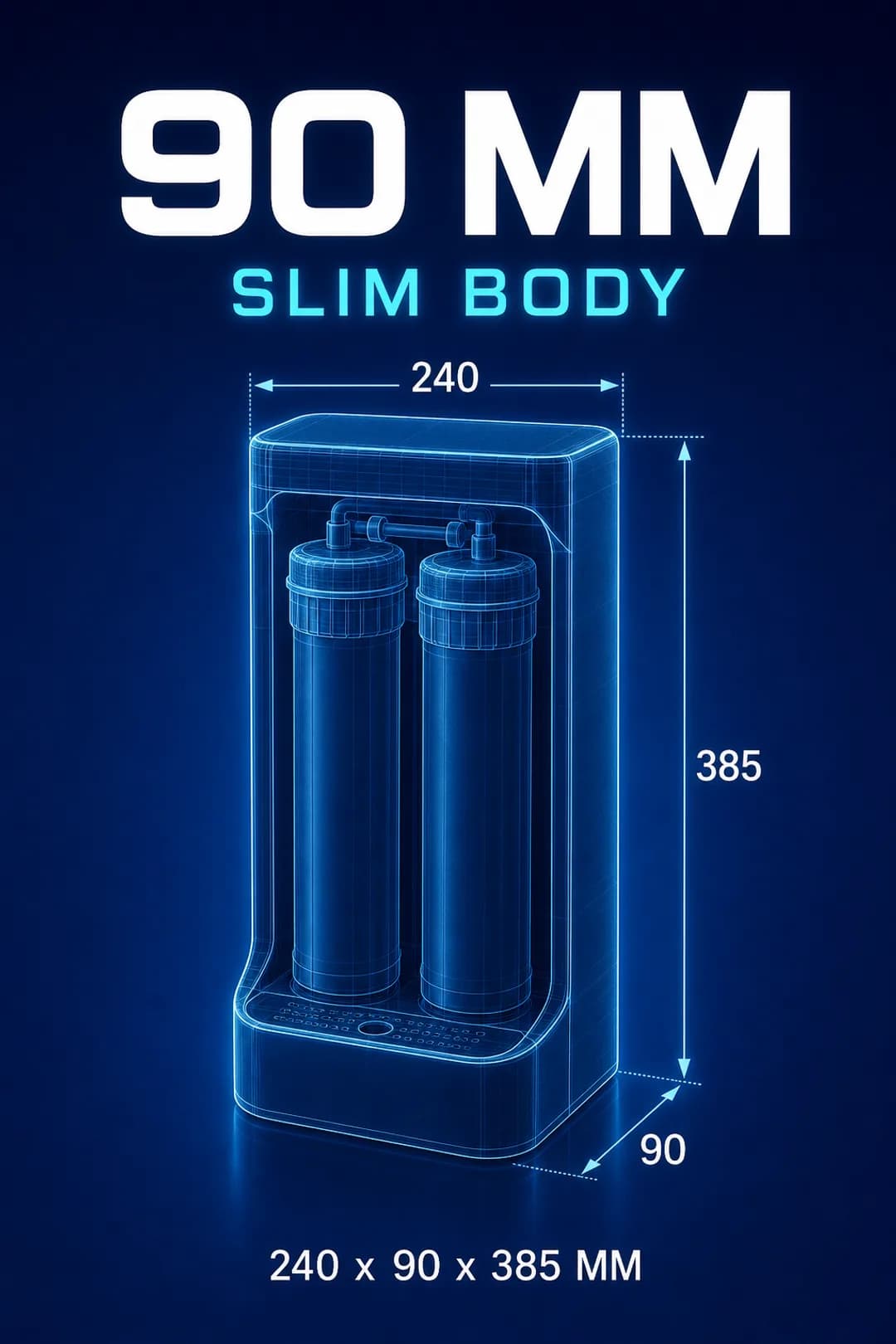
The unit sits on the counter, clips to the faucet via a diverter valve, and measures 240 × 90 × 385 mm. At 90 mm deep, it takes less worktop width than a box of rice.

When a UF unit is the right answer
UF filtration targets biological contamination — bacteria, cysts, and particles. For households in Indonesian cities on metered PDAM piped supply, that covers the primary risk. PDAM water is chemically treated at the plant. The concern for most urban households is not what enters the treatment works but what happens after: old distribution pipes, intermittent pressure that allows back-siphoning, or contamination introduced at the building's water tank. A UF membrane catches those biological risks before the water reaches the glass.
The case for UF over RO in this situation is straightforward:
- No electricity needed. The pump in an RO system is the only reason RO requires power. UF does not need one.
- No drain water. RO membranes reject a portion of incoming water as brine, which goes down the drain. UF passes all the water through — nothing is wasted.
- Minerals are preserved. RO removes dissolved solids broadly, including calcium and magnesium. UF keeps them. For a household already on reasonably low-TDS PDAM water, losing minerals is an unnecessary trade-off.
- Lower running cost. Two cartridges rated to 3,000 litres, no power draw, and a simple faucet clip: the annual cost of ownership is among the lowest of any active filtration system.
Where UF reaches its limits
UF is not the right answer for every situation, and this article would be incomplete without saying so clearly.
High TDS or borehole water. UF removes particles and biological contamination down to 0.01 micron, but it does not remove dissolved solids — heavy metals, nitrates, hardness minerals, or salinity. If your building draws from a deep well (borehole), if you are in a coastal area with saltwater intrusion, or if a TDS meter reads significantly above normal for your city's piped supply, UF will not touch those dissolved contaminants. That water needs reverse osmosis. A TDS meter costs very little and gives you a reading in seconds — it is worth buying before choosing a filtration type.
Very high sediment load. The CTO carbon block handles light sediment as part of its function, but a supply with heavy rust or particulate from damaged infrastructure works harder on the cartridge and shortens its life. In those cases, a pre-filter sediment stage helps.
If you need hot or cold dispensing. The CU3040 delivers filtered water at ambient temperature. It has no heating or cooling function. A household that wants hot water for kopi or formula, or chilled water in the midday heat, needs a different unit.
For PDAM-supplied households in Jakarta and other cities where the biological concern is the dominant one, UF covers the need completely. For groundwater users, coastal households, or anywhere TDS is elevated, RO is the appropriate choice — and within the Truliva range, options like the CR-ZX5170 (countertop RO, no plumbing) or the UR-Q3626 (under-sink RO) handle those conditions.
The electricity calculation in plain terms
The point of the CU3040 for a Golongan 900 VA household is not that the saving per month is enormous. It is that over the multi-year life of a filtration unit, the accumulation matters — and that the zero-power design removes one recurring line item permanently.
As an indicative example using the assumptions above, a household running a mid-range RO pump at moderate usage through the year would accumulate roughly 100–200 kWh in pump electricity costs over three years. On a subsidised tariff at those indicative rates, that translates to somewhere in the range of Rp 100,000–280,000 across that period — in addition to cartridge replacement costs. The CU3040 does not have that cost. Its three-year operating cost is two cartridge replacements and nothing else.
That calculation matters most at the entry level of the market, where the purchase price itself is lower and the recurring cost of electricity is a real differentiator between otherwise similar products.
Fitting it into the household
The CU3040 connects to any standard tap through a diverter valve included in the box. Installation takes under five minutes and requires no tools. When you switch to filtered mode on the diverter, water flows through the unit and out through the purifier's spout. When you want unfiltered tap water for washing up, you switch back.
The cartridge life is rated at 3,000 litres. For a household of two or three people drinking and cooking from the purifier — estimating roughly 5 to 8 litres a day — that works out to roughly 12 to 24 months of use before replacement. Replacement cartridges are the only recurring cost.
At 240 × 90 × 385 mm, the unit fits comfortably beside a standard kitchen sink. For a kost room or small apartment kitchen where counter space is genuinely limited, the 90 mm depth is meaningful. It clears most standard faucet diverters and leaves the rest of the counter usable.
The question of minerals, briefly
One reason Indonesian households sometimes hesitate before choosing UF over RO is a concern about whether UF filtration is thorough enough — and a separate, opposite concern from households who have read that RO removes beneficial minerals. The CU3040 sits in a useful position relative to both.
It removes bacteria and biological contamination with a 99.9% rated removal rate — that is the primary waterborne disease risk for piped PDAM supply. It does not remove dissolved minerals, which means calcium and magnesium remain in the water. For a household already on PDAM supply with a reasonable TDS reading, that outcome is straightforwardly positive: the contamination risk is addressed, and the mineral content is unchanged.
If you want more detail on how UF filtration affects water composition and what it means for daily use, the article on mineral retention in UF-filtered water covers that ground.
A note on galon as the comparison
Many households considering a countertop purifier are currently buying air galon refill — either from a local depot or through delivery. The full cost comparison between galon and a home purifier runs through the numbers in detail, but the short version for the CU3040 is this: the cartridge is rated to 3,000 litres, which is equivalent to roughly 158 standard 19-litre refill containers. When you cost the cartridge replacement against your monthly galon spend, the CU3040 typically shows a payback inside the first cartridge life for a household spending Rp 200,000 or more per month on refills.
For a household on PDAM supply where the mains water is already treated and the concern is the bacteria that pipes may add downstream, the combination of price, zero electricity cost, and reliable filtration makes the CU3040 one of the cleaner decisions in the category.
Further reading
- The Best Water Purifier for a Small Apartment or Kost — compares the CU3040 against countertop RO options for renters
- Galon Delivery vs a Water Purifier: The Real Cost — how to run the payback calculation for your household
- UF vs RO for PDAM Water: Which Filter Is Right for Jakarta Piped Supply — a deeper comparison across multiple SKUs
Not sure which system fits your water?
Aright Marketing Indonesia can assess your supply and recommend the right Truliva system for your home or business in Indonesia.