The Best Water Purifier for a Small Apartment or Kost
No drilling, no plumbing, no landlord arguments. How to pick a countertop water purifier that fits a kost or small apartment — UF and RO options that leave no trace when you move.
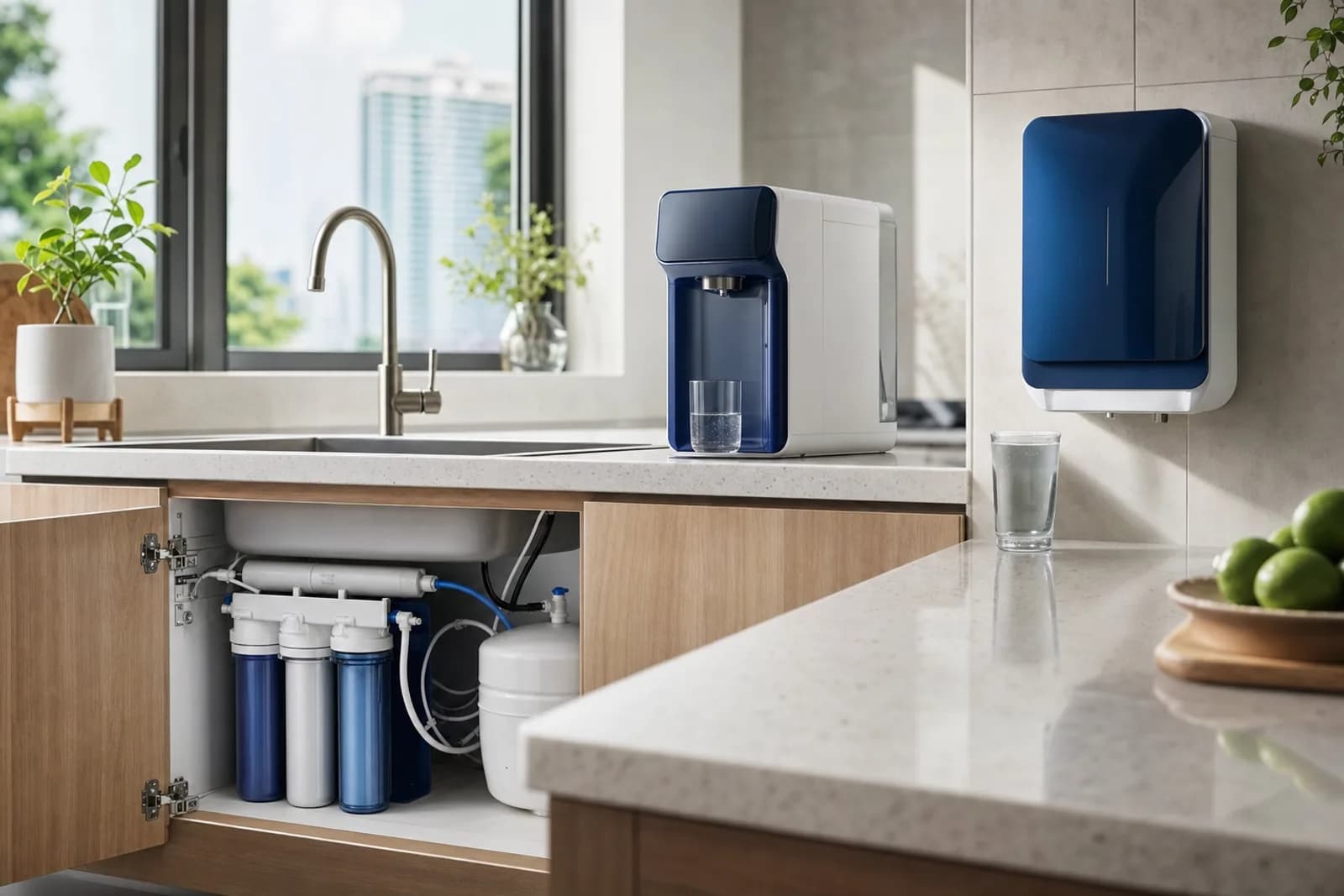
Renting a kost room or a small apartment in Indonesia comes with two constraints that shape the whole decision: limited counter space, and a landlord who will not let you drill into the cabinet or cut into the sink drain. Those two facts rule out most under-sink RO systems straight away — not because they are bad, but because they are built for owners who can modify the kitchen. The shortlist for renters is shorter and simpler than the full market suggests.
The installation problem, honestly
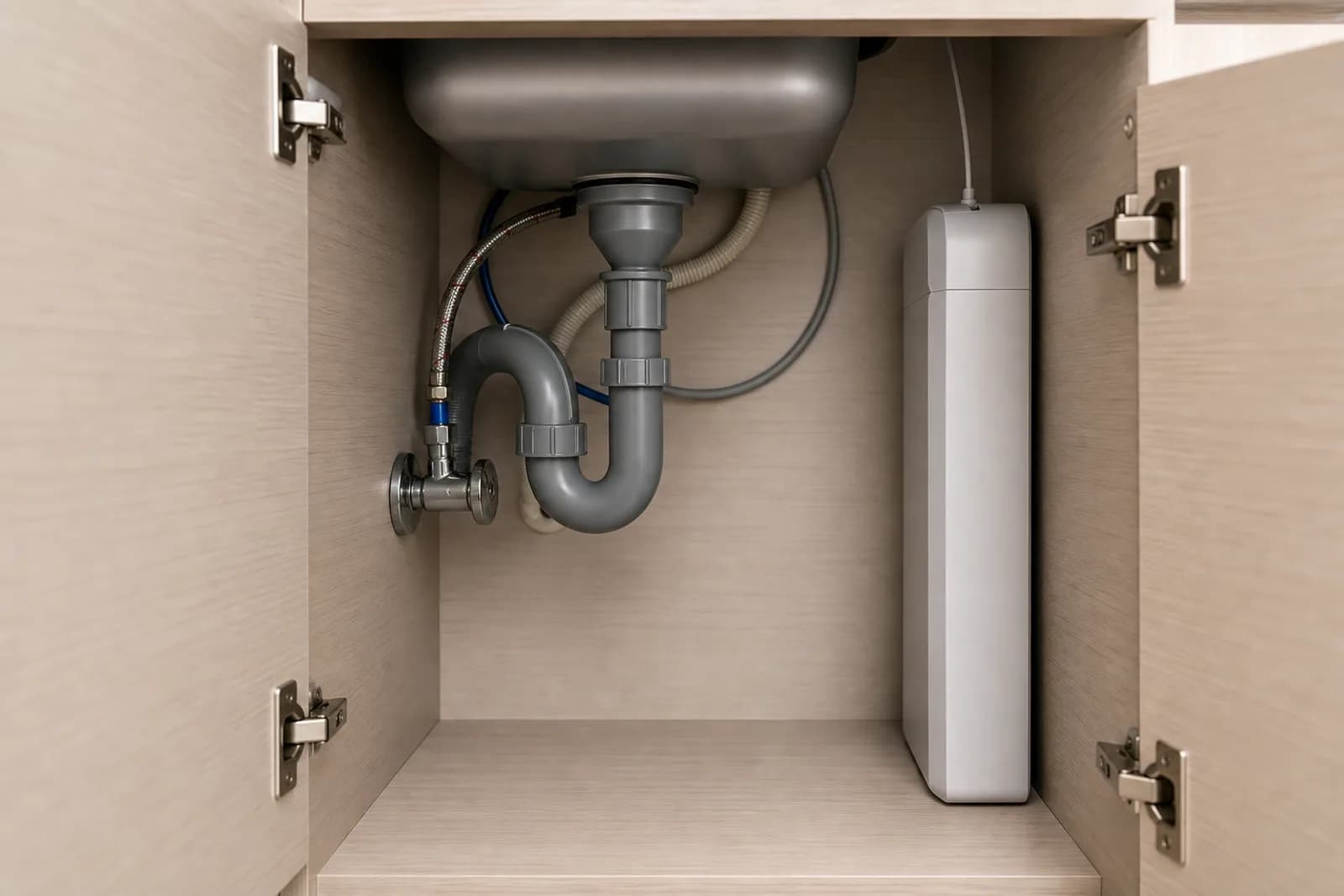
An under-sink system needs three things: a cold-water inlet connection, a drain tap, and often a power socket tucked inside the cabinet. Fitting one properly means drilling two or three holes — into the supply line, the cabinet back, sometimes the worktop for a dedicated faucet. In a kost or serviced apartment, that work is usually off-limits. And even where a landlord agrees, you inherit the same problem in reverse on the day you move out.
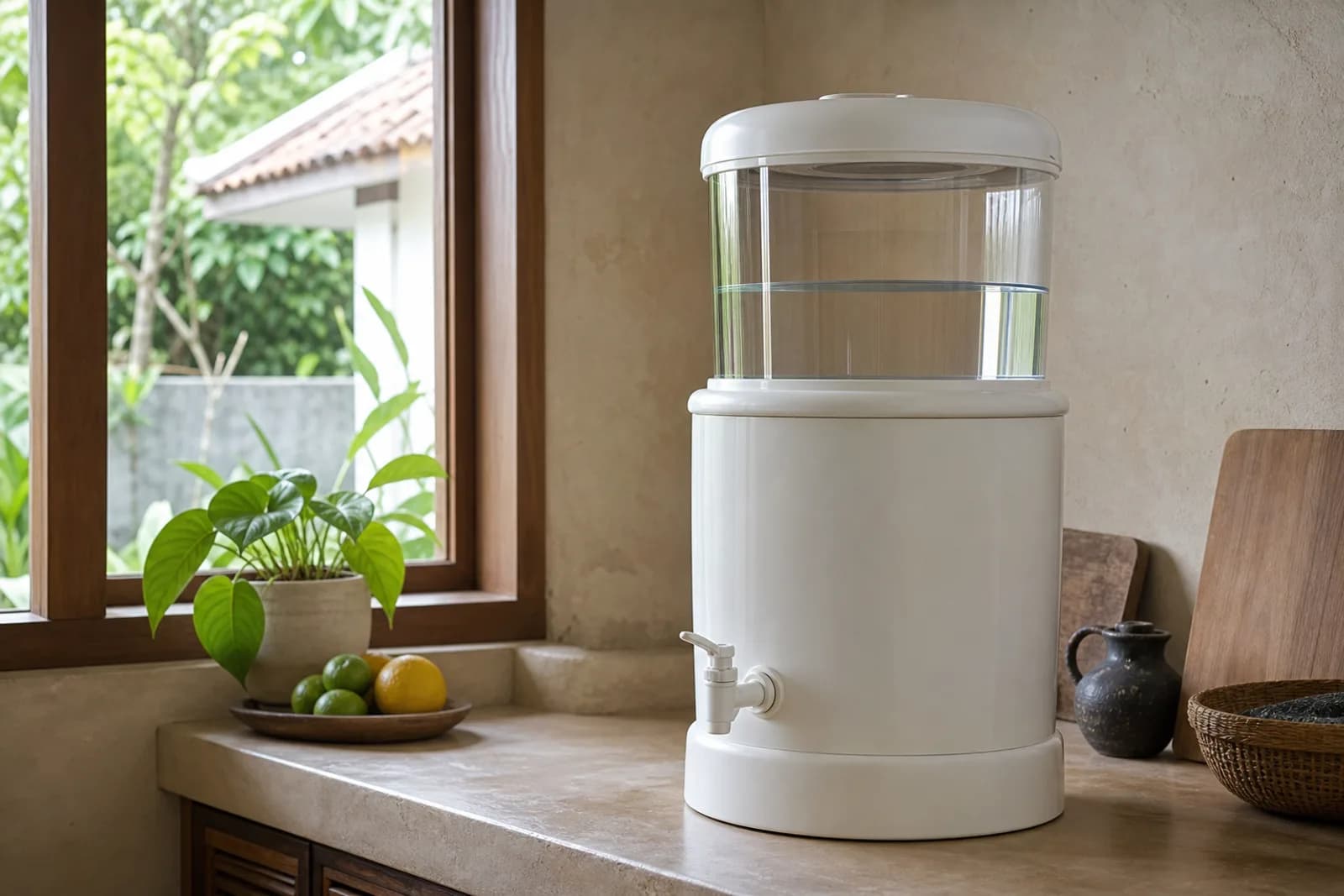
Countertop and freestanding units avoid all of it. They sit on the worktop, draw water from the tap through a diverter clip — or fill from a jug — and leave no trace when you pack up. That portability is not a compromise. For a renter, it is the whole point.
The two types worth considering
Countertop ultrafiltration (UF)
A UF unit uses a membrane with pores around 0.01 micron — fine enough to block bacteria, protozoa, and cysts, but open enough to let dissolved minerals pass. Water comes out microbiologically clean, tasting close to the source, with its calcium and magnesium intact.
The practical appeal for renters: no electricity, no wastewater, no drain connection. Tap pressure alone runs it. The Truliva CU3040 is a two-stage countertop design — a CTO carbon block that strips chlorine and polishes taste, followed by the UF membrane. It clips to the faucet through a diverter valve, delivers 2 litres per minute, and its cartridge is rated to 3,000 litres. The body measures 240 × 90 × 385 mm — at 90 mm deep, it tucks into a kost kitchenette with almost no worktop to spare.
UF is the right fit when your building runs on metered PDAM piped supply and the water is broadly clean. You strip out the bacteria and sediment that old or intermittent pipes add downstream, while keeping the minerals and keeping the electricity bill flat.
UF cannot help when the dissolved load is high — brackish groundwater, coastal supply with saltwater intrusion, or a borehole source. For those, you need RO.
Countertop RO
Reverse osmosis takes the same portable idea and adds a membrane tight enough to block dissolved salts, heavy metals, and most other dissolved contaminants. It is more thorough than UF, and it is the right answer when TDS is elevated or the source is uncertain.
Countertop RO units carry an internal water tank, so they are self-contained: fill the tank, plug in, pour. No plumbing at all — and on these models, not even a faucet diverter.
The Truliva CR-Z7170 holds a 6.8-litre internal tank, cools to 10°C electrically, and dispenses hot water across 38–98°C. Its six-layer filtration removes 104 substances at a 99.9% rate, and the filter set is rated to 4,000 litres. At 450 × 250 × 426 mm it is larger than the UF unit — roughly the footprint of a desktop water dispenser — and it needs a power socket within cable reach.
The Truliva CR-ZX5170 is the same category with one addition: it makes ice within seven minutes, using compressor cooling to reach a true 5°C rather than the CR-Z7170's electric cooling to 10°C. Same filtration spec, same tank-fill operation, same no-plumbing design, same 450 × 250 × 426 mm footprint. It suits a room where cold drinks and ice matter enough to justify the space.
Both RO units are freestanding. You fill the tank by hand or with a jug, plug into a standard socket, and press a button. When you move, you unplug and carry it out.
Matching the unit to your situation
On PDAM piped supply, low to moderate TDS, and you want the simplest option. The CU3040 UF is the fit. No electricity, no tank to refill, clips straight to the faucet, and the smallest footprint of the three. When you move, pull the diverter off and rinse it.
On groundwater, high TDS, or you want RO-grade thoroughness. The CR-Z7170 is the practical choice — hot and cold on demand, a generous tank for back-to-back pours, and no plumbing. Buy a TDS meter first; they cost very little. Measure your water before committing to UF, and if the reading is high, pay the extra for RO.
You want ice. The CR-ZX5170 is the only unit here that makes it, in seven minutes. If you share the room or entertain in it, that earns its counter space quickly.
The room is very small. Measure your available counter against the dimensions before ordering. The CU3040 at 240 mm wide fits almost anywhere. The two RO units at 450 mm wide need a clear run along the wall and a socket in reach.
Air galon as the baseline
Many kost residents rely on air galon refill — a 19-litre polycarbonate bottle collected from a local depot. It works as a starting point, but the quality depends entirely on the depot's upkeep. A cartridge run past its service life, a container that is not properly sanitised, water stored warm — any of these can let bacteria return to water that was clean when it left the treatment stage. A countertop filter at home is a second barrier you control, whatever happened at the depot.
If you already buy galon, a UF unit usually costs far less per litre over its service life than the refill habit. The CU3040's 3,000-litre cartridge is roughly 158 standard 19-litre refills — worth setting against your monthly depot spend before you decide.
What matters less than it seems
Stage count. Two well-designed stages, as in the CU3040, beat five stages that duplicate each other. Ask what each stage removes, not how many there are.
"Alkaline" claims. Adjusting pH changes taste, not your health. Choose on filtration performance first.
"Smart" features. LED filter-life indicators and app connectivity are convenient, but they are not a reason to pay significantly more — or to pick a unit that otherwise does not fit your space and your water.
A checklist before you buy
- Measure your counter space. Width matters more than height.
- Identify your source — PDAM or groundwater — and measure TDS if you can.
- Decide whether hot and cold dispensing is worth the larger footprint and a power socket.
- If you want ice, only one option here makes it.
- Cost the replacement cartridges over two years, not just the purchase price.
The short version: on clean piped supply in a tight space, the CU3040 is hard to beat. On any other supply — or where the TDS is unknown and you want a wider safety margin — the CR-Z7170 does the same job with RO-grade filtration and no installation required.
Not sure which system fits your water?
Aright Marketing Indonesia can assess your supply and recommend the right Truliva system for your home or business in Indonesia.