Faucet-Mount UF Filters: Pros, Cons, and When to Use One
A balanced guide to faucet-mounted ultrafiltration filters — what they remove, what they cannot, and whether one is the right fit for your kitchen tap and water supply.
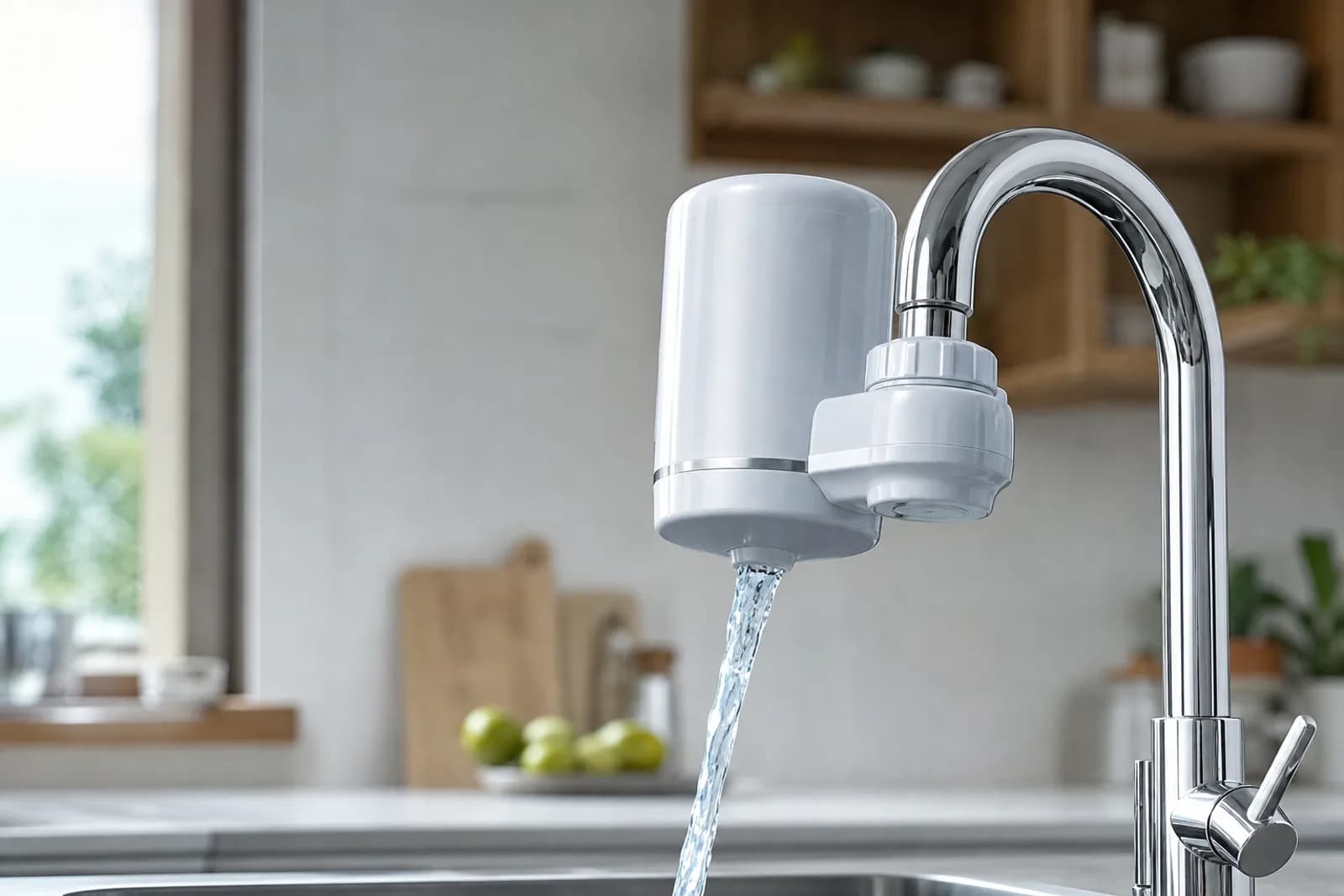
A faucet-mount ultrafiltration filter screws onto a standard tap and gives you filtered water at the turn of a lever — no electricity, no under-sink drilling, and a purchase price most renters can absorb. The convenience is real. So are the limits. Getting the decision right means knowing both.
What a faucet UF filter actually does
The filtration stage in a faucet-mount unit is a hollow-fibre UF membrane with pores rated around 0.01 micron. At that scale, bacteria, protozoa, and suspended particulates — rust flakes, sand, fine silt from ageing distribution pipes — are physically blocked. Water molecules and dissolved minerals, which are orders of magnitude smaller, pass straight through.
Better units pair the UF membrane with a carbon stage that adsorbs residual chlorine and the organic compounds behind the flat or chemical taste in chlorinated PDAM supply. The water that reaches your glass is cleared of common microbiological threats, stripped of its chlorine taste, and still carries the calcium and magnesium that give mineral-balanced water its character.
What changes at the tap matters. So does what stays the same.
The pros
Low entry cost. Faucet filters sit at the accessible end of the water-treatment market. A quality unit costs a fraction of an under-sink RO system, with no installation fee and no ongoing electricity cost.
Installs in minutes, takes nothing apart. The fitting threads onto most standard tap aerators. For renters in Jakarta or Surabaya who cannot modify plumbing, this matters a great deal. You bring it with you when you move.
No electricity required. Normal mains pressure from a PDAM connection is sufficient to push water through a UF membrane at a useful flow rate. There is no pump, no power socket to monopolise, and no electricity cost added to the monthly bill.
Compact footprint. A faucet-mount unit adds a few centimetres to the tap and nothing to the bench. In the small kitchens typical of apartment units and rented kos, this is a genuine advantage over counter-top or under-sink systems.
Retains dissolved minerals. Because UF does not remove dissolved solids, the water that comes through keeps its TDS reading and its mineral content. For households that value the taste profile that calcium and magnesium contribute, UF preserves it. This is a meaningful contrast to RO, which strips the dissolved load entirely.
Sediment and rust removal. Ageing PDAM pipe networks are a common route for turbidity into household water. Sand, rust, and fine grit that cloud the water or leave residue in a glass are reliably blocked by the membrane — often a visible improvement on the first day.
Washable cartridge, manageable running cost. Better faucet UF units use a hollow-fibre cartridge that can be backwashed or hand-cleaned rather than replaced outright on a short cycle. Cartridge life varies by unit and source water quality, but well-maintained cartridges in quality products commonly handle thousands of litres before replacement is needed.
The cons
UF does not remove dissolved solids. This is the most important limitation and it applies to all UF systems, faucet-mount or otherwise. Dissolved salts, nitrates, heavy metals in ionic form, and the minerals that drive a high TDS reading pass through the membrane unchanged. If your water source is a borehole with elevated TDS, a coastal area with saltwater intrusion, or any supply where dissolved contamination is the concern, a faucet UF filter will not address the problem. Only reverse osmosis does.
Limited virus performance — an honest caveat. UF membranes at 0.01 micron remove bacteria and larger organisms reliably. Viruses range from roughly 0.02 to 0.3 micron; many fall within or near the rejection range of a quality membrane, but the smallest sit close to the boundary. Vendor claims on virus removal vary and depend on membrane specification and test conditions. In treated urban PDAM water the viral load is already low, but a household with specific concerns about viral risk should weigh this against the published specification of the unit it is considering.
Chlorine-adsorption capacity is finite. The activated carbon in a faucet filter has a limited surface area for adsorption. High chlorine doses — which can vary by season or district in PDAM supply — exhaust the carbon faster. Once the carbon is saturated, chlorine taste returns even though the membrane continues to block particles. Replacing or regenerating the carbon stage on schedule is not optional if taste improvement is part of why you bought the filter.
Flow rate drops as the cartridge loads. Sediment and biofilm accumulate on the membrane surface over time, and as they do, flow rate decreases. On water with higher turbidity, this happens faster. Backwashing extends life, but there is a point at which flow restriction signals a cartridge that needs attention.
Only treats the one tap it is fitted to. Water at other taps in the kitchen or bathroom runs unfiltered. For households that want whole-kitchen coverage, or that draw cooking water from a second outlet, a single faucet-mount unit is not enough.
The right use case
A faucet UF filter is well-suited to a specific set of conditions. It works as intended — and works well — when:
- The source is chlorinated PDAM piped supply, where the primary concerns are sediment, rust from older pipes, and chlorine taste rather than dissolved contamination
- The TDS reading is in the low-to-moderate range typical of most urban Indonesian municipal supply
- The household is renting or otherwise cannot make permanent plumbing modifications
- Counter or cabinet space is limited
- Budget is constrained or the household wants a low-commitment first step toward home water treatment
It is not the right answer when:
- TDS is high, groundwater from a borehole is the source, or coastal saltwater intrusion is present
- Dissolved heavy metals or nitrates are a known or suspected concern
- Whole-house or multi-tap coverage is needed
If you are unsure about your water, a TDS meter gives a useful first reading in seconds. PDAM supply in most Indonesian cities sits at a TDS that UF handles well. If the number is high, or if your supply is groundwater rather than municipal, test more thoroughly before choosing a filter type.
Truliva O-O3912: a faucet-mount UF built for this use case
The Truliva O-O3912 is a faucet-mounted filter with a 7-layer UF cartridge built for the conditions described above. It blocks rust and sand, and the carbon stage adsorbs residual chlorine, so the taste improvement is immediate. The cartridge is washable, which extends its usable life and lowers running cost. There is no power connection and no drain line. A dual-mode selector switches between filtered and unfiltered flow — filtered for drinking, unfiltered for washing dishes or rinsing vegetables — without removing the unit.
It is designed for exactly the household that benefits most from this category: an apartment renter or small-kitchen user on PDAM supply who wants a concrete, low-cost improvement at their primary drinking tap.
The bottom line
A faucet-mount UF filter does a specific job well. On chlorinated PDAM supply, it removes rust and sediment, adsorbs the chlorine behind municipal water's flat taste, and blocks bacteria — with no electricity, no installation work, and a compact body that fits where nothing else would. The water that comes out tastes better and is microbiologically cleaner than what went in.
It does not reduce TDS, remove dissolved metals, or substitute for RO where source water carries a heavy dissolved load. Knowing that distinction before you buy separates a filter that solves your actual problem from one that answers the wrong question. Match the technology to the water. For most urban renters on PDAM supply, a faucet UF filter is the right match.
Not sure which system fits your water?
Aright Marketing Indonesia can assess your supply and recommend the right Truliva system for your home or business in Indonesia.