Galon Delivery vs a Water Purifier: The Real Cost
Air galon refills feel cheap month to month, but over one to three years the numbers often tell a different story. Here is how to run the comparison for an Indonesian household.
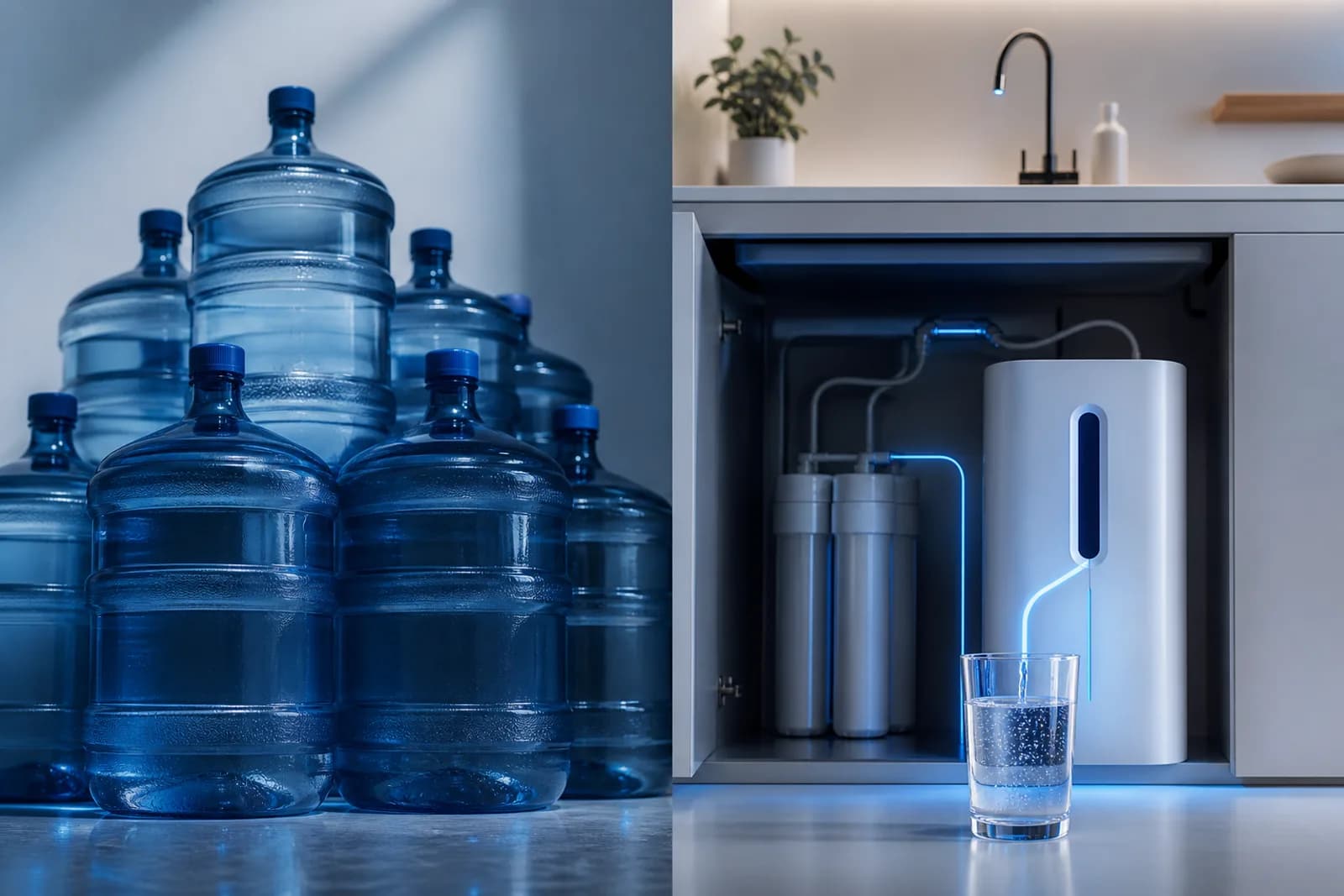
A galon refill is a small, painless payment, and that is exactly why the cost is easy to miss. Nobody adds up twelve months of refills until they go looking. Run the numbers for a household of four over two or three years, and the economics shift far enough to change the decision.
This article walks through an honest comparison. The figures below are illustrative and clearly hedged — prices vary by city, supplier, and household size — but the method is sound, and you can apply it to your own situation in five minutes.
What a galon habit actually costs
A standard 19-litre refill gallon in Indonesia commonly runs Rp 5,000 to Rp 20,000 per unit, depending on whether you refill at a depot or take door-to-door delivery, and on where you live. Jakarta deliveries from a branded supplier sit toward the higher end; neighbourhood depot refills sit lower.
A household of four that drinks and cooks mainly from galon water typically gets through four to six gallons a week — roughly 16 to 25 gallons a month. Put those two numbers together:
| Scenario | Cost per gallon | Monthly usage | Monthly spend |
|---|---|---|---|
| Depot refill, mid-size city | Rp 7,000 | 18 gallons | ~Rp 126,000 |
| Delivery service, Jakarta | Rp 15,000 | 20 gallons | ~Rp 300,000 |
| Branded delivery, Jakarta | Rp 20,000 | 20 gallons | ~Rp 400,000 |
Add delivery fees, the occasional rush order when stock runs dry, and the deposit and replacement cost for damaged containers, and the real monthly figure climbs higher still.
Over twelve months, the mid-range delivery household commonly spends Rp 3.6 million to Rp 4.8 million on drinking water alone — before counting any cooking water drawn from a second source.
What a purifier costs over the same period
A purifier has two costs: the unit, paid once, and the cartridges, paid on a schedule. The purchase is a one-time outlay. The cartridges are the true running expense, and they are what you compare against galon.
A capable under-sink RO system — the kind in the Truliva lineup — typically sells for Rp 3 million to Rp 8 million in Indonesia. Entry-level ultrafiltration units start lower; premium models with long-life membranes and UV sterilisation sit higher.
Cartridge replacement, as a rule of thumb for a household of four in Indonesian conditions, commonly runs Rp 500,000 to Rp 1,200,000 a year, depending on the model and the source-water quality. RO membranes last longest — premium Truliva models are rated for up to eight years — while the sediment and carbon pre-stages are swapped more often but cost less each.
Here is a rough three-year total cost of ownership for a mid-tier under-sink RO system (purchase plus cartridges, no financing), using the assumptions above:
| Year 1 | Year 2 | Year 3 | 3-year total | |
|---|---|---|---|---|
| Unit purchase | Rp 5,000,000 | — | — | Rp 5,000,000 |
| Annual cartridges | Rp 800,000 | Rp 800,000 | Rp 800,000 | Rp 2,400,000 |
| Purifier total | Rp 5,800,000 | Rp 800,000 | Rp 800,000 | Rp 7,400,000 |
| Galon delivery (Rp 300k/month) | Rp 3,600,000 | Rp 3,600,000 | Rp 3,600,000 | Rp 10,800,000 |
Under those illustrative assumptions, the purifier closes the purchase gap during the second year and saves roughly Rp 3.4 million over three years against mid-range delivery galon — and that is before delivery price rises or the emergency refill on a Sunday night. For a household on branded delivery at Rp 400,000 a month, the three-year saving is closer to Rp 6 million.
Finding your own crossover point
Your break-even year turns on three numbers: what you pay per gallon, how many gallons you use, and what the purifier costs upfront. To estimate it:
- Multiply your monthly galon spend by 12 to get your annual galon cost.
- Subtract the purifier's annual cartridge cost. What remains is your annual saving.
- Divide the purifier purchase price by that annual saving. The result is your payback period in years.
Work the mid-range example through: Rp 3,600,000 in annual galon spend, minus Rp 800,000 in cartridges, leaves an annual saving of Rp 2,800,000. A Rp 5,000,000 purifier then pays back in just under two years.
A household close to a depot, spending around Rp 126,000 a month, sees a longer payback — roughly four years at that consumption. For them the case shifts away from money toward water quality, convenience, and never carrying a 19-litre container up the stairs again.
What the numbers leave out
Cost is the headline, but it is not the whole comparison.
Quality control. A home purifier treats your specific water, on your schedule, where you can see it. Galon quality depends on the depot's filter-maintenance routine, which you cannot inspect. Containers that are not properly sanitised between fills let bacteria return — a commonly reported concern with refill depots.
Convenience. Running out at 10 pm, or arranging deliveries around working hours, carries a real cost in time and irritation. A purifier produces treated water continuously, on demand.
Plastic. A household getting through 20 gallons a month handles and returns about 240 containers a year. That is not a decisive argument on its own, but for households that weigh waste, it belongs in the picture.
Coverage. Most galon-dependent homes still use unfiltered tap water for cooking, washing produce, and making ice. A purifier treats those uses at the same tap. Galon water only covers what you carry to the kitchen.
Matching the purifier to the household
No two households start from the same place, and the right system depends on the water source as much as the budget.
- Piped PDAM supply, reasonable quality. An ultrafiltration unit at the lower end of the range usually covers it — bacteria and particles removed, minerals kept, and no electricity on gravity-fed designs.
- Groundwater or coastal supply with high TDS or a brackish taste. Reverse osmosis is the right tool. It removes the dissolved salts and heavy metals that UF cannot touch.
- Renting, or no cabinet space under the sink. A countertop RO system needs no drilling and moves with you. The trade-off is the footprint it takes on the worktop.
The Truliva range spans all three — under-sink RO, countertop RO, and ultrafiltration — at entry, mid, and premium tiers. Flow rates run from 1.5 to 3 litres per minute, comfortable for a family of four, and the RO systems remove up to 99.9% of 104 substances, including heavy metals, bacteria, and dissolved solids.
A practical starting point
Before buying anything, spend five minutes on a rough estimate. Add up last month's galon spend, delivery fees included, and multiply by 12. Set that against the three-year cost of a purifier that fits your situation — purchase plus annual cartridges. If it pays back inside two to three years and your water source warrants proper filtration, the case is usually clear.
The upfront cost is real. So is the cost of paying, gallon by gallon, for water you could be making at home.
Not sure which system fits your water?
Aright Marketing Indonesia can assess your supply and recommend the right Truliva system for your home or business in Indonesia.