Minerals in Filtered Water: Why a UF System Keeps What RO Removes
UF membranes block bacteria but let calcium and magnesium pass straight through — here is what that means for your family's daily water, and which Truliva UF units deliver it.

A UF membrane does not remove calcium or magnesium from water — not because the technology is less thorough, but because the physics make it structurally impossible. The pores that block bacteria are simply far too large to catch dissolved ions. Understanding this one fact settles most of the anxiety parents carry into the purifier conversation.
The "dead water" worry, and where it comes from
Somewhere along the path of online research, many Indonesian parents land on a claim that RO makes "dead water" — water stripped of everything beneficial, reduced to pure H₂O with no nutritional value. The concern is not baseless. Reverse osmosis membranes do reject the overwhelming majority of dissolved solids, including calcium, magnesium, and other minerals. That is precisely how RO achieves its deep purification: the membrane's pores are tight enough — around 0.0001 micron — to block almost anything that is not a water molecule.
The natural response is to ask whether there is a technology that removes bacteria without touching the minerals. There is. That technology is ultrafiltration, and the reason it preserves minerals is the same reason it cannot remove dissolved salts: its pores sit in the 0.01–0.1 micron range, which is orders of magnitude too large to stop anything as small as a dissolved ion.
What is actually dissolved in PDAM tap water
Jakarta's PDAM network draws from surface sources and treats water with coagulation, sedimentation, and chlorination before distribution. The dissolved mineral content — measured as TDS, total dissolved solids — in most Jakarta districts commonly falls in the range of 80–250 mg/litre under normal supply conditions, though this varies by district and season. The dominant dissolved minerals in treated piped water are typically calcium, magnesium, sodium, and bicarbonates.
These mineral and TDS figures are indicative — local water varies by district, season, and pipe condition; test your own supply before drawing conclusions.
Calcium and magnesium in particular enter the supply from source water passing through geological formations. How much ends up at your tap depends on the catchment area, pipe age, and blending ratios at the treatment plant — figures that PDAM publishes in annual reports for each service zone. As a general reference point, water in the range of 50–150 mg/litre TDS is considered low to moderately mineralised.
The numbers matter for one specific reason: they set the ceiling on how much calcium and magnesium could possibly be present to keep or lose. Minerals in water vs diet covers the nutrition picture in full — the short version is that food contributes far more calcium and magnesium than typical drinking water does. But water's contribution is not zero, and for parents who value it, keeping those dissolved minerals in the glass is a legitimate preference.
How UF handles bacteria while minerals pass through
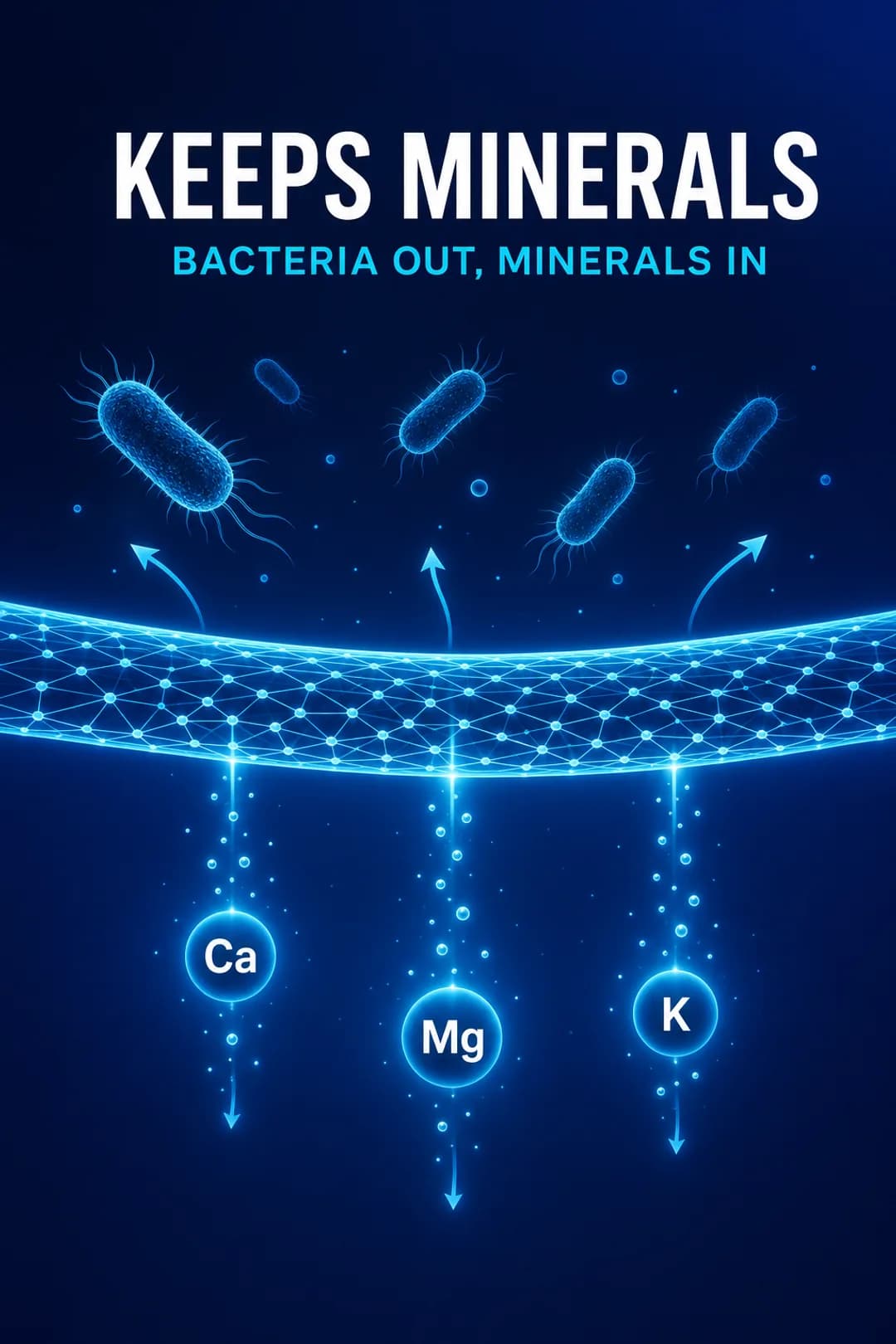
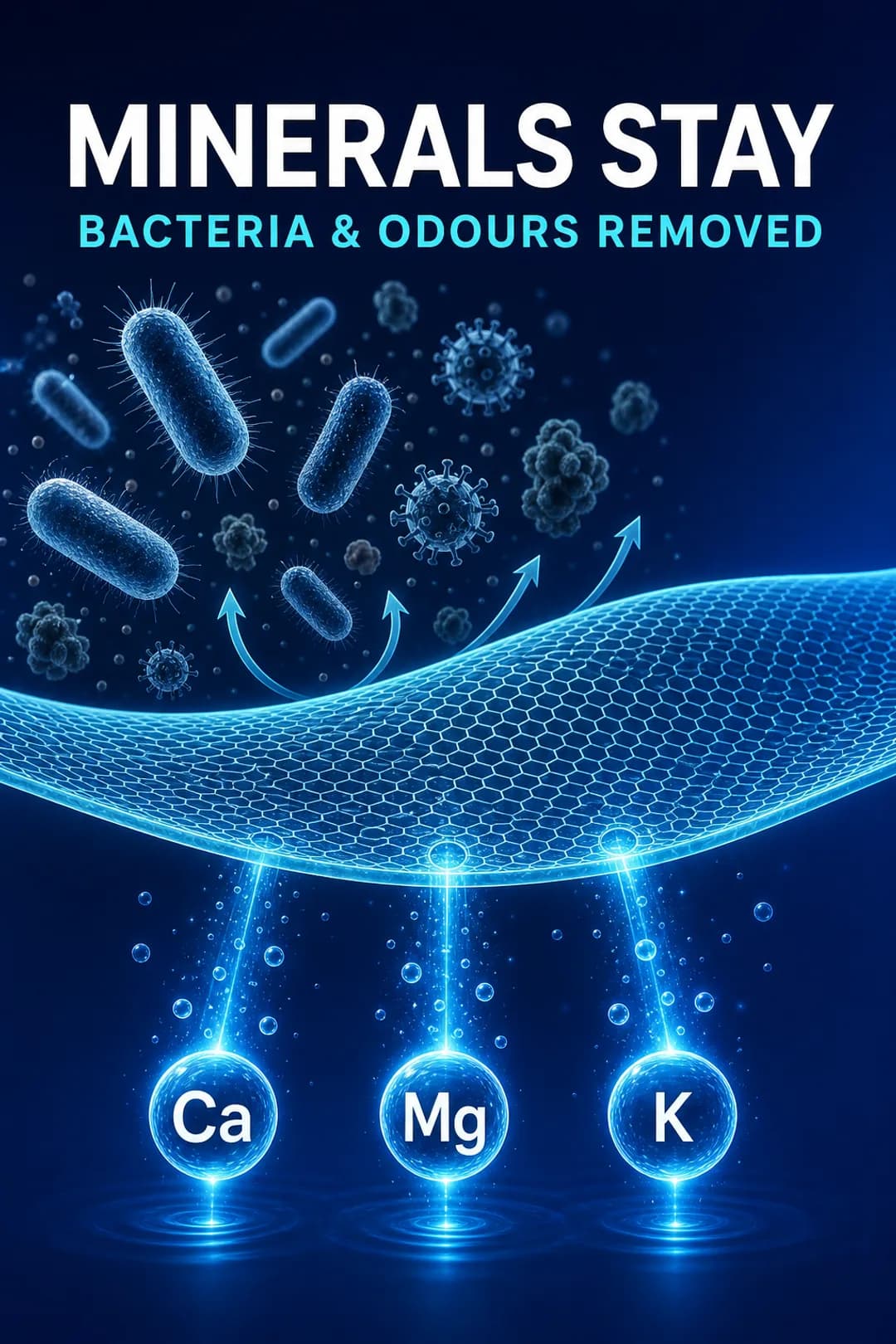
Bacteria are physical particles. A typical waterborne bacterium — E. coli or Salmonella, for instance — measures roughly 1–5 microns in its longest dimension (orders-of-magnitude estimates; individual strains vary). A UF membrane rated at 0.01–0.1 micron stops bacteria the same way a fine sieve stops grains of rice: the opening is simply smaller than the object.
Dissolved calcium and magnesium ions measure on the order of ~0.0001 micron — roughly ten thousand times smaller than the membrane pore. They pass through with the water, unchanged and unimpeded. There is no mechanism by which a UF membrane could retain them even if the design intended to.
This is the core reassurance for parents concerned about mineral loss: choosing UF means the filter removes what is biologically risky (bacteria, protozoa, suspended particles) while leaving intact what is dissolved (minerals, trace electrolytes). The water that comes out of a UF system is the same water that went in, minus the microbial threat.
For a fuller explanation of how the hollow-fibre membrane works and what its removal profile covers, how ultrafiltration works goes through the process stage by stage.
What RO actually removes, and why that is sometimes the right call
RO's mineral removal is a consequence of its thoroughness, not a design flaw. The tight membrane that rejects calcium and magnesium also rejects dissolved heavy metals, nitrates, fluoride, and — critically — dissolved salts from saline groundwater intrusion. For households whose water source is a shallow borehole near the coast, or a deep sumur in areas where the aquifer TDS reads above 300–500 ppm, this removal is exactly what is needed. UF cannot address high TDS, dissolved lead, or salinity.
The practical question is therefore about source water, not technology preference. PDAM supply in most Jakarta and Java districts comes in at a TDS level where UF is adequate for the biological risk. Borehole water or coastal areas where seawater has intruded into the aquifer — the northern coastal rim of Jakarta is one such zone — are better served by RO.
Testing with a TDS meter (available for under Rp 150,000 at most electronics shops) takes thirty seconds and answers the question directly. As a general rule of thumb, if TDS reads below roughly 200–300 ppm and the supply is PDAM, UF is a technically sound choice for most households — though local contamination profiles vary and a lab test is more conclusive than a TDS reading alone. If TDS is elevated, RO's thoroughness earns its trade-offs.
The worry about children drinking "dead water" from RO is addressed separately in is RO water safe to drink. The mineral contribution of water is genuinely smaller than most parents estimate, and a varied diet carries the real load.
The two Truliva UF units: what each one keeps
Both TRULIVA UF systems are designed around the mineral-keeping principle, but they serve different households.
Counter-Top Ultrafiltration — CU3040
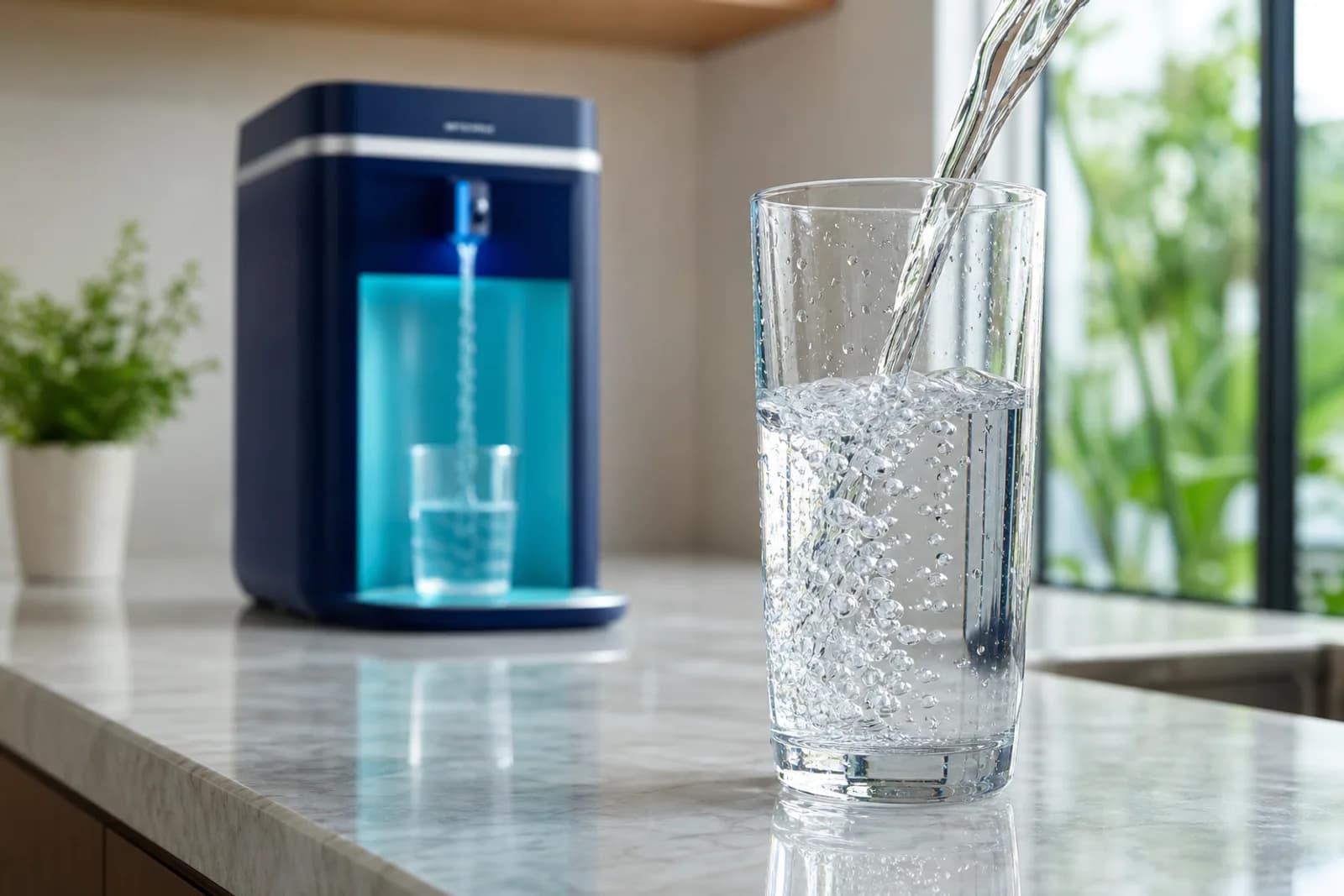
The CU3040 uses a two-stage configuration: an activated carbon block (CTO) followed by the UF hollow-fibre membrane. The carbon stage adsorbs residual chlorine and the taste compounds that make PDAM water smell like a swimming pool. The UF stage then blocks bacteria and particles at the sub-micron level.
Practically, the CU3040 sits on the countertop and clips directly to a standard faucet — no installer required, no drilling, no drain line. It delivers 2 L/min at no electrical cost. The cartridge set handles 3,000 litres before replacement. For renters in a kost or apartment, or any household that wants clean water without any installation commitment, this is the simplest route to UF.
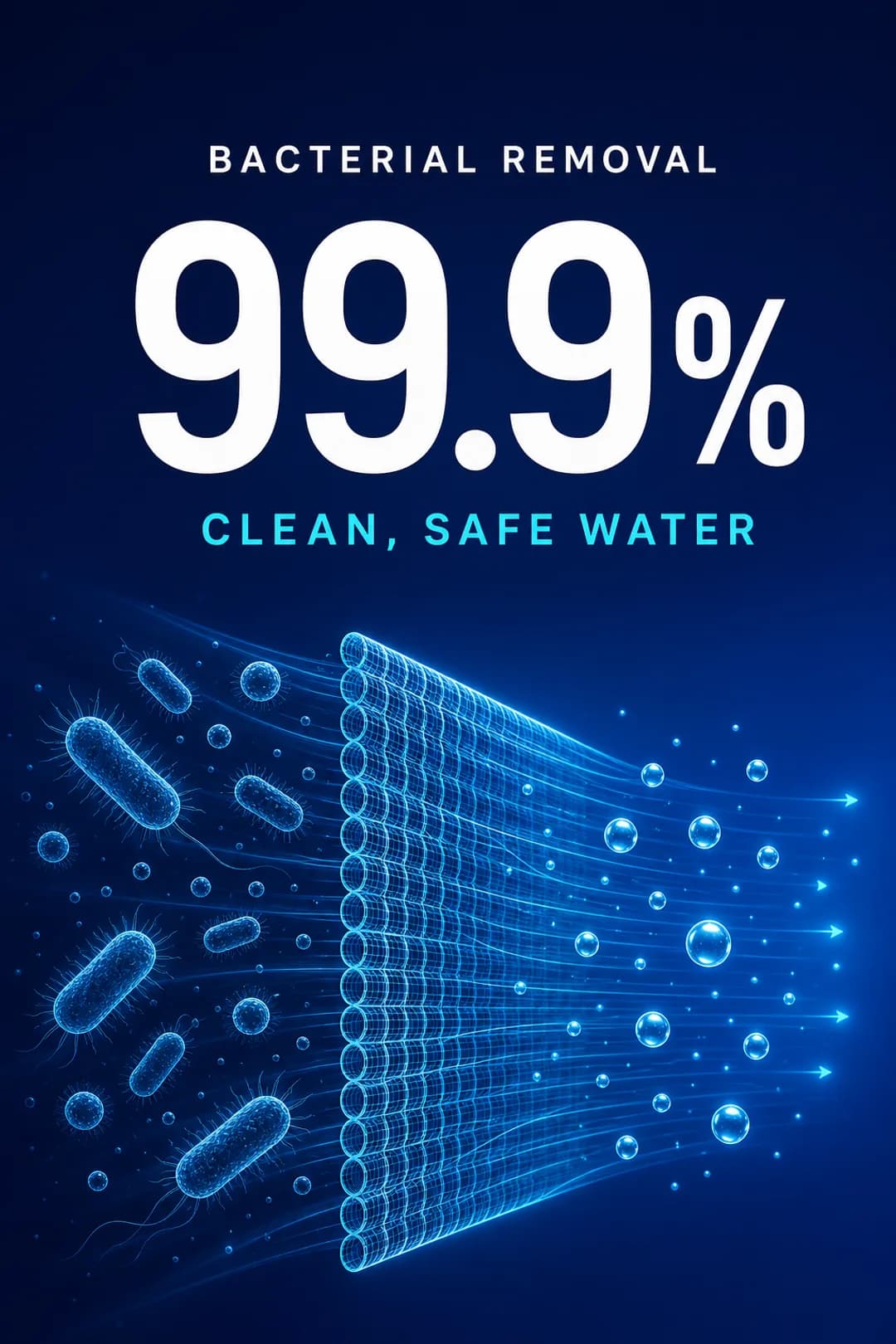
What comes out: PDAM water with bacteria removed at 99.9%, chlorine taste gone, and every milligram of dissolved calcium and magnesium still present.
Under-Sink Ultrafiltration — UU-N3010
The UU-N3010 extends the process to four stages: PP sediment pre-filter, CTO carbon block, UF membrane, then a second CTO polishing carbon. The PP stage captures the rust flakes, sediment, and sand that older Jakarta pipe networks regularly shed into the supply — a real consideration for buildings that predate modern pipe lining. The second carbon stage after the UF membrane refines the final taste.

The UU-N3010 sits under the sink and connects to a dedicated faucet, keeping the main sink faucet free. It runs at 2.2 L/min — fast enough to fill a pot for cooking without waiting — and produces no drain water. Cartridge capacity is 2,000 litres per set.
The four-stage sequence means the UF membrane in the UU-N3010 receives cleaner feed water than a simpler single-stage unit would handle. Sediment and chlorine are stripped upstream, so the hollow fibres do their biological work on already-improved water, which extends membrane life and keeps flow consistent over the cartridge's life.
Honest limits: what UF will not fix
Keeping realistic expectations matters. A UF system will not:
- Remove heavy metals dissolved in the water (lead, arsenic, cadmium)
- Lower high TDS readings from borehole or saline source water
- Strip out dissolved nitrates or pesticides
- Address fluoride or industrial chemical contamination
For any of these concerns, RO is the correct technology. UF is the right answer for a specific, very common Indonesian scenario: PDAM piped supply where bacteria and taste are the real problem, and where the household wants the dissolved mineral content preserved. That scenario describes a large share of households across Java and other islands with established PDAM networks.
What this means at the breakfast table
A glass of water from a UF-filtered PDAM supply will contain the same calcium and magnesium it had before it entered the purifier. If the source water contributes, say, 20–40 mg of calcium per litre — a commonly cited indicative range for moderate-TDS PDAM supplies, though actual values differ by zone — that remains in every glass. Over the course of a day's drinking, especially for a child who drinks two or more litres, the contribution is not nutritionally decisive on its own, but it is there, and it is not zero.
More importantly for parents, the choice of UF over RO is not a sacrifice in filtration quality for a source like PDAM water — it is a match of technology to water type. Bacteria and taste are addressed. Minerals are preserved. The family gets what they were hoping for.
If source water quality is unclear, start with a TDS meter and, if possible, a basic water test from a local lab. PDAM supply quality data is also published by each city's water authority. The decision is easier once the water is actually characterised rather than assumed.
Not sure which system fits your water?
Aright Marketing Indonesia can assess your supply and recommend the right Truliva system for your home or business in Indonesia.