No Plumbing, No Installer: How Countertop RO Works for Indonesian Renters and Kost
Sceptical about 'no plumbing' countertop RO? Here is exactly how the top-fill tank, the RO membrane, and the concentrate system work — so you can decide with confidence before buying.

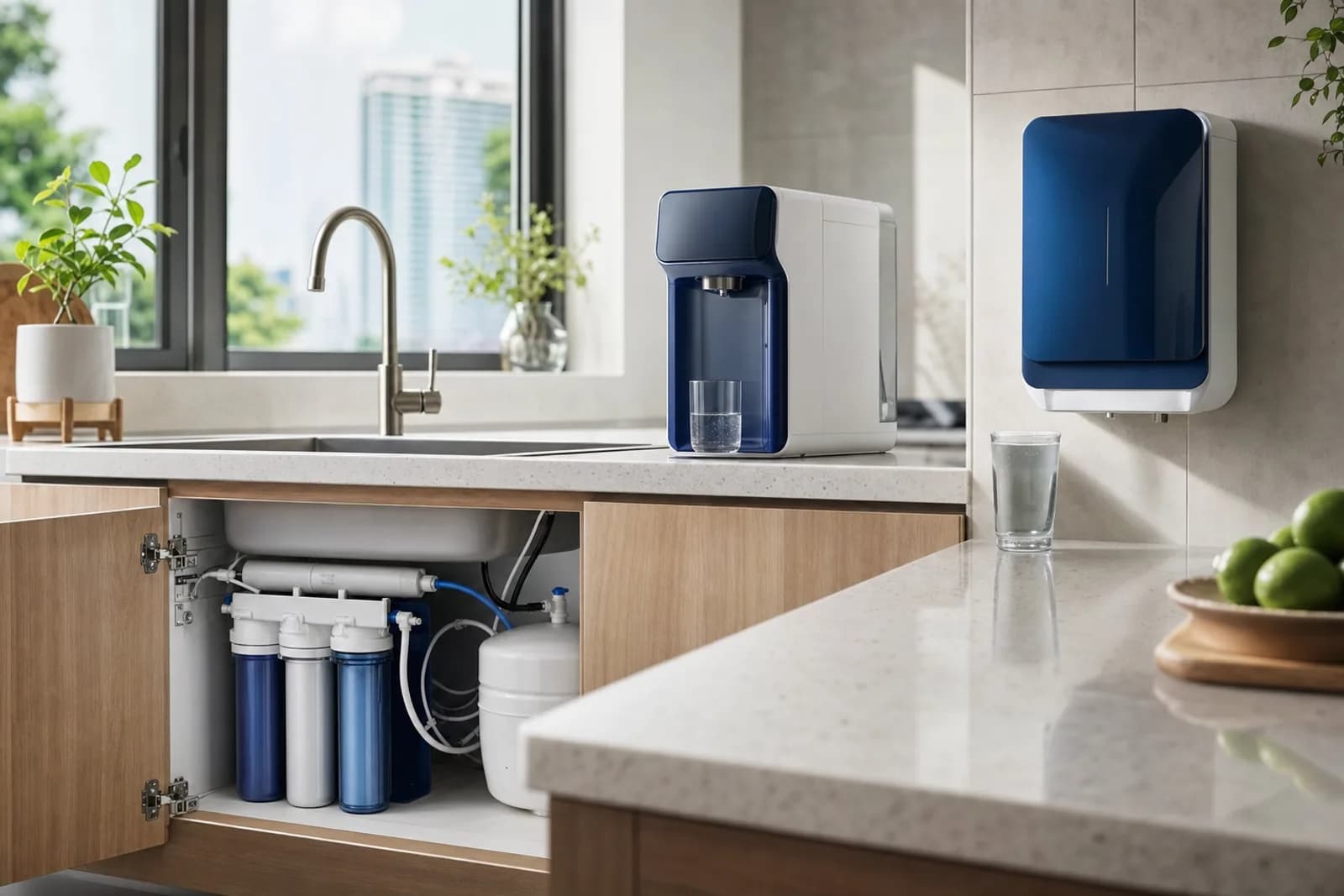
Kost and contracted-apartment life in Jakarta comes with one firm rule: you do not modify the landlord's plumbing. No drilling into the cabinet. No tapping the cold-water supply line. No drain connection under the sink. That rule blocks most under-sink RO systems immediately — not because they are bad, but because they are designed for homeowners who can make permanent changes to the kitchen. The countertop RO category exists precisely for everyone who cannot.
The claim sounds almost too easy: fill from the top, plug in, drink purified water. Before committing to a machine that costs more than a month of galon deliveries, it is reasonable to ask how it actually works. This article answers that question in full — the mechanics, the filtration, the concentrate, and the tank sanitisation — for a reader who has never opened one.
Why the standard under-sink RO is off-limits
A standard under-sink RO requires three permanent connections: a cold-water inlet tapped from the supply line, a waste outlet tapped to the drain, and often a hole through the worktop or cabinet for the dedicated faucet. Setting one up takes a technician about two hours and leaves visible modifications. On the day you move out, you either restore the plumbing yourself or absorb the cost from your deposit.
For a kost resident or someone on a one-year apartment contract, none of that makes sense. A countertop unit bypasses all three connections by carrying its own water supply in a sealed internal tank.
How the top-fill system works, step by step
1. You fill the input tank
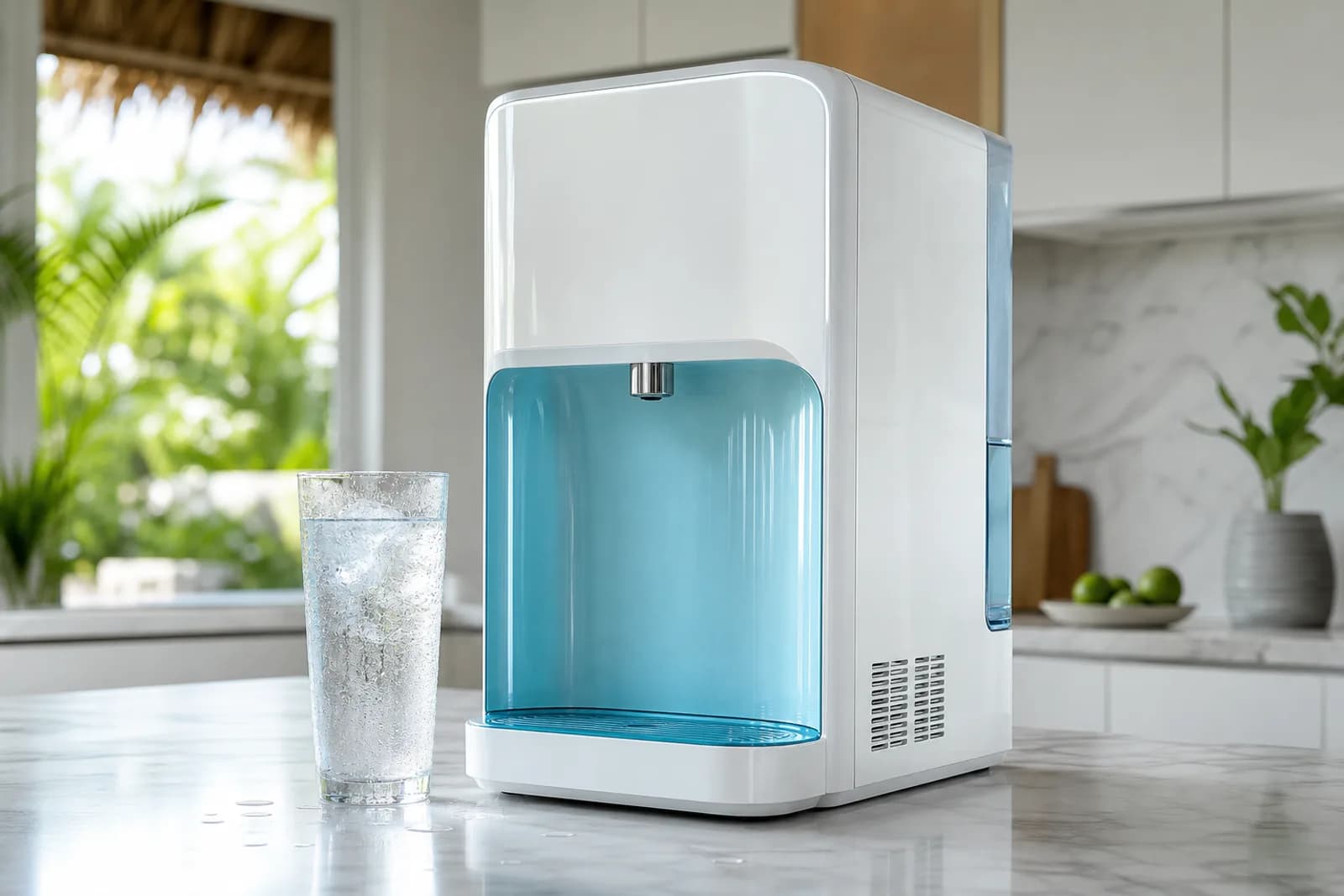
Both the CR-ZX5170 and the CR-Z7170 have an input reservoir at the top of the unit. You fill it using a jug, a water bottle, or directly from a tap — whatever is convenient. The source can be PDAM piped water, galon water, or borehole water. There is no connection to the mains at all; the water sits in the reservoir waiting to be processed.

The CR-Z7170 holds a 6.8-litre internal tank of processed water — enough for a full day's drinking in most single-occupancy rooms without a refill. The CR-ZX5170 operates on the same fill-and-process principle. Fill the input, let the machine work, draw from the output.
2. An internal pump pressurises the water
Reverse osmosis requires pressure to push water across the membrane — typically 0.3–0.5 MPa. In an under-sink RO, that pressure usually comes from the mains supply. In a countertop unit with no mains connection, a small built-in electric pump handles it. When you switch the unit on and place a cup, the pump activates and drives water from the input reservoir through the filtration stages.
This is why these units need a power socket. The pump, the heating element, and the cooling system all draw from the same plug. The socket requirement is the only utility connection the machine needs.
3. Water passes through six filtration stages
Both models carry six-layer filtration across two cartridges (the CR-ZX5170 uses a PCB / RO configuration; the CR-Z7170 uses PPC / RO). The sequence mirrors what a full under-sink system does, compressed into a compact countertop form:
- Pre-stages strip sediment, chlorine, and dissolved organics. PDAM water in Indonesian cities carries residual chlorine as a disinfectant; the carbon pre-stage removes it before it can degrade the RO membrane.
- The RO membrane handles dissolved solids — salts, heavy metals, fluoride, and the broad category of contaminants that sediment and carbon filtration alone cannot touch. Both units are rated at 99.9% removal of 104 harmful substances.
- Post-carbon polishing removes any off-tastes picked up during processing before the water reaches the dispenser.
The membrane itself is the same core technology as a plumbed system. Pores roughly 0.0001 micron across — tight enough to block dissolved ions, but water molecules pass through. The same physics, the same rejection rates, contained in a machine you carry in one hand.
For a deeper explanation of what each RO stage does and why, see How Reverse Osmosis Works.
4. Concentrate exits — but not to your drain
Every RO process produces two streams: purified permeate (the water you drink) and concentrate (the rejected, more-contaminated stream). In an under-sink system, the concentrate flows down a drain line connected to the household waste pipe. In a countertop unit, there is no drain pipe.
The concentrate collects in a separate internal chamber within the unit. Depending on the model's design, this chamber either empties automatically into the output flow at a controlled ratio, or it is discharged into a collection tray that you empty periodically. The concentrate is not toxic — it is more concentrated tap water, safe to pour down any drain, use on plants, or discard in a bucket. What it is not is something that accumulates unnoticed. The machine manages it; you handle the occasional emptying as part of normal use.
This is the part of "no plumbing" that is most worth understanding before purchase. The machine does not magically make the concentrate disappear — it simply internalises the management of it, removing the need for a permanent drain connection.
5. Processed water is chilled or heated on demand
Once the water is purified, both units hold it at temperature.
The CR-ZX5170 uses compressor cooling — the same mechanism as a refrigerator — to bring water down to a true 5°C. That is meaningfully colder than the 10–12°C a basic electric-cooling system reaches. It also makes ice within seven minutes from purified water. Hot dispensing covers the full range from 38°C to 98°C. See the CR-ZX5170 product page for the full specification.

The CR-Z7170 uses electric cooling to reach 10°C — less intense than compressor cooling, but the 6.8-litre tank means a household that pours glass after glass has a larger reserve before the dispenser pauses to catch up. Hot dispensing is the same 38–98°C range. See the CR-Z7170 product page for the full specification.
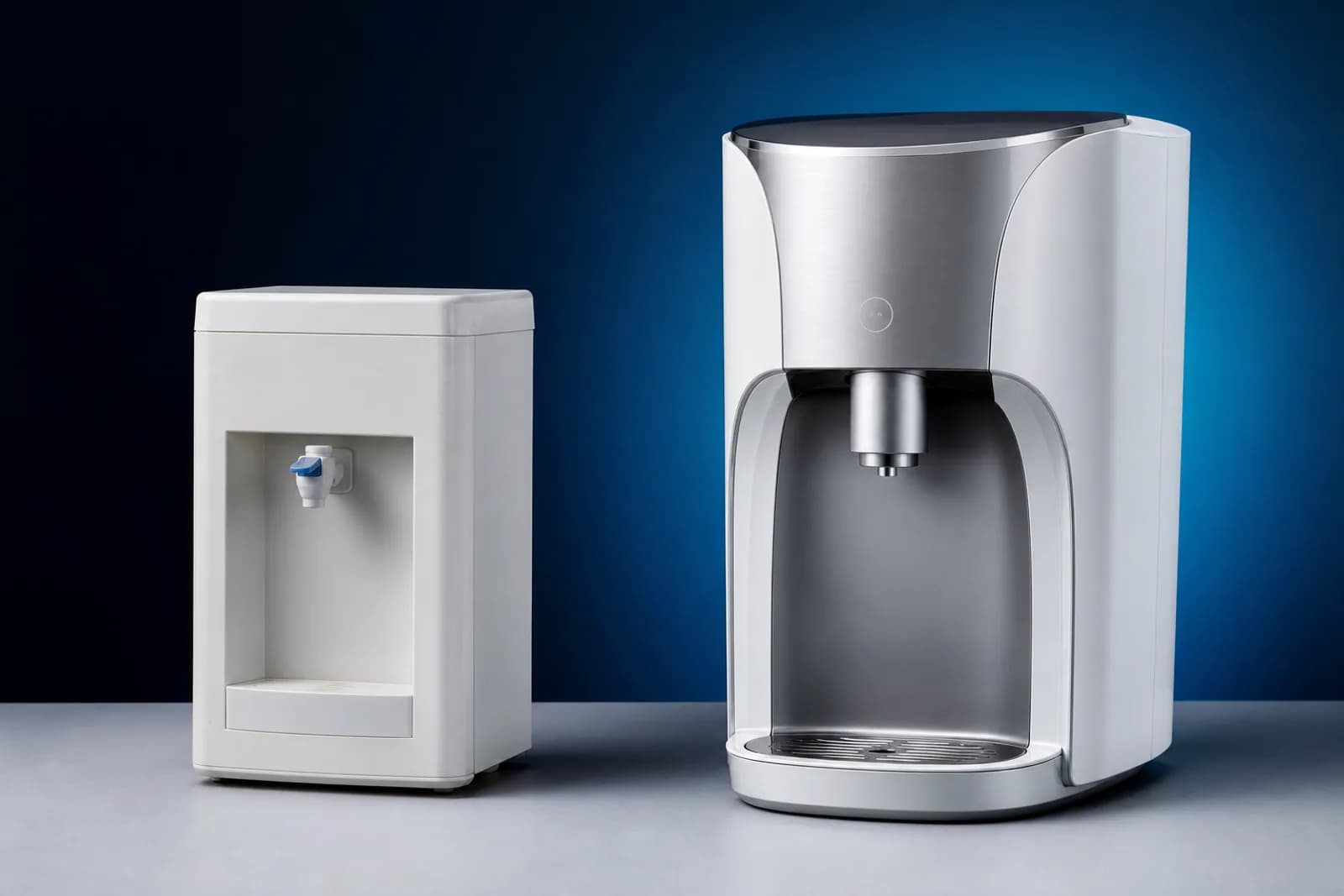
Both units share the same external dimensions: 450 × 250 × 426 mm. That is roughly the counter footprint of a microwave oven and a standard socket within cable reach. If your kost counter has that much clear space, the unit fits.
The sanitisation question
A water tank that you fill by hand raises a fair question: does the inside of the tank grow bacteria over time?
The short answer is that the RO membrane and the pre-stages remove the microbiological load before water enters the processed-water side of the system. The output chamber holds clean, filtered water at either chilled or ambient temperature — conditions less hospitable to bacterial growth than an unfiltered galon container sitting warm in a room. The input reservoir, which holds unprocessed water, is designed to drain fully into the system rather than hold standing water for extended periods.
That said, good practice applies. Do not leave the input reservoir sitting full for more than a day or two without running the unit. Follow the manufacturer's cartridge replacement schedule — both models have a 4,000-litre total capacity before the cartridge set needs changing. A cartridge that is past its service life loses filtration effectiveness, which affects both water quality and how clean the internal surfaces remain downstream of the membrane. For a comparison of factors to consider when choosing between countertop options for a small space, see The Best Water Purifier for a Small Apartment or Kost.
What the "no plumbing" claim actually delivers
Scepticism about "no plumbing" is sensible — the phrase can sound like a marketing shortcut for something that does not work as well. The reality is more specific: the machine internalises the three connections that an under-sink system externalises. It carries its own water supply, manages concentrate internally, and generates its own pressure with a pump. The filtration is equivalent. The trade-off is manual refilling and periodic concentrate management instead of permanent connections that a renter cannot make.
For a household on PDAM piped supply where TDS is low to moderate and the concern is primarily microbiological — bacteria, viruses, residual chlorine from the distribution network — a countertop UF unit is a simpler answer that needs neither pressure nor electricity. But for renters dealing with borehole water, coastal supply with saltwater intrusion, or simply uncertain TDS, countertop RO gives the same dissolved-solid removal as any plumbed RO system, with no landlord conversation required.
Measure your TDS before deciding. If the reading is moderate and the water is PDAM, a UF countertop unit is sufficient. If TDS is elevated or the source is groundwater, countertop RO is the practical path — and the two units above are the only options in this market that deliver it without a single drill or installer visit.
Not sure which system fits your water?
Aright Marketing Indonesia can assess your supply and recommend the right Truliva system for your home or business in Indonesia.