Why Instant Hot Water Matters for Indonesian Tea, Kopi, and Baby Formula
The kettle is the bottleneck in most Indonesian kitchens. Here is what 3-second instant hot water from a purifier actually changes across the three moments where it matters most.

Most Indonesian kitchens run on a kettle. It sits on the counter, gets filled, gets switched on, and then you wait — three to seven minutes depending on the kettle's wattage and how full you filled it. For one cup of kopi tubruk before work, that wait is a minor inconvenience. Replicated across three or four drinks a day, across a full household, the kettle becomes a fixture you manage around rather than a tool you use freely.
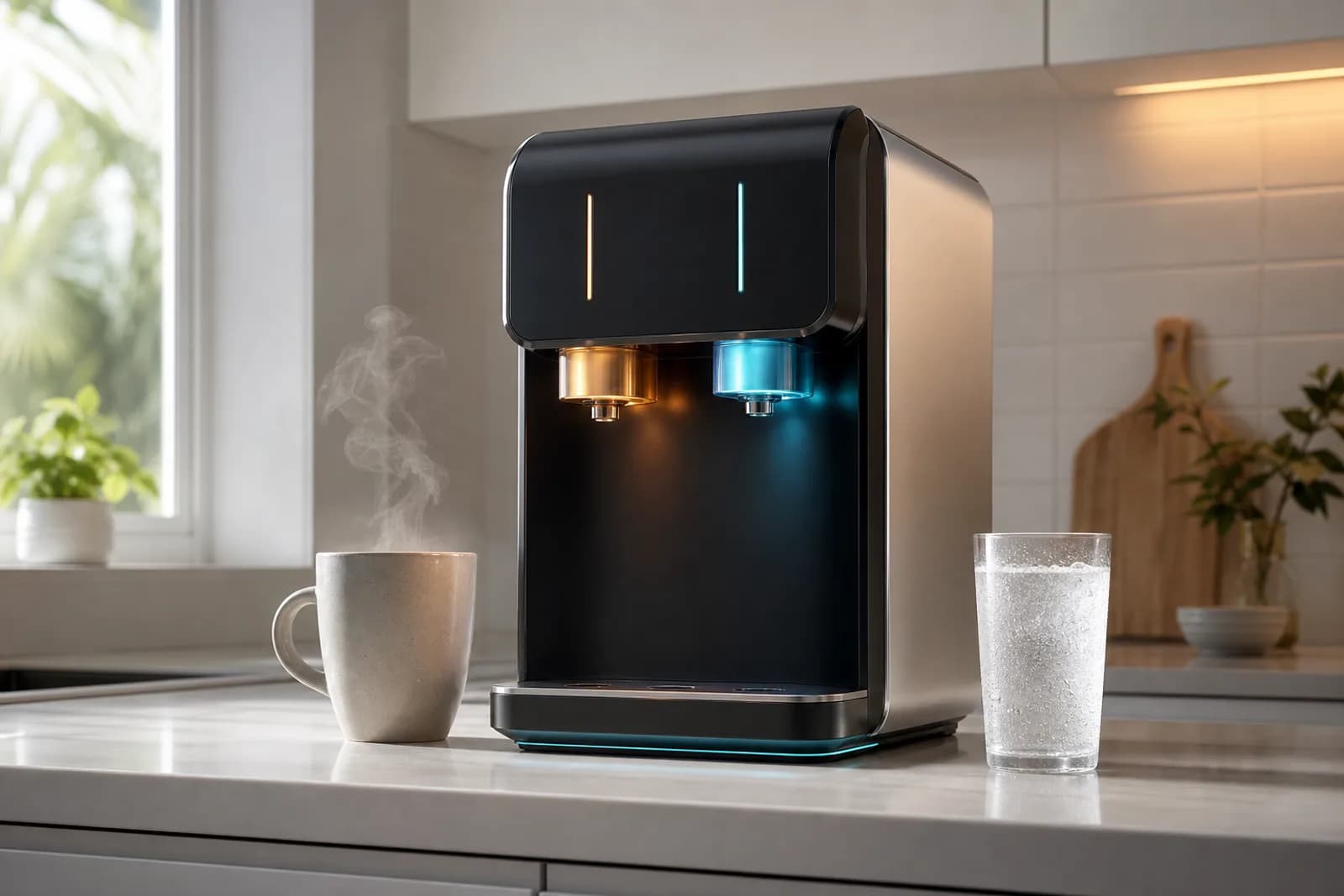
A water purifier with built-in instant hot changes that arithmetic. The UR-S61096H, TRULIVA's flagship under-sink RO, delivers hot water at the faucet within three seconds of the tap turning. That number means something specific in three situations that recur in Indonesian daily life.

The morning kopi ritual
Kopi in Indonesia is not typically brewed through a machine. A sachet of kopi instant, a spoonful of kopi tubruk grounds dropped into a glass, or a careful pour over a cloth strainer — all of them need water that is genuinely hot, not warm. Below around 85°C, many grounds steep poorly and the flavour is flat. At 90–95°C, the extraction happens properly.
A conventional kettle boils to 100°C and then you pour immediately, or let it cool slightly if you are being precise. An instant-hot purifier holds the dispensing temperature in a small, heavily insulated cavity that stays ready. You get hot water when you reach for it, not ninety seconds later.
The second difference is the water itself. Tap water boiled in a kettle picks up whatever is in your supply — residual chlorine, sediment from old pipes, whatever the PDAM distribution system has added on the way to your building. Chlorine in particular has a noticeable flavour in hot water. An RO purifier removes that before it reaches the heating element, so the hot water dispensed is clean. The difference in taste is not subtle, especially for kopi prepared without milk.
The UR-S61096H runs seven layers of reverse osmosis filtration, removing 99.9% of 104 substances including heavy metals, bacteria, and dissolved chlorine compounds, at a constant 2.66 L/min. The hot function draws from that filtered output, not the raw supply.
Formula at 2 a.m.
Parents who have done a night feed know the sequence: baby wakes, you have perhaps two or three minutes before the situation escalates, and you need water at the right temperature to make the formula. A kettle takes four minutes to boil. You then wait for it to cool to the correct range — or you run it under cold water to bring it down faster, or you had the foresight to prepare a batch in advance and refrigerate it.
WHO guidance commonly recommends preparing infant formula with water that has been heated to at least approximately 70°C, because powder formula is not sterile and bacteria in the powder itself need that temperature to be dealt with. The water needs to be hot enough to be effective, but it should not be dispensed into the bottle at 100°C — a brief wait or a measured cool brings it to the right preparation temperature.
An instant-hot purifier addresses the core problem: you get hot filtered water in three seconds, at whatever temperature the unit is set to, without boiling a full kettle in the dark at 2 a.m. The UR-S61096H's faucet delivers within the 38–98°C range, so you can set a working temperature that suits formula prep and draw precisely what you need.
Filtered water also removes the parallel concern about contaminants entering the feed. For more on what Indonesian water sources carry and why it matters for formula specifically, see Safe Water for Babies and Infant Formula.

Buka puasa and hosting
During Ramadan, the moment of iftar brings the household together at the table within minutes of the call. Hot drinks — teh manis, kolak, wedang — are part of nearly every buka puasa spread, and they appear on the table fast. If you are hosting, you may be pouring for ten or fifteen people, and a single kettle's capacity runs out at around five or six mugs. You refill, you wait, you pour. The last guests get lukewarm tea.
The instant-hot faucet on the UR-S61096H draws from a system producing 1,000 GPD at 2.66 L/min. That is not a capacity constraint — you are not waiting for a tank to refill between pours. The small hot-water cavity reheats its replacement volume quickly, so back-to-back dispenses work in a way a kettle cannot match.
The same dynamic applies to any gathering: a kenduri, a family visit, Sunday morning with several generations at the table. Having hot water on demand that is also filtered takes one variable off the hosting list.
What "instant" actually means mechanically
The three-second figure is not marketing arithmetic. Conventional water heaters maintain a large reservoir at temperature around the clock, drawing power continuously. A kettle heats a full litre or more even when you need one cup. The instant-hot mechanism in the UR-S61096H uses a small, heavily insulated cavity — water already at temperature sits ready; when you open the faucet, that water flows immediately, and the small volume replaced reheats quickly.
Three seconds is the time to dispensing temperature at the faucet — not the time for a full heating cycle. It behaves like a tap rather than like a waiting appliance.
Over a day, heating only what you draw and only when you draw it generally uses less energy than keeping a kettle plugged in or running a standalone countertop heater on standby. The exact figure depends on how much hot water the household actually uses, but the principle favours on-demand heating for most usage patterns.
The filtration behind the hot water
Instant-hot capability without filtration is just a small boiler — you still have whatever was in the supply. The UR-S61096H pairs the instant-hot function with a full seven-layer RO sequence across two cartridges (PCB / RO configuration), removing bacteria, viruses, heavy metals, dissolved chlorine, and a range of other substances at 99.9%.
That matters for both flavour and safety. For kopi, the absence of chlorine and off-flavours from the supply is the most immediate difference. For formula, the filtration removes contaminants that boiling alone cannot touch — heavy metals, nitrates, excess sodium. For cooking water more generally, clean source water performs better across the board.
The system runs tankless at 1,000 GPD, so there is no stored tank of water sitting and potentially developing bacteria between uses. Water is filtered on demand, then either dispensed as ambient or diverted through the instant-hot cavity.
An 80% water efficiency rating means that for every five litres processed, only one litre goes to drain. A conventional RO commonly wastes two to three litres per litre produced. For households on metered PDAM supply, the efficiency gap translates into a measurable monthly difference in the water bill.

Under the sink: what fits and what it takes
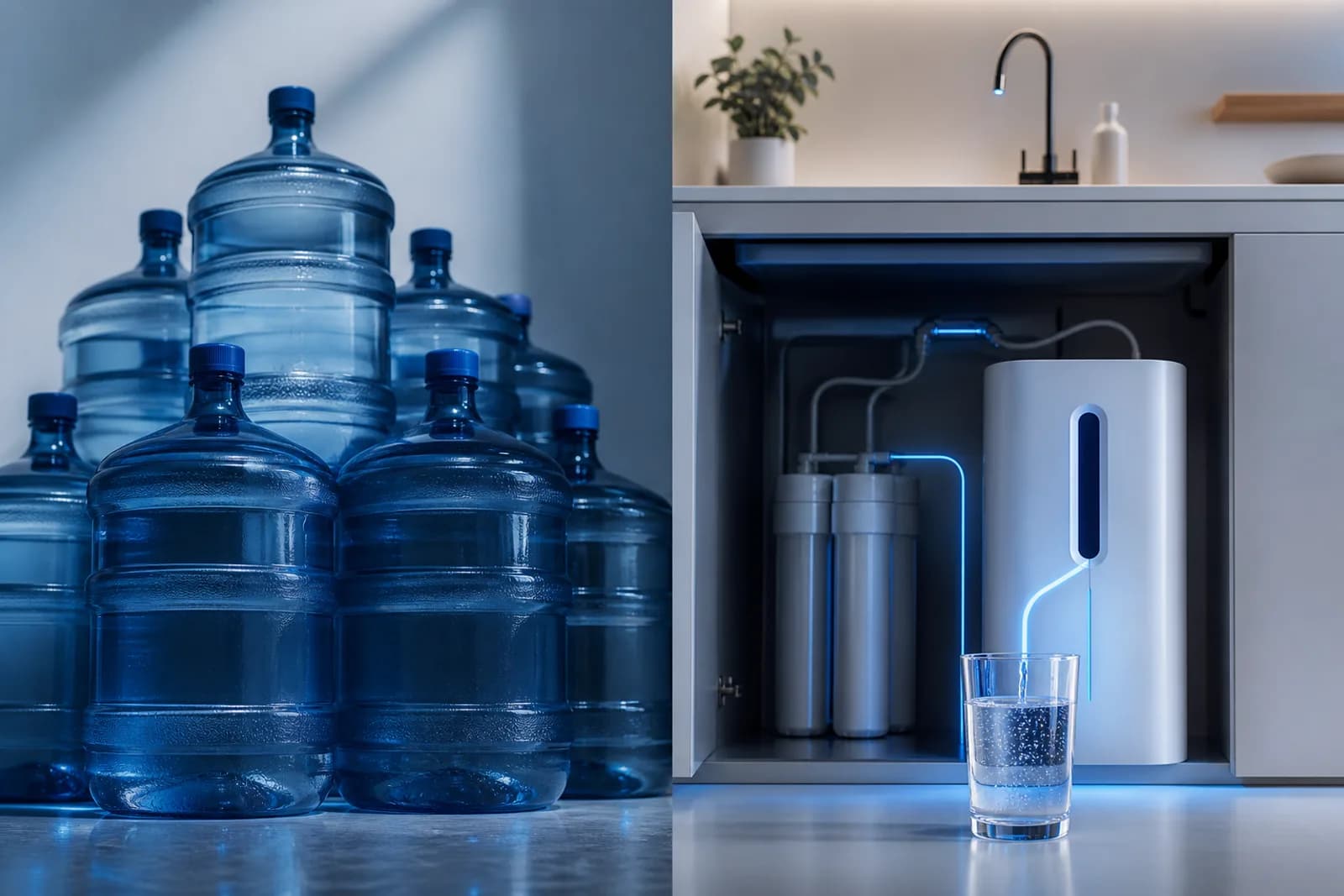
The UR-S61096H installs under the kitchen sink and connects to the existing cold supply and drain. The unit body measures 440 × 145 × 420 mm — not a compact appliance, but sized to fit a standard under-sink cabinet alongside the drain pipe and supply connections without needing a full cabinet to itself.
A plumber does the installation. Unlike a countertop unit you fill from the top, this system requires a supply line tap and a drain connection — typically a one-time install that then runs unattended. The dedicated faucet mounts through the sink or worktop.
The 8-year long-life RO membrane with anti-fouling flush is the maintenance headline: the membrane that does the filtration work does not need replacement on a two-year cycle like a conventional RO. The flush mechanism clears accumulated material automatically, extending membrane life. Filter cartridge replacement is a separate schedule; the membrane cost is the big-ticket item that a conventional RO accumulates over time.
For renters who cannot commit to under-sink plumbing, or households that prefer a countertop setup, TRULIVA's CR-ZX5170 and CR-Z7170 countertop purifiers also deliver hot water to 98°C without any installation. See the Hot and Cold Water Purifiers Guide for a comparison of what each type does and which household it suits.
Three seconds, three times a day
The value of instant hot is cumulative and specific. It is not abstract convenience — it is three minutes returned to the morning before work, a 2 a.m. feed that does not require a strategy, and a buka puasa table where the tea is ready when the iftar moment arrives. Measured in those terms, the kettle sits idle more often than not.
The UR-S61096H delivers that at the kitchen faucet, from purified source water, with no counter space given to a separate heating appliance.
Not sure which system fits your water?
Aright Marketing Indonesia can assess your supply and recommend the right Truliva system for your home or business in Indonesia.