Safe Water for Babies and Infant Formula
Water for infant formula carries more risk than water for adults. Here is what Indonesian parents need to know about boiling, filtering, and which sources to avoid.
A newborn's kidneys run at roughly half the functional capacity of an adult's. That single fact changes the calculation on water quality: a contaminant an adult body filters and excretes without obvious effect can build up faster in an infant, and the dose per kilogram of body weight is much higher. Getting the water right for formula is not over-caution. It is basic physiology applied to a vulnerable body.
Why formula water is not the same as ordinary drinking water
An adult takes in two to three litres of water a day, spread across food, drinks, and plain water. A young infant on formula may consume a volume approaching their own body weight in fluid every week, and almost all of it comes from the prepared feed. The water is not a minor background ingredient. It is the bulk of every bottle.
The contaminants worth worrying about fall into two groups, and they need different treatment.
Microbiological. Bacteria such as Salmonella and Cronobacter are linked to serious illness in infants. Powdered formula is not sterile as manufactured, and neither is water from PDAM pipes, a backyard borehole, or a refill depot (air galon) that is not regularly sanitised. Heat kills most waterborne pathogens reliably, which is why boiling remains the core step.
Chemical. Nitrates from agricultural runoff or septic leachate, heavy metals such as lead from old pipework, and excess sodium from coastal saltwater intrusion are the main concerns. None of these is removed by boiling. In fact, boiling concentrates dissolved solids slightly as water evaporates. A chemical problem needs filtration, not heat.
The state of water in Indonesian homes
Water supply in Indonesia varies enormously by location, building type, and season. The broad picture:
PDAM piped supply. Treated at the plant, but the distribution pipes in older areas can add bacteria and sediment, especially after a supply interruption. The period right after a pressure outage is the highest-risk moment, because emptied pipes draw in surrounding material as they refill.
Groundwater and boreholes. In dense urban areas, shallow wells often sit within metres of septic tanks, and bacterial contamination is commonly reported. Coastal cities — parts of north Jakarta, Surabaya's waterfront, areas around Semarang — face saltwater intrusion, which raises sodium and total dissolved solids to levels unsuitable for formula. High sodium in the water tips the mineral balance of every feed.
Refill gallon water (air galon). Widely used and usually treated, but the quality of a depot's filtration and the cleanliness of the container both vary. A gallon that is not properly sanitised between fills can reintroduce bacteria into otherwise treated water. Once it is home, keeping the tap or pump clean matters too.
Boiling: what it does and what it does not
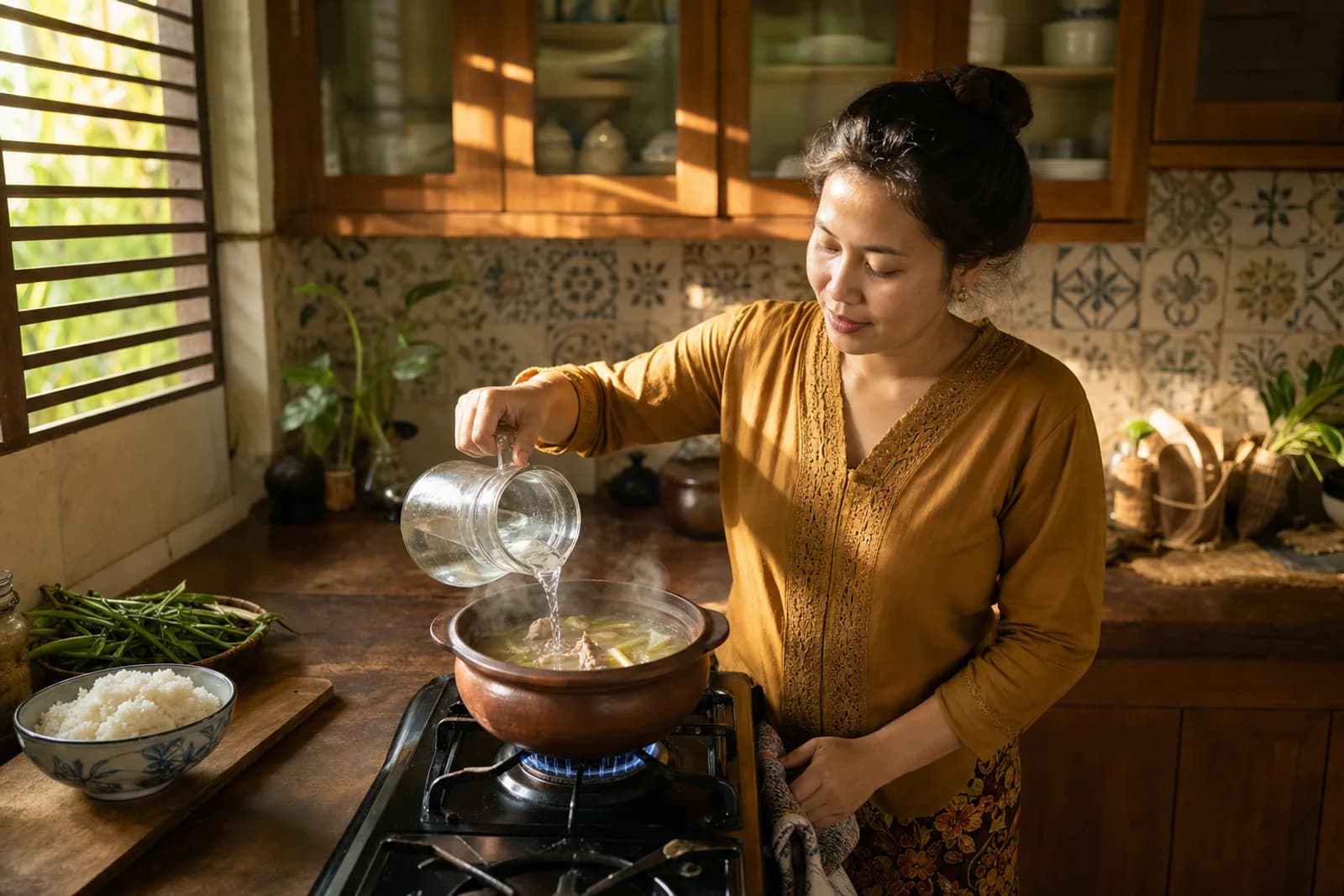
A rolling boil for at least one minute kills bacteria, viruses, and protozoa. For parents on PDAM supply or groundwater, where the main risk is microbiological, boiling is the single most important step.
What boiling does not do:
- Remove heavy metals such as lead, arsenic, iron, and manganese
- Remove nitrates
- Remove excess sodium from saltwater intrusion
- Remove agricultural or industrial chemical residues
If your water has any of these chemical problems — and in many Indonesian households it does — boiling alone is not enough. You also need a filtration step.
One practical note on temperature. The commonly recommended method is to prepare formula with water that has been boiled and then cooled to no lower than 70 °C — still far too hot to drink — because water at that temperature kills bacteria that may be in the powder itself. Then cool the made-up bottle to feeding temperature under running cold water. In Indonesian ambient heat, do not leave prepared formula standing at room temperature for more than two hours.
Purified water and household filtration
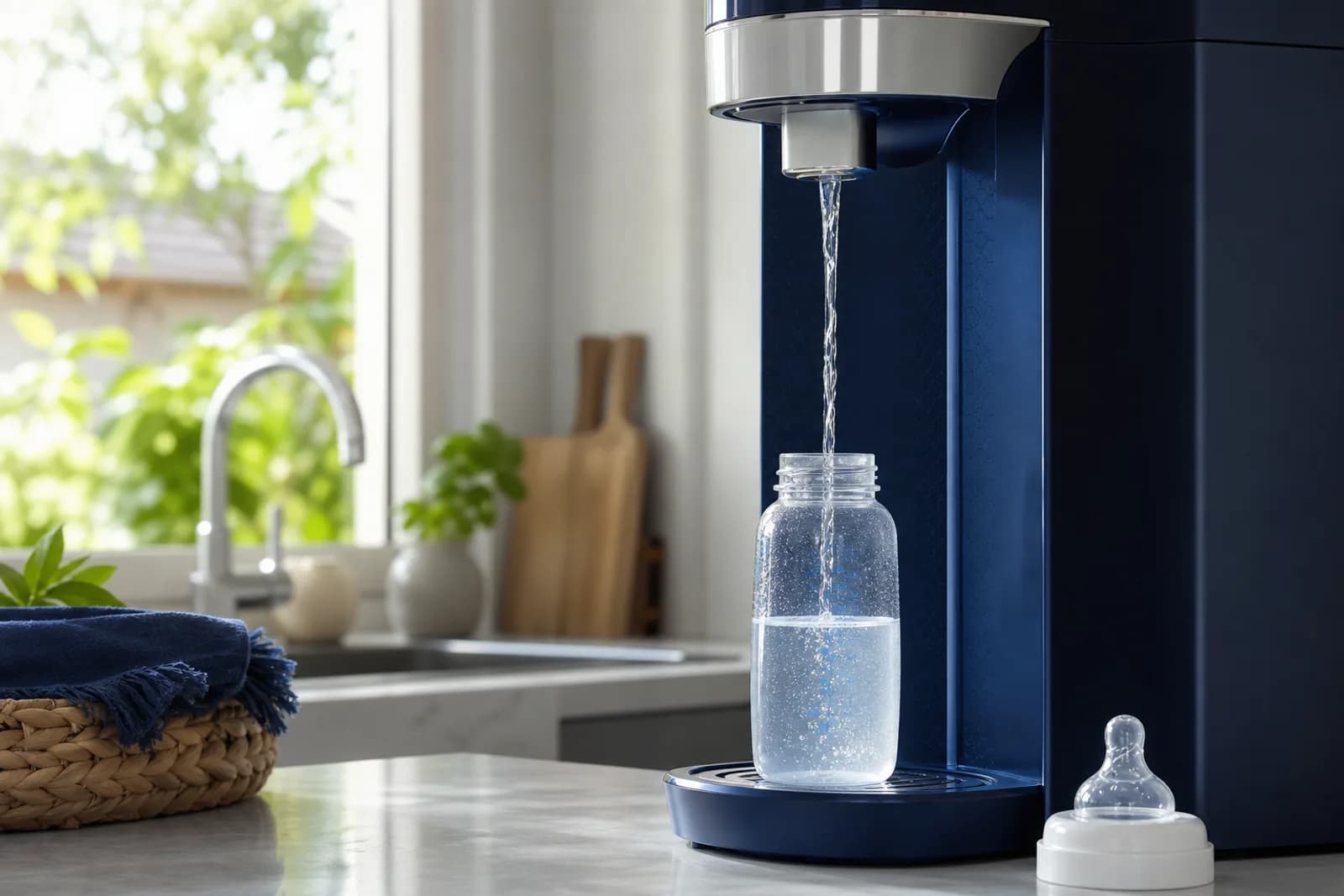
A household purifier with a reverse osmosis (RO) membrane removes dissolved solids, heavy metals, and microorganisms in a single pass. RO water typically reads very low on total dissolved solids (TDS), commonly below 50 mg/L, which means it carries minimal minerals and minimal contaminants alike.
For formula, very low TDS water is generally considered appropriate, because the powder is formulated to supply all the minerals a baby needs when mixed at the correct ratio. Adding formula to water that is already mineral-heavy can push the total mineral load above the level the manufacturer designed for.
Even purified water should still be boiled for formula during the first months, as a second safeguard. Once filtration has done the hard work, the boiling step is about eliminating any residual risk from the storage container or the dispensing tap, rather than treating the water itself.
Ultrafiltration (UF) removes bacteria and particles but lets dissolved minerals pass through. UF suits a supply where the concern is microbiological and the dissolved-solids load is already low. It is not sufficient for water high in TDS, nitrates, or heavy metals.
Pitcher and gravity carbon filters improve taste and reduce chlorine, but they do not reliably remove bacteria or dissolved contaminants. They are not suitable as the primary treatment for formula water.
What to avoid
Bottled "natural mineral water." Spring mineral water can be high in sodium, calcium, sulphate, and other minerals that are fine for adults but wrong for formula, where the mineral balance is set by the powder. Check the sodium figure on the label and prefer a low-sodium water for formula. As a rule of thumb, the lower the sodium and total mineral content, the closer the made-up feed stays to what the manufacturer designed for.
Water from tanks that are not cleaned. Rooftop storage tanks accumulate sediment and can harbour bacterial growth, especially if they are not cleaned at least twice a year. If your building relies on a rooftop tank, treat the water at the point of use rather than assuming the tank is clean.
Re-boiled water. Each boiling cycle evaporates a little water and concentrates the dissolved solids slightly. Water that has been boiled and then stored for more than 24 hours should be boiled fresh, not re-boiled.
Cold water straight from any source. No tap, borehole, or refill gallon in Indonesia can be assumed microbiologically safe for formula without boiling or another disinfection step.
A practical approach for Indonesian parents
The routine that fits local conditions:
- Use treated water — ideally from a household RO system, or from a reliable refill depot if you have no home treatment.
- Boil the water and let it cool to no lower than 70 °C before mixing the feed.
- Make one feed at a time where you can. Do not keep prepared formula in the fridge for more than 24 hours.
- Keep dispensing taps, gallon pumps, and storage containers clean and dry between uses.
If you are unsure about your source, a TDS meter costing a few thousand rupiah gives an immediate reading of the dissolved-solids load. A reading above 300 mg/L, a salty or metallic taste, or orange-brown staining on fixtures are all reasons to look harder before using that water for formula.
The steps are not complicated. What matters is doing them the same way every time, because a young infant meets them at every feed.
Not sure which system fits your water?
Aright Marketing Indonesia can assess your supply and recommend the right Truliva system for your home or business in Indonesia.