Cooking with Purified Water: Does It Change the Taste of Rice, Soup, and Tea?
Most Indonesian households fill the rice cooker and soup pot from the same tap they wash dishes with. Here is what chlorine, sediment, and bacteria do to cooked food — and how flow rate determines whether a purifier keeps up with a kitchen.
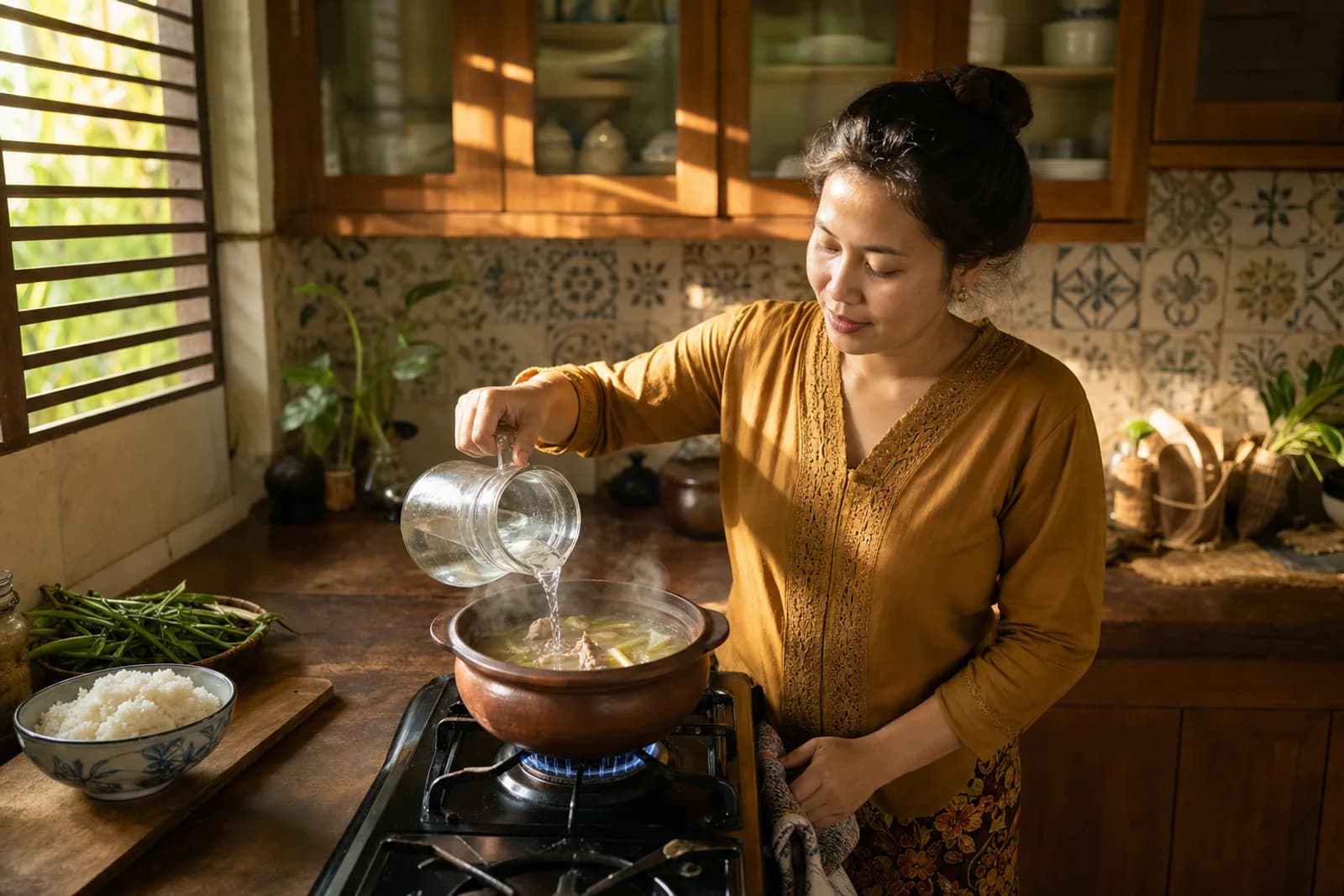
The water that fills an Indonesian pot of nasi usually comes from the same tap used to wash dishes — and in most urban households, that tap is connected to PDAM piped supply or a backyard borehole. For drinking, many families switch to air galon or a filtered source. For cooking, the assumption is that boiling handles everything. It mostly does, for bacteria. It does not remove chlorine byproducts, dissolved sediment, or the taste compounds that carry through into the rice and broth.
This article looks at where cooking water actually matters, what the science and common kitchen experience suggest, and how to choose a purifier that keeps up with real cooking volumes.
What tap water carries into your food
Understanding the kitchen impact starts with what the water contains before it goes into the pot. The two articles worth reading alongside this one are What's Actually in Indonesian Tap Water and Chlorine and Chloramine in Tap Water, which cover the chemistry in depth. For cooking purposes, the three categories that matter most are:
Residual chlorine. PDAM suppliers maintain a chlorine residual through the distribution network — this is deliberate and necessary. The residual at your tap is typically in the range permitted by Indonesia's Ministry of Health drinking-water quality standard (Permenkes) — readers should check the current regulation, as specific limits are periodically revised — and the actual level varies by district, season, and how far you sit from the treatment plant. Chlorine has a noticeable taste and odour in drinking water. It also reacts with organic compounds in food during cooking, and its byproducts — trihalomethanes and haloacetic acids — are not fully removed by boiling. Volatile THMs do partially gas off when water is heated in an open pot, but non-volatile byproducts concentrate.
Sediment and turbidity. Ageing distribution pipes shed rust, sand, and fine particles. After a supply interruption, the first litres out of the tap often carry visible cloudiness. Fine particles that are too small to see settle into the bottom of the rice cooker or soup pot. They contribute a flat, slightly earthy baseline that accumulates over years of cooking without most households noticing it.
Hardness and dissolved minerals. This varies widely by location. Households on coastal groundwater or in areas with naturally hard supply will notice mineral deposits in their kettle and rice cooker — a sign the same minerals are going into the food. In moderate amounts, minerals are not a health concern and some cooks prefer the flavour they impart. At high concentrations, they leave a chalky residue and affect the texture of rice, which absorbs water as it cooks.
Does purified water change the taste of white rice?
Home cooks across East Asia have observed that the quality of water used to cook nasi putih affects the outcome. This is consistent with what happens during cooking: rice commonly absorbs somewhere in the range of 1.5 to 2 times its dry weight in water during the cooking process — a commonly cited rule of thumb that varies with rice variety and cooker type. Whatever is dissolved or suspended in that water goes into the grain.
Common household observations — confirmed in kitchen tests and qualitative cooking comparisons, though rigorous controlled studies are limited in number — suggest that:
- Rice cooked in water with high chlorine residual can carry a faint chemical aftertaste, particularly noticeable in the first few mouthfuls of a plain serving with no strong condiments.
- Rice cooked in soft, low-TDS water tends to come out slightly stickier and more evenly hydrated, because the grain can absorb the water without competing mineral interactions.
- At low chlorine levels and moderate mineral content, the difference is subtle enough that most people would not detect it in a blind tasting. The effect is more pronounced in households with high-chlorine supply, old building plumbing, or brackish groundwater.
The honest summary: purified water does not transform nasi putih into something qualitatively different. But for households where the tap water has a noticeable chlorine smell or mineral taste, that character does carry into the cooked rice. Removing it is not a dramatic upgrade — it is simply cooking with neutral water, which is the baseline most cooks assume they already have.
Soto, sup, and broth-based dishes
The effect is more pronounced in dishes where water is the primary flavour base. A pot of soto ayam or bakso broth simmers for an extended period, concentrating whatever is in the water as some of it evaporates. A faint chlorine note or flat mineral taste in the cooking water becomes a more detectable characteristic in the finished broth.
This is the same principle professional kitchens in countries with high culinary standards apply when they use filtered or specifically sourced water for broths and stocks. The starting water is a flavour ingredient, not a neutral medium.
For everyday Indonesian cooking, the practical implication is simple: if your tap water has a detectable taste or smell, your soto will inherit some of that character. Filtered water that is neutral in taste produces a broth that starts from a clean baseline, which is easier to season accurately.
The flow rate question
A 5-litre pot of air untuk sup requires 5 litres of purified water before cooking begins. A household that runs a rice cooker, a pot of vegetables, and fills a kettle for teh in the same morning session could easily draw 8 to 10 litres of purified water in a single hour.
This is where the flow rate specification of a purifier becomes a real kitchen constraint, not just a product number.
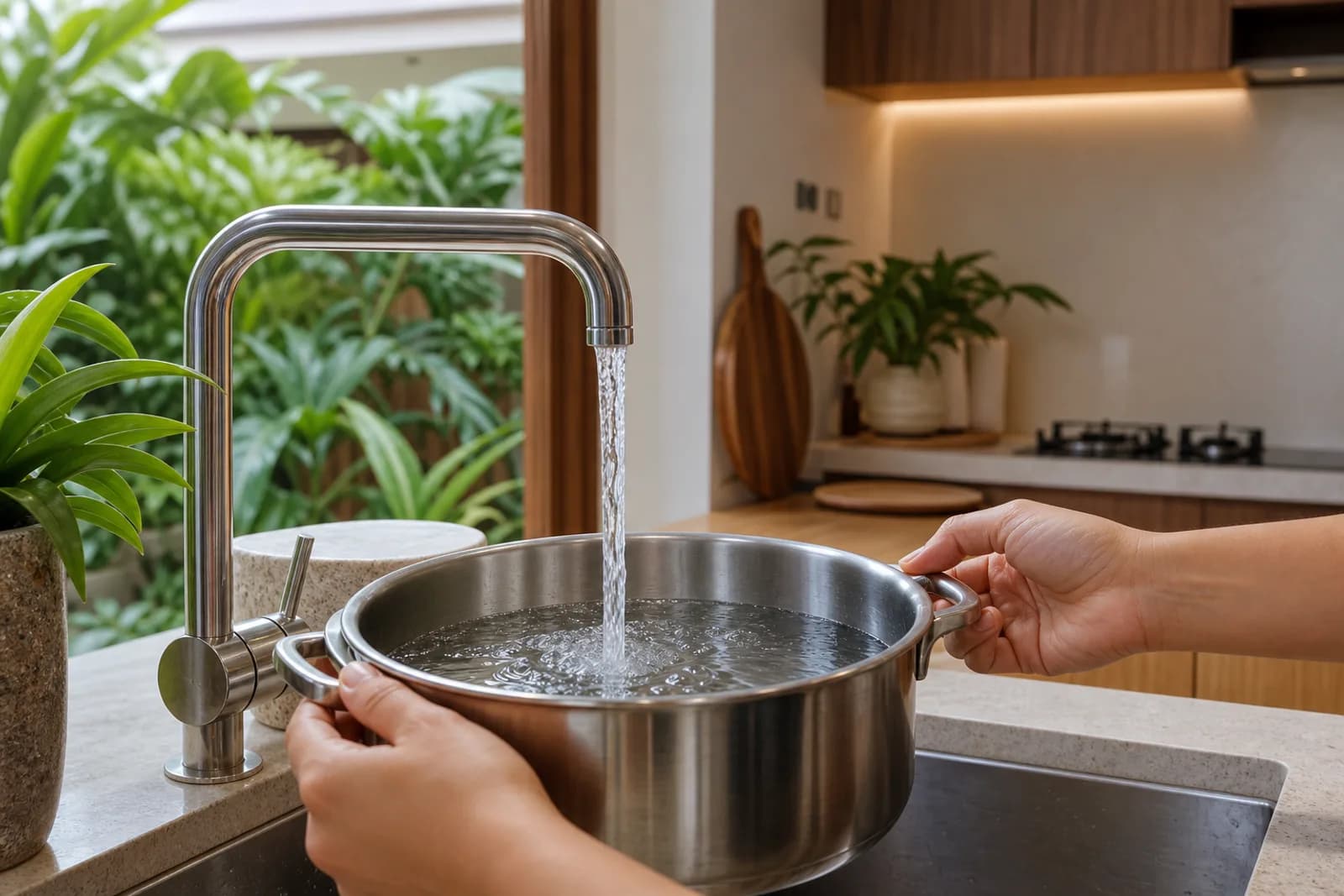
At 1.5 L/min, filling a 5-litre pot takes approximately 3.5 minutes. That is a reasonable wait for a single pot. It is less convenient when two pots are needed back-to-back or when the cook is working quickly. The UR-Q3626 runs at this rate — it is the entry-tier under-sink RO, and 1.5 L/min is adequate for a household that draws cooking water once or twice a day without time pressure.
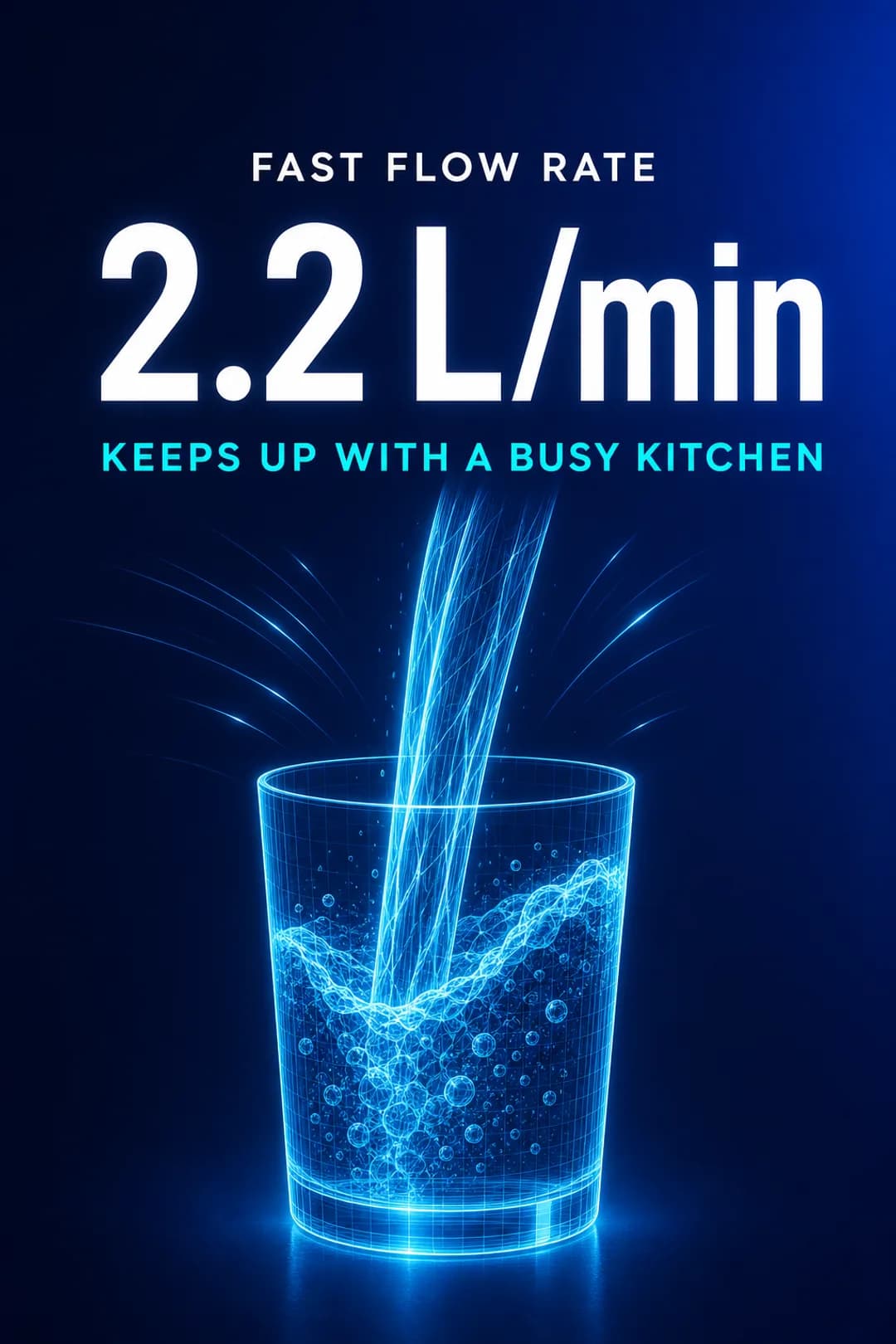
At 2.2 L/min, the same 5-litre pot fills in roughly 2.5 minutes — a meaningful difference when a meal is being assembled and the pot is the last thing waiting. The UU-N3010 runs at this rate. As an under-sink ultrafiltration system, it removes bacteria and particles while retaining natural minerals, which suits households on cleaner PDAM supply where dissolved mineral content is not a concern but biological and sediment contamination are. It produces no drain water, which keeps running costs low.
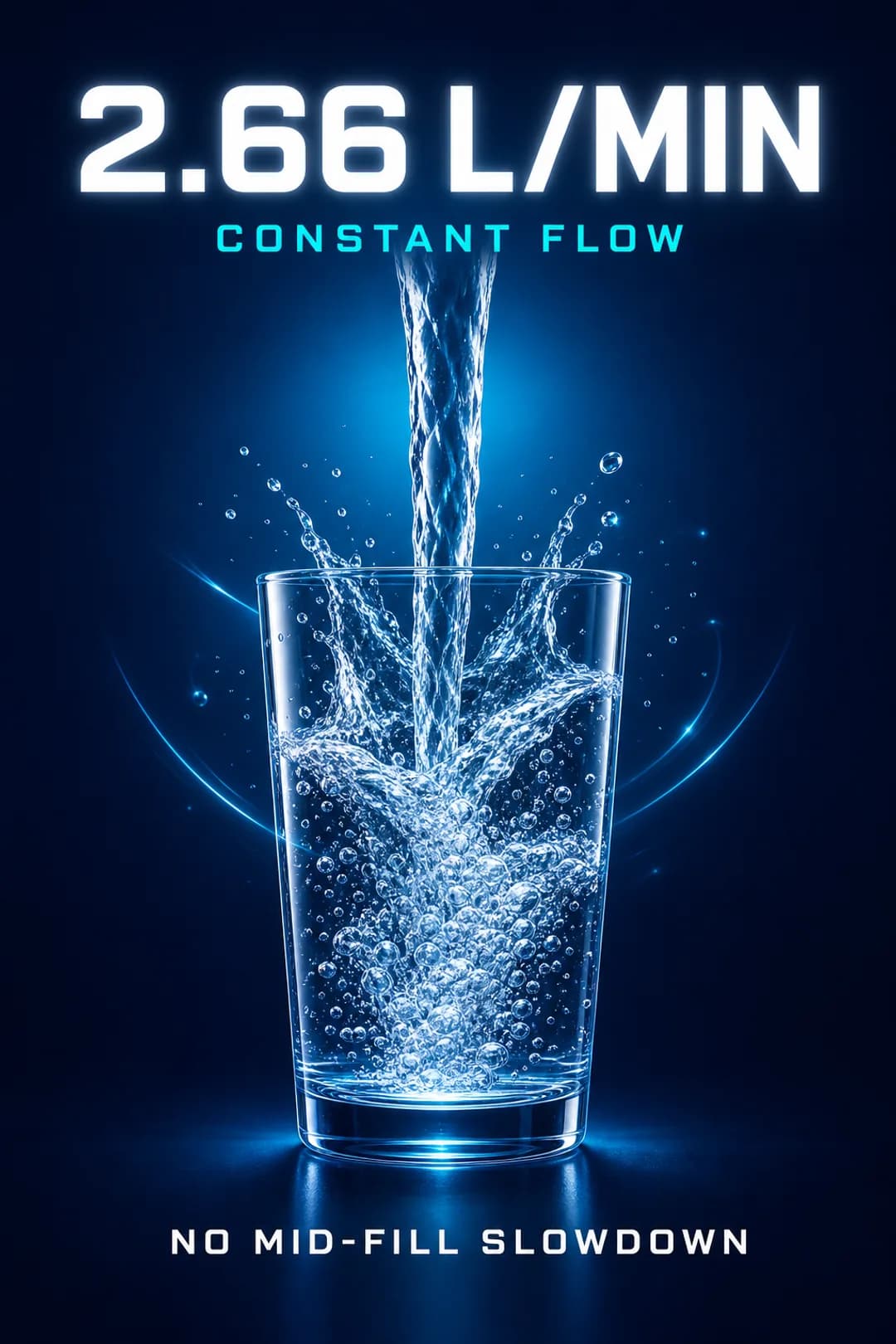
At 2.66 L/min, a 5-litre pot fills in under 2 minutes, and the kitchen does not feel like it is waiting on the purifier. The UR-S61096H delivers this rate constantly through its 7-layer RO filtration — 104 contaminants removed at 99.9%, including dissolved heavy metals, bacteria, viruses, and the chlorine byproducts discussed above. At this flow rate, drawing 10 litres for a cooking session takes less than 4 minutes total, which fits naturally into the rhythm of meal preparation.
The practical guidance: if cooking water is a priority use case and your household draws more than 5 litres in a typical cooking session, a purifier rated at 2 L/min or above keeps pace without friction. Below that threshold, a single 5-litre fill is manageable but back-to-back draws will require patience.
Which technology suits a cooking household?
The choice between RO and UF filtration for cooking use comes down to what your water source contains, not to personal preference.
Ultrafiltration (UF) — such as the UU-N3010 — removes bacteria, viruses, and particles down to the UF membrane pore size, while allowing dissolved minerals to pass through. For households on PDAM piped supply where the main concerns are biological contamination and sediment, UF is sufficient for both drinking and cooking. The water tastes clean and neutral without stripping the mineral content that contributes to body and mouthfeel. It is also worth noting that UF produces no drain water, which matters for water-conscious households.
Reverse osmosis (RO) — such as the UR-Q3626 or UR-S61096H — removes dissolved salts, heavy metals, chlorine byproducts, and biological contaminants alike. For households on groundwater, coastal supply with saltwater intrusion, or PDAM supply with high chlorine residual and measurable THM formation, RO produces the most neutral starting water for cooking. Some cooks find that RO water makes rice slightly less textured than mineral water; others consider the clean baseline an improvement. The practical cooking difference is modest, and most households switching from unfiltered tap water will find the upgrade clear.
Neither technology is wrong for cooking. The correct choice depends on your source water — which is covered in detail in What's Actually in Indonesian Tap Water.
A note on boiling versus filtering
The common household logic is: boiling kills bacteria, so cooking solves the problem. This is true for pathogens. It is not true for dissolved contaminants.
Boiling concentrates non-volatile compounds — including haloacetic acids, heavy metals, and dissolved minerals — because some water evaporates while non-volatile solutes remain. Volatile chlorine compounds do gas off when water is boiled in an open pot, but the reaction byproducts are less volatile than free chlorine itself.
For households that cook with tap water and boil it, the pathogen risk is substantially reduced. The taste, sediment, and chemical byproduct question is a separate matter that boiling does not fully address. This is why households that care about water quality for drinking should apply the same logic to cooking — the pot is not a filter.
Practical starting point
If your household already notices a chlorine smell in tap water, a flat or slightly brackish taste, or white mineral deposits inside the rice cooker, those are direct indicators that the cooking water has room to improve. A basic TDS meter — available inexpensively at most hardware stores in Jakarta — gives a starting reading. If TDS reads above roughly 300–500 ppm, the mineral load in your cooking water is likely meaningful — treat this as an indicative rule of thumb rather than a precise threshold, as the relevant standard is water source and use-case dependent. Below that range, with clean PDAM supply, bacterial and sediment removal (UF) is typically the primary concern.
Figures in this section are indicative; actual water quality and rice absorption vary by source and variety.
The purifier that makes the most difference for a cooking household is the one that is convenient enough to actually use for cooking — which means a flow rate that does not make the cook wait, and an installation that puts the purified outlet where it is reached naturally. An under-sink system with a dedicated faucet at the sink places the purified water exactly where pots are filled.
For most Indonesian urban households, the shift from tap to purified cooking water is quieter than expected — not a dramatic flavour transformation, but a removal of the variables that most cooks did not realise they were cooking around.
Not sure which system fits your water?
Aright Marketing Indonesia can assess your supply and recommend the right Truliva system for your home or business in Indonesia.