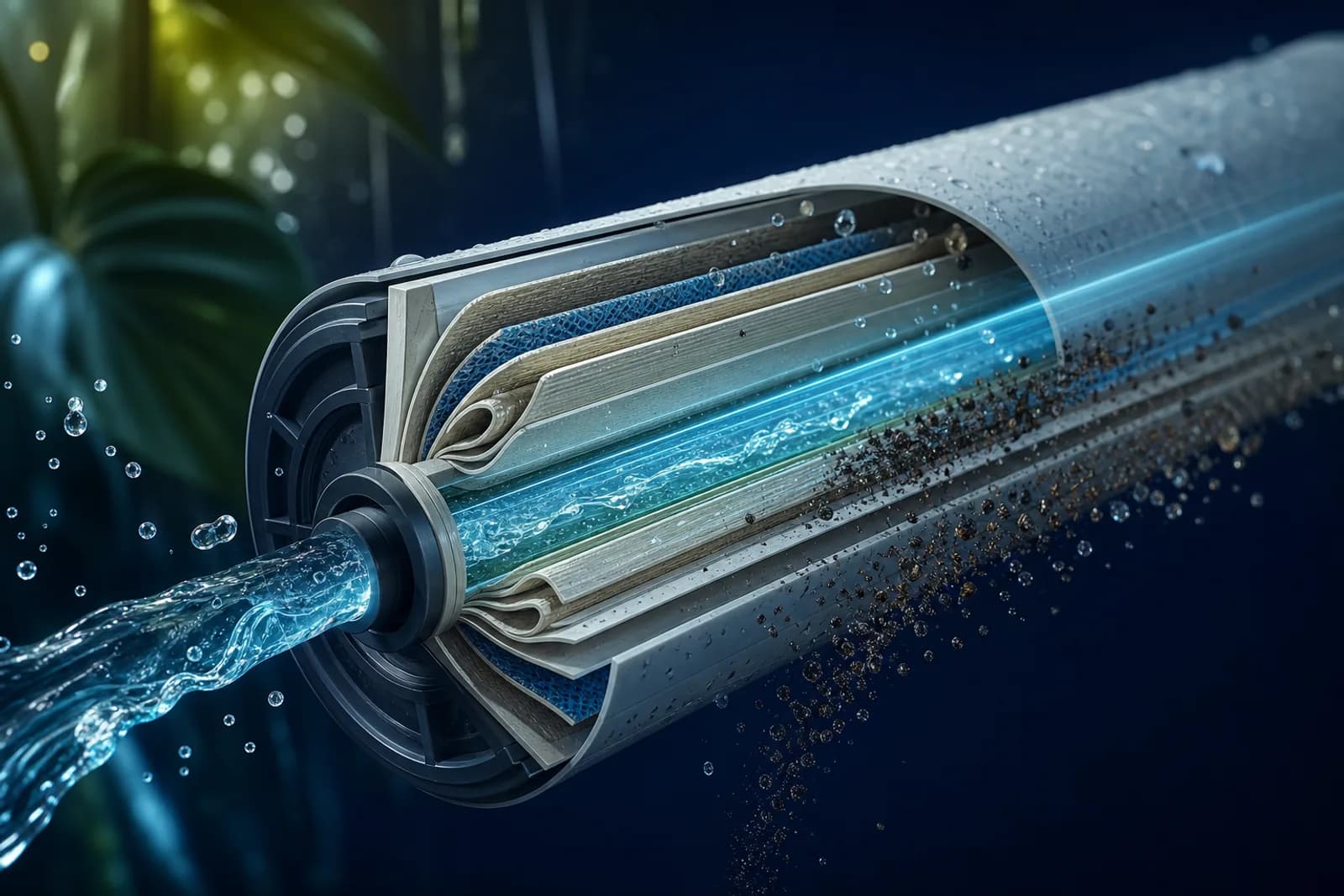
Chlorine and Chloramine in Tap Water: What They Are and Why Carbon Removes Them
Chlorine and chloramine disinfect piped water — but both react with organic matter to form disinfection byproducts including trihalomethanes. Here is the chemistry, why activated carbon removes them, and what it cannot do.
The faint swimming-pool smell in a freshly drawn glass of piped water is chlorine doing its job. Municipal suppliers add it deliberately — without a residual disinfectant in the pipe, bacteria would recolonise the distribution network between the treatment plant and your tap. The chemistry that makes chlorine effective, however, is the same chemistry that creates a secondary problem: when it reacts with naturally occurring organic matter, it forms compounds called disinfection byproducts. Understanding both sides of that trade-off is what separates informed treatment choices from guesswork.
Why water suppliers add chlorine in the first place
Before chlorination became standard practice in the early twentieth century, waterborne diseases — typhoid, cholera, dysentery — were endemic in cities. Chlorination effectively ended that pattern in countries where it was adopted, and its use in municipal systems since then is one of the most consequential public health interventions on record.
In Indonesia, PDAM operators typically dose chlorine at the treatment plant to maintain a residual throughout the distribution network. The residual is intentional: it must still be detectable at the most distant point in the pipe to confirm nothing has grown in between. Indonesian drinking water standards (Permenkes Nomor 2 Tahun 2023) set a maximum allowable chlorine residual at the consumer's tap; figures commonly cited in technical literature place this around 0.5 mg/L (0.5 ppm), though readers planning to publish or cite this figure should verify the current regulation text directly. Actual residual levels vary by operator, season, and distance from the treatment plant.
The smell is most noticeable first thing in the morning when water has sat in the household pipes overnight, and after distribution interruptions when freshly treated water refills the mains.
Chloramine: the alternative disinfectant
Many water systems, particularly larger ones serving dense urban areas, have shifted from chlorine to chloramine as their primary residual disinfectant. Chloramine is formed by adding ammonia to chlorinated water in controlled ratios. The result is a more stable compound that persists further through the distribution network without dissipating as fast as free chlorine.
The practical differences matter for treatment:
Free chlorine reacts quickly and strongly. It is highly effective at killing pathogens near the dosing point, but it dissipates relatively fast and produces more disinfection byproducts when it encounters organic matter in the water.
Chloramine is slower to react and more persistent in the network. It produces fewer of the disinfection byproducts associated with free chlorine, but it generates its own set — including nitrosamine compounds, an area of ongoing research where risk quantification at typical drinking water concentrations is still being established — and it is harder to remove with standard carbon filtration.
Whether your PDAM uses free chlorine, chloramine, or a combination depends on the utility. Most smaller Indonesian municipal systems use free chlorine; some larger utilities may use chloramine for specific network segments. If the chlorine smell is unusually low but you still notice a slight flat or medicinal quality, chloramine may be present.
Disinfection byproducts: the trade-off
When chlorine reacts with natural organic matter — dissolved humic acids, plant material, and similar compounds that enter water from soil and decaying vegetation — it produces a class of compounds called disinfection byproducts (DBPs). The two most studied groups are:
Trihalomethanes (THMs) — including chloroform, bromodichloromethane, and related compounds. These form when chlorine reacts with humic substances. THMs are volatile, meaning they partially gas off when water is heated or left open.
Haloacetic acids (HAAs) — a second major group, less volatile than THMs, that also forms through chlorine-organic reactions.
Epidemiological research has associated long-term exposure to elevated THM levels with increased risk of bladder cancer and, in some studies, adverse reproductive outcomes. The WHO and IARC classifications place chloroform (the most common THM) as a possible human carcinogen based primarily on animal data; the epidemiological evidence in humans is considered suggestive but not conclusive, and the associations consistently emerge from populations at or above regulatory limits over many years — not from occasional exposure or water that meets standards. Regulatory limits set by the WHO and referenced by many national standards reflect a designed margin of safety.
For Indonesian households on PDAM supply, DBP levels depend on the organic content of the raw water source and the dosing practices of the utility. River-fed supplies during high-turbidity season — common in Java after heavy rains — typically carry more organic precursors and can see higher THM formation.
Boiling water, often assumed to be the safest step, actually concentrates non-volatile DBPs like HAAs while reducing volatile THMs. It is not a reliable removal method.
How activated carbon removes chlorine
Activated carbon is the workhorse of chlorine removal in household filters. Understanding why it works explains both its strengths and its limits.
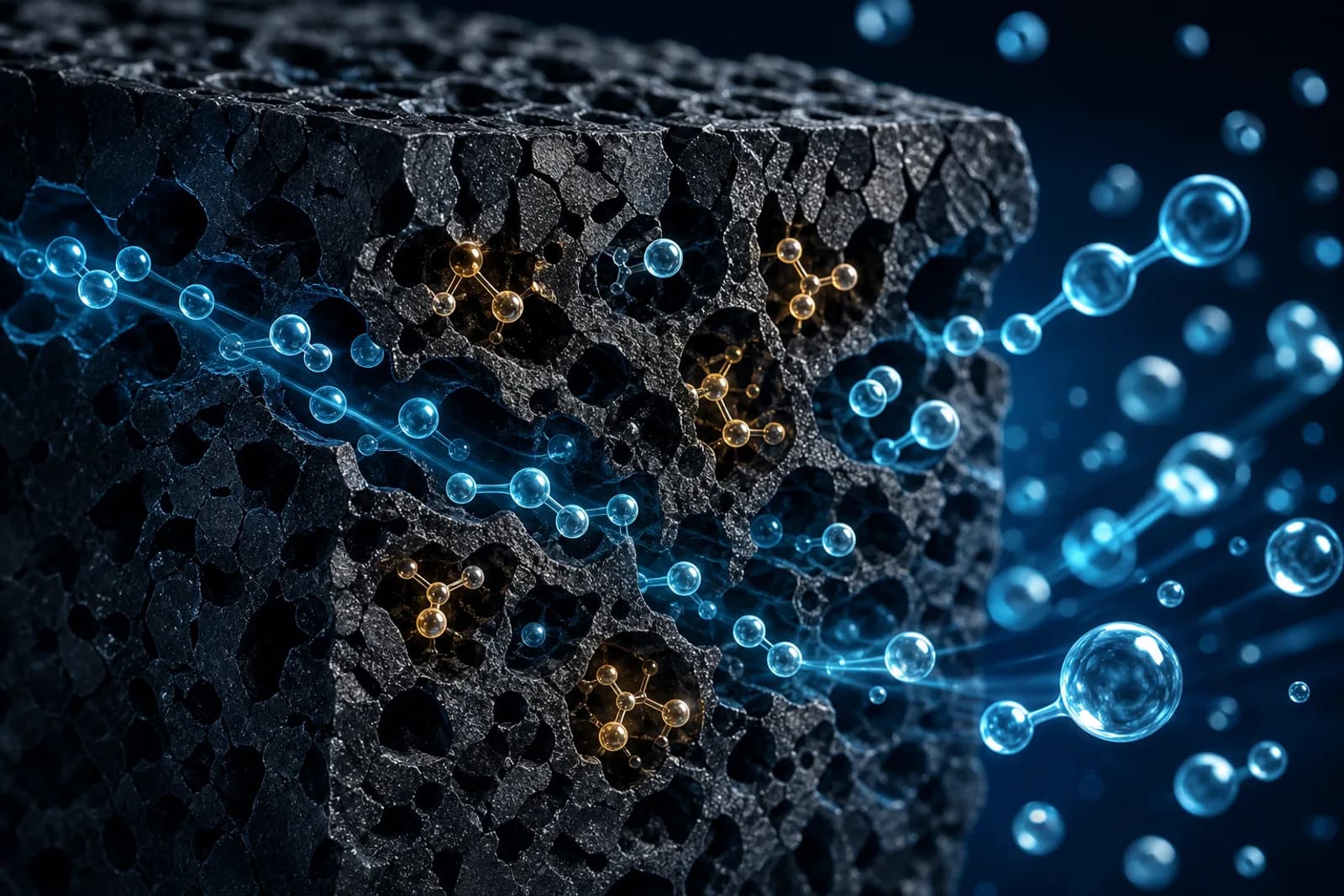
Activated carbon is produced by heating carbon-rich material — most commonly coconut shell or coal — in a low-oxygen atmosphere to open an internal pore structure of extraordinary complexity. A single gram typically carries hundreds to over a thousand square metres of internal surface area, depending on source material and activation method — an area roughly comparable to a football pitch packed into a teaspoon. That surface is the mechanism.
Adsorption, not absorption: free chlorine does not simply stick to carbon — it reacts with it through chemical reduction (Cl₂ + C → CO₂ + HCl). The reaction is fast and efficient; carbon removes free chlorine readily at short contact times. Carbon also effectively adsorbs THMs, HAAs, and other organic DBPs that have already formed upstream.
Chloramine requires more. Chloramine adsorbs more slowly and through a different mechanism than free chlorine. Catalytic activated carbons — formulated specifically for this — perform significantly better than standard carbons. Contact time determines outcome: a quality carbon block filter with longer contact time removes substantially more chloramine than a thin granular filter that water bypasses quickly. Carbon filter grade and flow rate both govern real-world performance.
Carbon does not remove nitrates, heavy metals, or dissolved salts. These require different technologies — ion exchange for nitrates, RO membranes for dissolved metals and salts. Carbon excels at organics and disinfectants; it is not a universal barrier.
Carbon block versus granular activated carbon
Household filters use two main forms of activated carbon:
Granular activated carbon (GAC) consists of loose carbon particles. Water moves around the granules, and contact time varies. GAC is effective for taste and odour but can develop channelling — paths of least resistance through the bed — that reduce contact and drop performance over time.
Carbon block is finely ground carbon compressed into a solid cartridge. Water is forced through the carbon matrix with no option to channel around it, giving more consistent contact time and better THM and chloramine removal. Carbon block also acts as a mechanical filter for fine sediment. For PDAM households where chlorine taste and DBP reduction are the main concerns, a quality carbon block is the stronger choice.
In multi-stage RO systems, carbon appears in two positions by design. The pre-carbon stage removes chlorine before it reaches the RO membrane, because chlorine degrades the polyamide thin-film composite that most membranes are made from. The post-carbon stage polishes any residual taste from the pressurised storage tank. Neither stage is decorative.
What carbon filtration does not address
Carbon is not a disinfectant. It removes chlorine and organic compounds, but it does not kill bacteria. An exhausted or infrequently replaced carbon filter can become a site for bacterial growth, because it removes the residual chlorine that was suppressing microbial activity downstream. Filter replacement schedules are not advisory — they are a functional requirement.
Carbon also does not address microbiological risk from groundwater (sumur bor) or from galon refill water where source quality or depot sanitation is in question. For those supplies, carbon alone is insufficient; a UF membrane or RO system is needed for pathogen removal.
Practical implications for Indonesian households
The smell of chlorine in Jakarta tap water is a sign the supply chain is doing something right, not something wrong. Residual chlorine is evidence that the water was disinfected and that disinfectant survived the journey through the network. The same holds across other cities on piped supply — Surabaya, Bandung, Medan.
What a good carbon filter does for PDAM users is remove what the chlorine leaves behind: the taste, the odour, and the DBPs that formed en route. For a household on piped supply with no heavy-metal concern and reasonably low TDS, a quality carbon block or a UF system with integrated carbon is often sufficient — full RO is not always the default answer.
For households on groundwater, where bacterial contamination is a real risk and TDS may be elevated from saltwater intrusion or dissolved minerals, carbon is one stage among several, not a standalone solution. Treatment should match the source.
A basic observation of taste and odour is a useful starting point. If your water smells of chlorine but is otherwise clear and sourced from PDAM, a carbon-based filter addresses the most immediate concern directly.
The calculation utilities are making
Water treatment is not trying to produce chemically pure water. It is managing a specific trade-off: the certainty that untreated water carries pathogens that kill people, against the low-probability risk of long-term DBP exposure in water that meets standards. Every independent health authority that has reviewed the evidence reaches the same conclusion: disinfection wins. The role of household filtration is not to second-guess that decision, but to remove what was added for the journey once the water has safely arrived.
Not sure which system fits your water?
Aright Marketing Indonesia can assess your supply and recommend the right Truliva system for your home or business in Indonesia.