How Ultrafiltration Works
Ultrafiltration pushes water through hollow-fibre membranes with pores of 0.01–0.1 micron, blocking bacteria, protozoa, and particles while keeping dissolved minerals intact. A plain-language guide to UF membrane technology, what it removes versus RO, and how to know which suits your water.
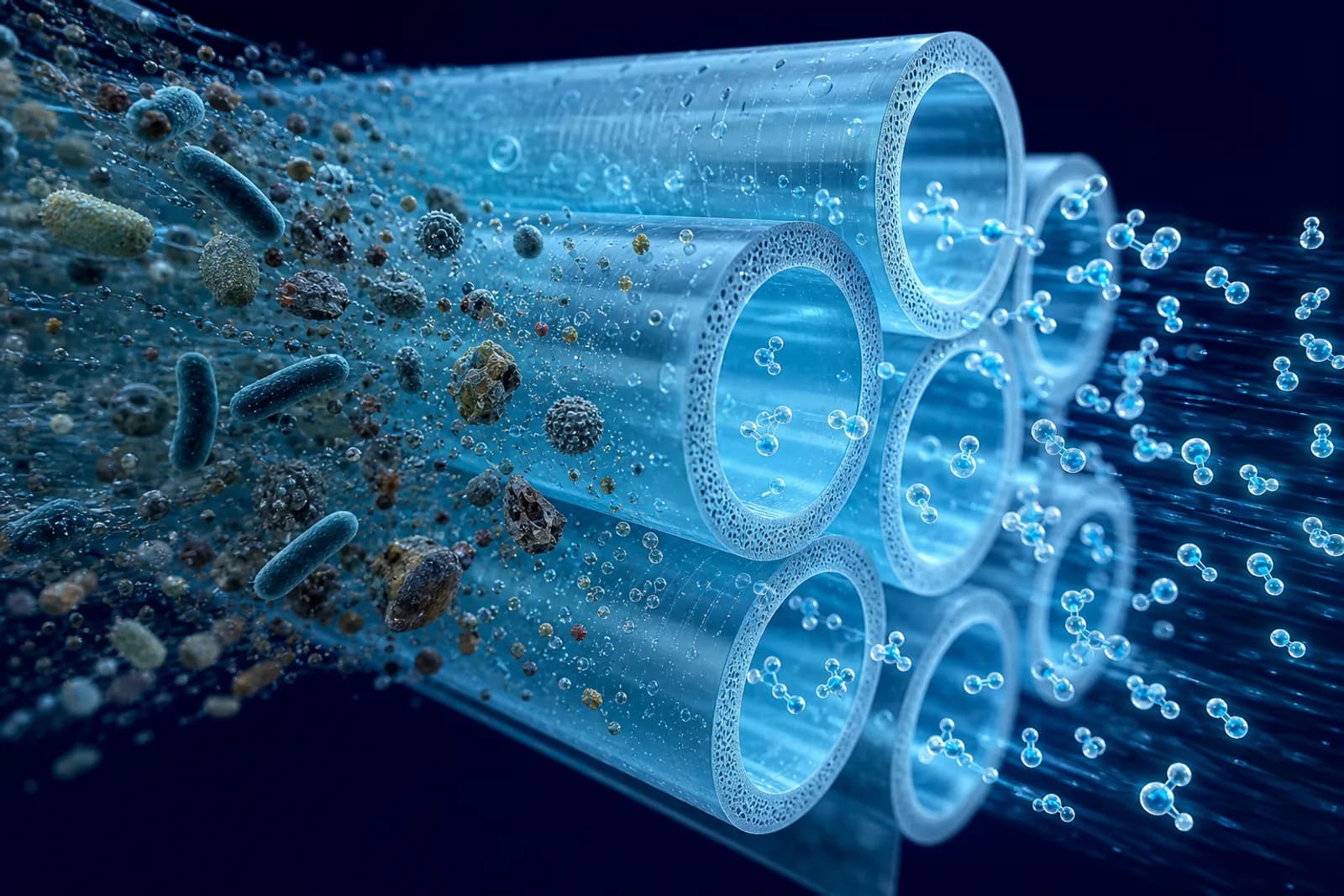
Ultrafiltration works by pushing water through millions of hollow fibres — thin tubes with walls riddled with pores roughly 0.01 to 0.1 micron across. Bacteria are typically 0.5–5 microns in size; suspended particles and colloidal matter sit in a similar range. They cannot pass. Water molecules, dissolved salts, and the beneficial minerals calcium and magnesium are small enough to go through unimpeded. This single size distinction defines what UF does well and where it reaches its limit.
The hollow-fibre membrane: structure and physics
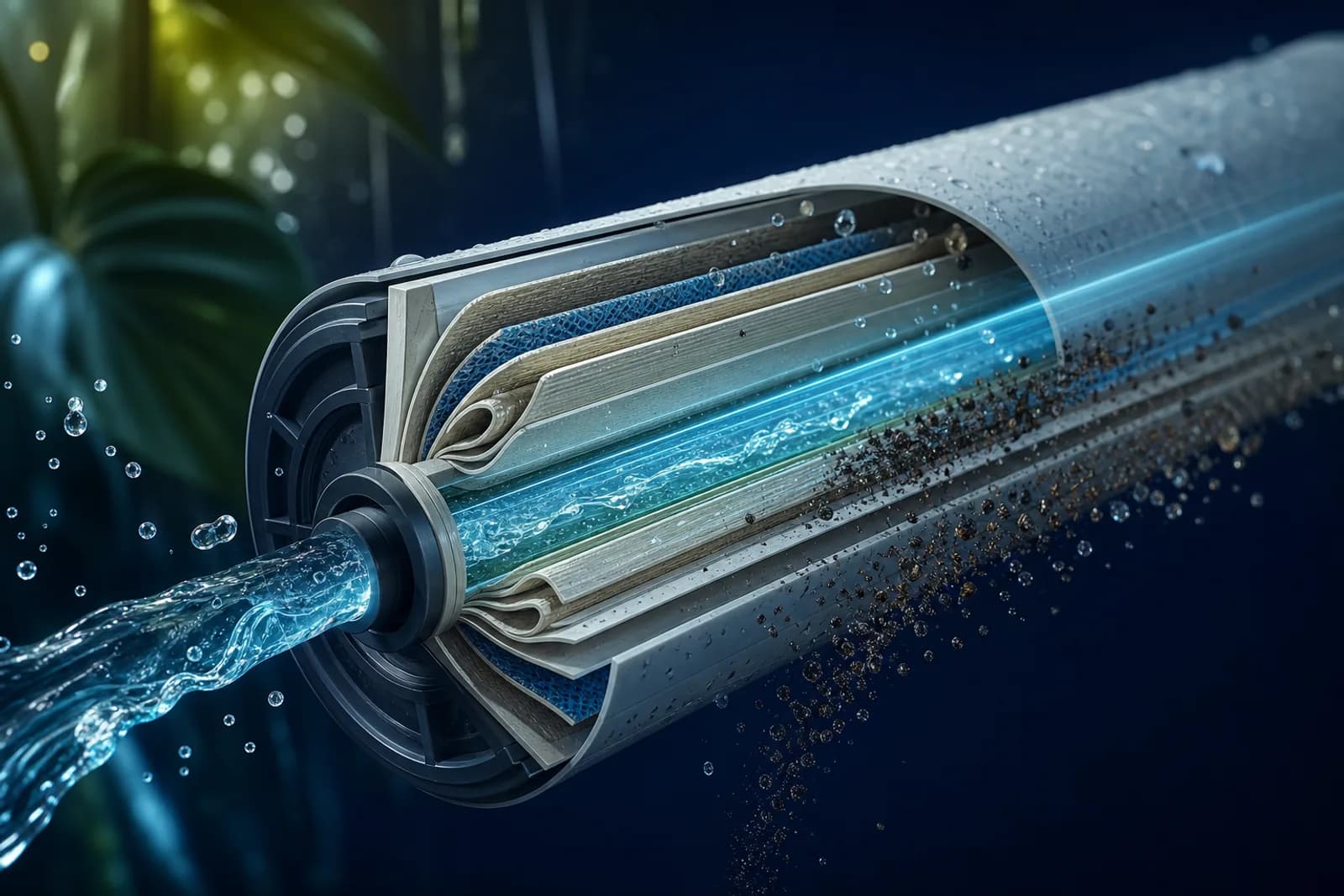
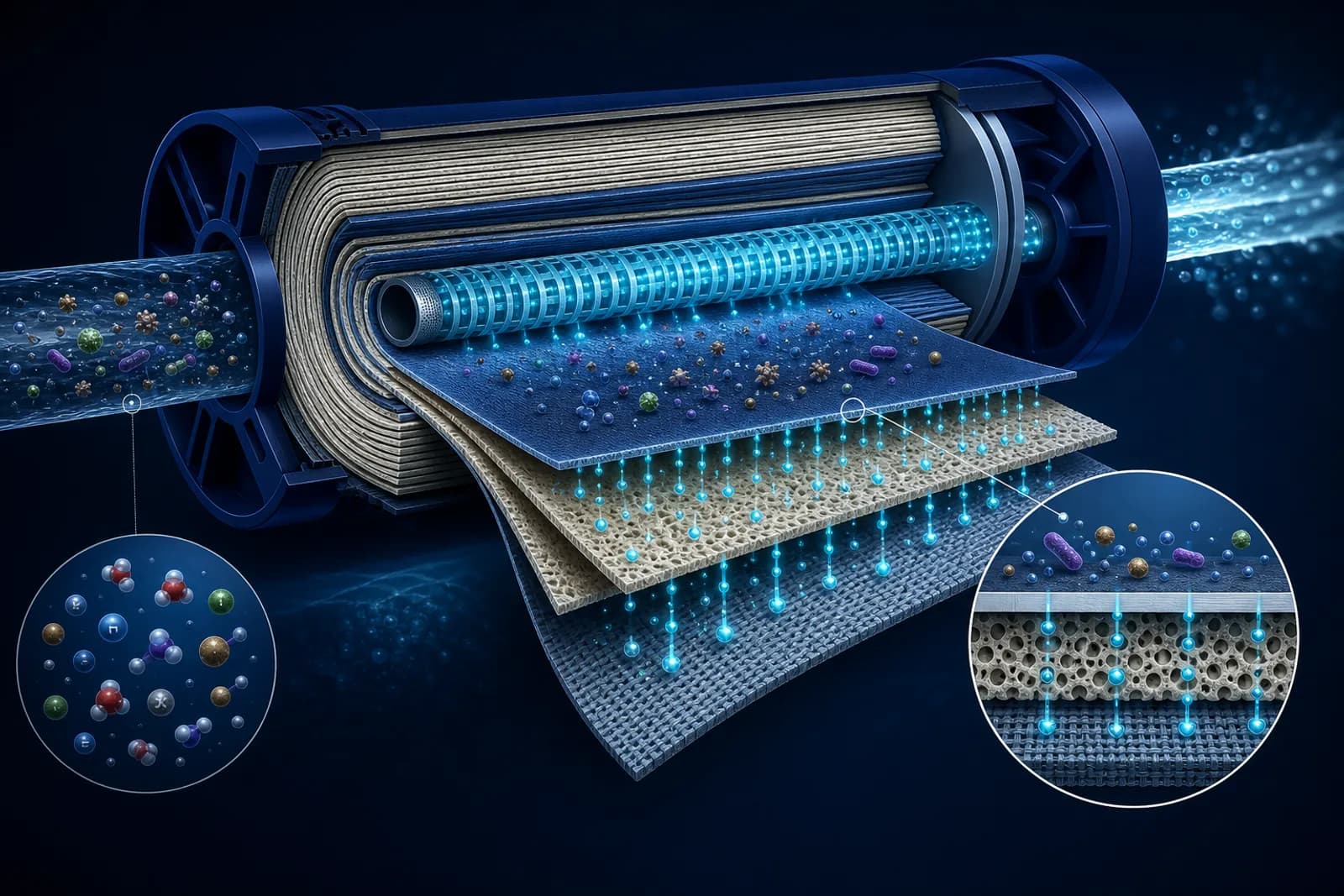
The core of any UF system is a bundle of hollow-fibre membranes, each resembling an extremely fine drinking straw. A single cartridge may contain thousands of fibres packed in parallel. Feed water enters either through the inside bore of each fibre (inside-out flow) or from the outside (outside-in flow); the clean permeate exits through the porous wall. Both configurations achieve the same barrier effect — the geometry chosen depends on the application and how the system manages backwashing.
The pore size is what determines the separation. UF membranes are typically rated in the 0.01–0.1 micron range, placing them between microfiltration (which operates at 0.1–10 microns and stops larger particles but may pass some bacteria) and nanofiltration (which approaches dissolved-ion territory but is less thorough than full RO). Hollow-fibre UF is widely regarded as effective against bacteria and most viruses — though virus retention varies by membrane specification and flux conditions, so high-quality membranes from reputable manufacturers matter.
The fibres are made from a polymer chosen for chemical resistance, mechanical strength, and the ability to withstand repeated backwash cycles without losing pore integrity. Polyvinylidene fluoride (PVDF) is one widely used material in the water treatment industry; the specific polymer in a given cartridge depends on the manufacturer's design.
What UF removes — and what it does not
UF's removal profile follows directly from its pore size. It reliably blocks:
- Bacteria — including common waterborne pathogens such as E. coli, Salmonella, and Vibrio cholerae
- Most viruses — at 0.02–0.3 micron, many viruses sit within or near the rejection range of a quality UF membrane
- Protozoa and cysts — Giardia, Cryptosporidium, and similar organisms, which are considerably larger than the pores
- Suspended particles and colloids — silt, rust, sand, and fine turbidity from ageing pipes
- Some large organic molecules — humic substances and other colloidal organics are partially retained
What UF does not remove is equally important to understand:
- Dissolved salts and minerals — sodium, chloride, calcium, magnesium, and sulphates all pass through freely
- Heavy metals in ionic form — lead, arsenic, or mercury dissolved in water are far below the pore size and are not retained
- Residual chlorine and chloramines — these are molecules, not particles, and pass through the membrane
- Small organic compounds — pesticides, industrial solvents, and most pharmaceuticals
For source water where the primary concern is microbiological — bacteria and particles from PDAM piped supply or a shallow sumur bor — UF handles the relevant threat while preserving the dissolved mineral content that makes water taste natural. For water where the TDS is high, dissolved metals are present, or salinity intrusion from coastal groundwater is a factor, UF is insufficient and RO is required.
How the stages work together
A standalone UF membrane would clog quickly on raw tap water. In practice, UF systems run the feed through preparatory stages before it reaches the membrane.
Pre-sediment stage (PP). A polypropylene spun-fibre cartridge captures large particles — sand, rust flakes, fine grit — that would otherwise accumulate on the membrane surface and restrict flow. In areas with older distribution pipe networks, and particularly where PDAM supply pressure fluctuates and draws sediment into the line, this stage works hard.
Activated carbon stage (CTO). A carbon block adsorbs residual chlorine, chloramines, and dissolved organic compounds responsible for taste and odour. This stage matters both for palatability and for membrane longevity: sustained chlorine exposure can degrade some membrane polymer materials over time, so removing it upstream is sensible practice even if the immediate chemical threat to UF membranes is lower than it is for RO polyamide membranes.
UF membrane stage. With the feed pre-cleaned, the membrane performs its primary job: blocking bacteria and particles at the sub-micron level while passing clean, mineral-bearing water.
Post-carbon polishing (CTO). A second carbon stage after the membrane refines taste and catches any residual odour before the water reaches the tap.
Truliva's Under-Sink Ultrafiltration (UU-N3010) runs exactly this four-stage sequence — PP / CTO / UF / CTO — delivering 99.9% bacterial removal at 2.2 L/min without any electrical connection or drain line. The Counter-Top Ultrafiltration (CU3040) uses a two-stage UF + CTO configuration for households where simplicity and counter placement take priority; it produces 2 L/min and handles 3,000 litres per cartridge set.
Backwashing: how the membrane stays clean
A practical advantage of hollow-fibre UF over flat-sheet RO membranes is that the fibres can be backwashed — water is forced in the reverse direction through the pores to dislodge accumulated material. Well-designed UF systems do this automatically at set intervals or when pressure drop across the membrane reaches a threshold, extending membrane life and maintaining consistent flow rate.
Where backwashing is not available or the pre-stages are neglected, progressive fouling raises the pressure required to maintain flow and eventually causes irreversible pore blockage. Cartridge replacement schedules are not arbitrary — they account for the realistic accumulation rate given the source water quality.
No electricity, no drain water
For many households, the operational profile of UF is as significant as the filtration chemistry. Because the hollow-fibre membrane passes water under normal mains pressure — PDAM supply in most Indonesian cities delivers roughly 0.1–0.3 MPa, which is sufficient for UF — no electric pump is required. Water flows continuously without accumulating in a pressurised storage tank.
There is also no reject stream. Every litre that enters the system either passes through as clean permeate or is purged in a brief backwash cycle; there is no continuous concentrate drain the way an RO system produces. In areas with high water costs or intermittent PDAM supply, this is a real operating advantage.
Air galon refill culture — buying 19-litre gallon jugs — remains widespread across Indonesia even where PDAM supply is reliable, partly because chlorine-treated piped water retains a taste that many households find unpleasant. A UF system with an activated carbon stage addresses that at the tap, delivering water that competes directly with the jug on taste without the ongoing purchase cost.
UF versus RO: the practical comparison
The difference is not quality hierarchy — it is match to source water.
| Ultrafiltration | Reverse Osmosis | |
|---|---|---|
| Removes bacteria | Yes, 99.9% | Yes (pre-stages + membrane) |
| Removes viruses | Partially to substantially | Yes |
| Removes dissolved salts / TDS | No | Yes |
| Removes heavy metals | No | Yes |
| Retains calcium and magnesium | Yes | No (removed with everything else) |
| Electricity required | No | Yes (booster pump) |
| Drain water produced | Minimal to none | Yes — 25–50% of feed typically |
| Suitable for high-TDS borehole water | No | Yes |
| Suitable for low-TDS PDAM supply | Yes | Yes (with remineralisation option) |
The question is therefore: what is actually in your water? A TDS meter gives a fast reading of dissolved solids. PDAM water in most Indonesian cities sits at a TDS that UF handles competently. Groundwater from a sumur bor, water in coastal areas where seawater infiltrates the aquifer, or any supply where the TDS reads above approximately 300–500 ppm — these warrant RO.
If the water test shows low TDS but microbiological risk is present, UF addresses the relevant threat without the infrastructure and operating costs of RO. That is the right technology for that problem.
Tropical conditions and membrane storage
Indonesia's climate introduces a practical consideration that colder climates do not face to the same degree: in stagnant warm water, bacteria multiply faster. A UF system left unused for several days may accumulate bacterial growth within the housing, particularly in the post-membrane stages, despite the membrane's barrier function upstream.
This is not a UF-specific problem — all filter systems share it to some degree — but it reinforces the value of a post-carbon final stage and sensible flushing habits. A common recommendation is to run water through the tap for around 30 seconds after an extended non-use period — check your system's specific maintenance guide for the advised interval — and periodic sanitisation according to the maintenance schedule. Replacing cartridges on the stated schedule rather than stretching life to cut costs is particularly important in high-ambient-temperature environments.
Choosing UF: when it is the right answer
The decision is straightforward once you know what is in your water. UF is the right technology when your source is PDAM piped supply — or low-TDS borehole water — and the primary concern is microbiological: bacteria, protozoa, turbidity from ageing pipes, and the chlorine taste that comes with treated municipal water. It preserves the dissolved minerals that contribute to natural-tasting drinking water and does all of this without electricity or a drain connection.
Where UF falls short is equally clear: dissolved heavy metals, high salinity, or TDS readings that suggest significant mineral load require RO. When in doubt, test first — a TDS meter costs under Rp 150,000 and takes thirty seconds. If the number is low and the concern is biological, UF addresses the problem directly and economically.
Not sure which system fits your water?
Aright Marketing Indonesia can assess your supply and recommend the right Truliva system for your home or business in Indonesia.