Do You Get Your Minerals From Water or Food?
RO removes calcium and magnesium from water — but how much of your daily intake does that change? Here is what the evidence suggests about minerals in drinking water versus diet.
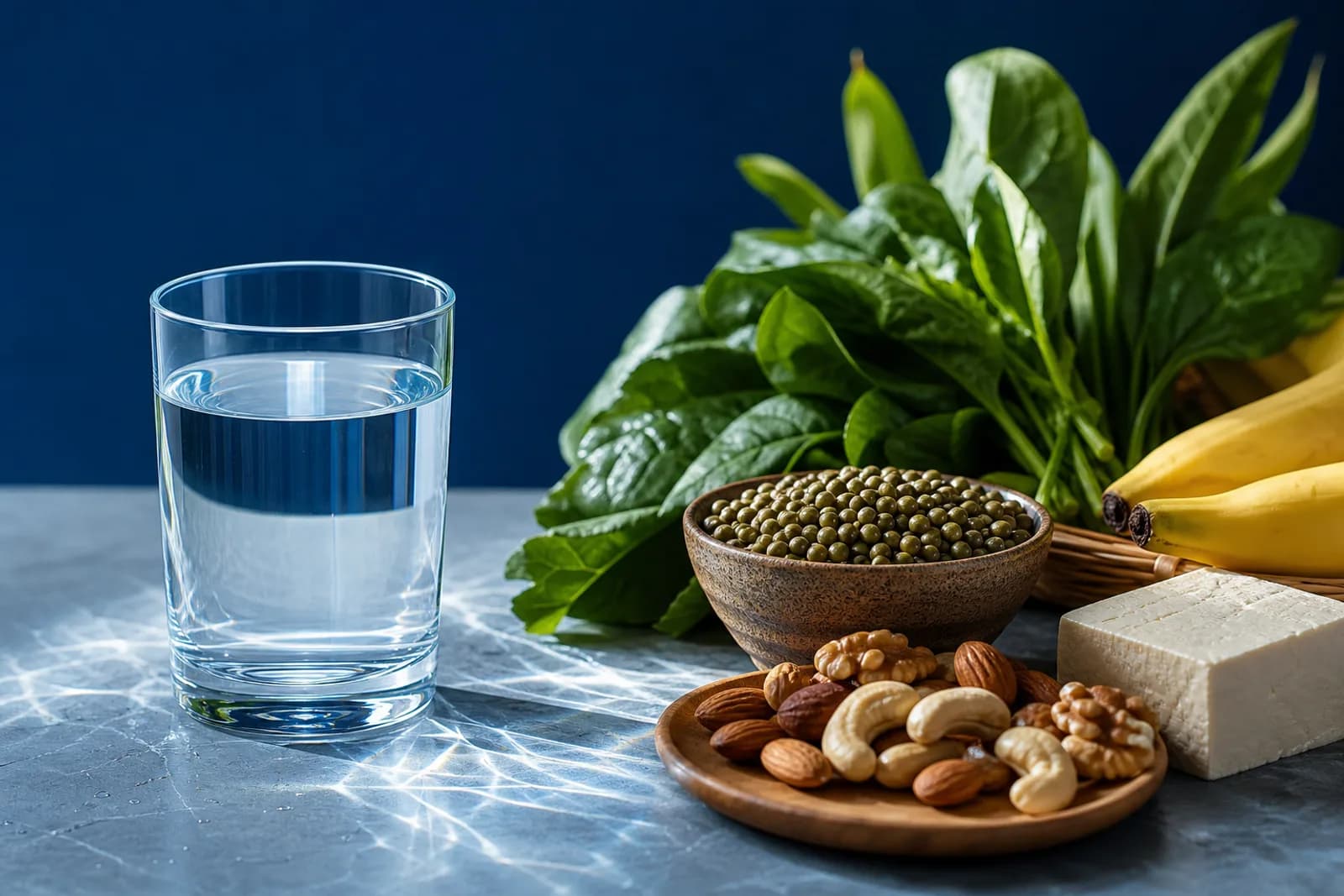
Reverse osmosis removes minerals from water, and that fact is often used to alarm people. The concern is not invented: calcium and magnesium are genuinely present in drinking water, and RO does strip them out. What the alarm leaves out is the rest of the picture — where those minerals actually come from in the diet, and how small a share drinking water contributes next to food. The numbers put the worry in a calmer light.
Where your minerals actually come from
The body needs a range of minerals — calcium, magnesium, potassium, sodium, iron, zinc, and others. Nearly all of them come from food. Dairy, legumes, nuts, green vegetables, grains, and meat carry concentrations that dwarf what is usually present in drinking water.
Take calcium. A 200 ml glass of milk commonly provides over 200 mg. A serving of tempeh can add well over 100 mg. Two litres of moderately hard tap water — more than most people drink in a day — might supply somewhere between 40 and 100 mg depending on local geology, and often less. That is a useful top-up on a good diet, but it is not the foundation of your calcium intake.
The same pattern holds for magnesium. Cashews, spinach, tofu, and whole grains are dense sources. Water adds to the total; in a normal diet, food contributes far more.
What the numbers look like in practice
Dietary reference values for calcium in adults are commonly set around 700–1,000 mg per day by health authorities, varying by age and sex. Magnesium targets typically sit in the range of 300–400 mg per day. Water hardness — and therefore mineral contribution — varies widely between regions and sources, but even fairly hard water rarely supplies more than 10–15% of a day's calcium need at normal drinking volumes.
For a household on clean, moderately mineralised piped water, switching to RO might reduce daily calcium intake by a few tens of milligrams. That is not nothing. But a single serving of most dairy foods, or a decent portion of cooked kale or tofu, more than makes up the difference.
These figures shift with the source. Some supplies are genuinely hard — calcium above 150 mg/litre is not unusual — and there, water contributes more. Even then, the calculation assumes the diet is otherwise adequate.
The broader nutritional picture
Nutritional research consistently points to food patterns, not water mineralisation, as the main driver of mineral status. Deficiency in calcium or magnesium across the general population is far more closely linked to inadequate food intake — limited dairy, few legumes, low vegetable diversity — than to which water someone drinks.
That does not make mineral intake from water irrelevant. Where food diversity is limited, every source of micronutrients counts, and calcium and magnesium from water appear to be reasonably bioavailable. The World Health Organization has noted that drinking water's contribution to mineral intake deserves consideration, particularly for calcium and magnesium. But the same literature is careful to add that the contribution varies widely and that the question is not fully settled. It would be wrong to treat any single figure as a universal standard.
Who should pay closer attention
For most households eating a reasonably varied diet — rice, tempeh, vegetables, some dairy or protein — moving from mineral-bearing tap water to RO-treated water is not a health risk. The dietary margin is wide.
A few situations are worth thinking through more carefully. Young children, who drink a lot relative to body weight and often eat a narrow range of foods, are one group. Elderly adults with low appetite and small food intake are another. Anyone managing a condition that raises dietary mineral needs should speak to a dietitian rather than lean on any single source — water included.
In each case the sensible response is not "avoid RO" but "watch overall diet adequacy." Water is one input, not the lever.
What about very low mineral water over the long term?
Concern is sometimes raised about long-term consumption of very low mineral water — RO or distilled water with no remineralisation. The body adjusts to a wide range of water mineral contents, and the clinical evidence for harm from low-TDS water in people eating normally is not strong. At the same time, several health bodies suggest that some mineralisation is preferable, partly for taste and partly as a precautionary position.
If this worries you, it is easy to settle. A remineralisation cartridge fitted after the RO membrane adds back a controlled amount of calcium and magnesium. The water tastes noticeably better to most people, and the low-mineral question simply stops arising. It is not a required fix, but it is a simple one.
Putting the "RO removes minerals" claim in context
The statement is technically accurate. An RO membrane does reject most dissolved minerals. The real question is whether that translates into a practical health problem for the person drinking the water — and the answer depends on what else they eat.
For someone eating a varied diet in Indonesia — rice with vegetables, tempeh, fish, the occasional glass of susu — the mineral contribution of unfiltered water is a small fraction of total intake. Removing it does not create a deficiency. The far larger drivers of mineral adequacy are food choices, not filter choices.
What RO does offer is a thorough barrier against dissolved contaminants that UF cannot touch: heavy metals, nitrates, and dissolved salts from coastal groundwater. For households on borehole water or groundwater with high TDS, that trade-off sits squarely in favour of RO.
The honest summary
Water can contribute to mineral intake, and that contribution is not zero. It is also not the main event. A varied diet is the foundation of mineral adequacy for nearly everyone. Switching to RO-treated water while eating well is not a nutritional risk. If you want the reassurance of mineralised water, either choose UF — which keeps minerals because it never removes them — or add a remineralising stage after RO. Both are reasonable preferences. Neither is a health emergency.
The filter choice is a water-quality decision. Mineral nutrition is a food decision. They are related, but not nearly as tightly as the "dead water" argument implies.
Not sure which system fits your water?
Aright Marketing Indonesia can assess your supply and recommend the right Truliva system for your home or business in Indonesia.