The 80% Water-Efficiency RO: What It Means for Your Water Bill
Most RO systems discard three litres for every one they purify. The UR-S61096H's 80% efficiency rating changes that calculation — here is what it means for a household on metered PDAM supply.
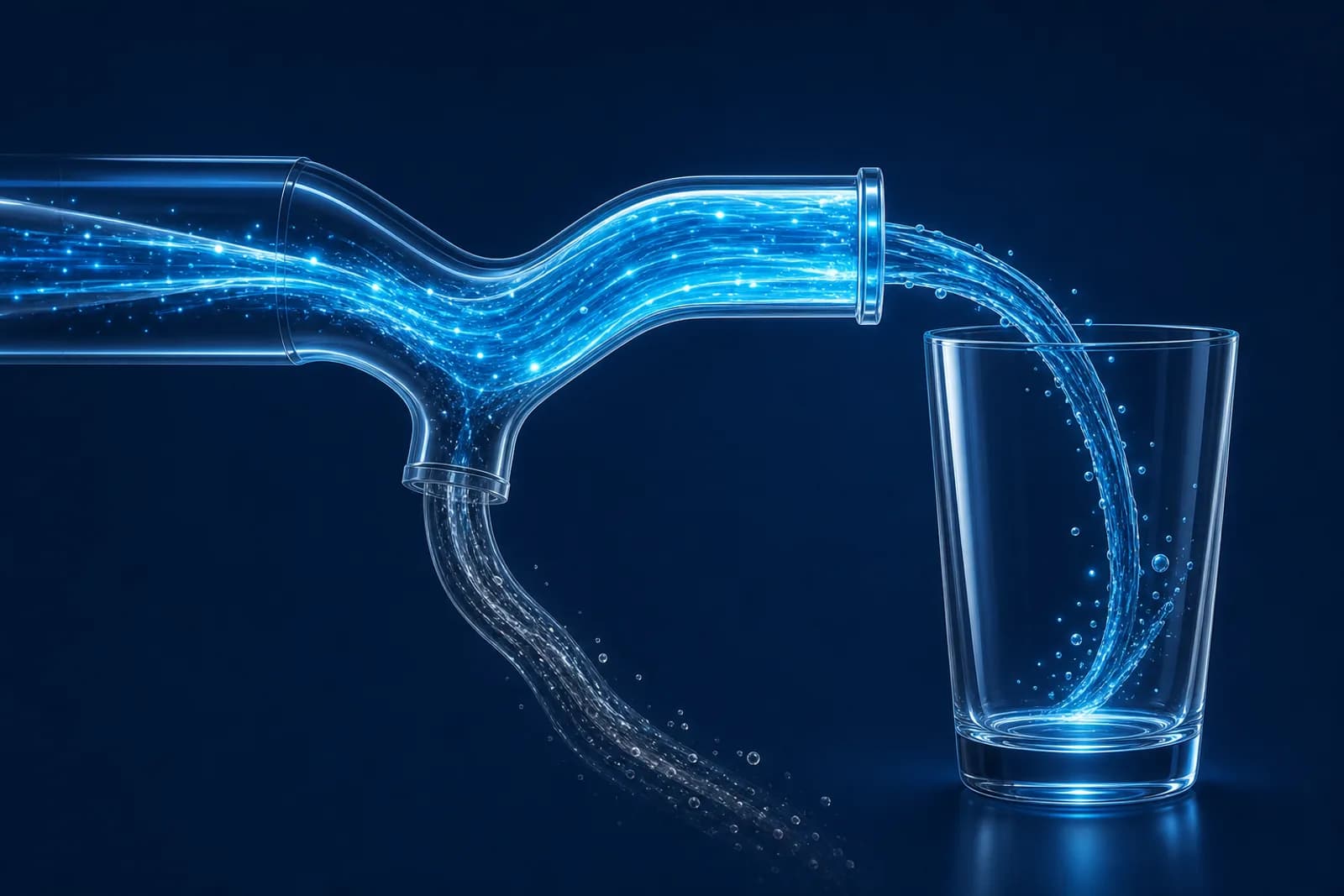
Most reverse osmosis systems throw water away. For every litre delivered from the tap, three or four litres go straight to the drain. On a borehole you pay for this with pump wear and electricity. On a metered PDAM connection you pay the utility for it directly — every litre through the meter, including every litre the RO rejects, appears on the bill. The UR-S61096H is rated at 80% water efficiency, which means it reverses that equation. This article explains what that figure means in practice and how it translates into a concrete monthly water saving.
Why conventional RO wastes so much
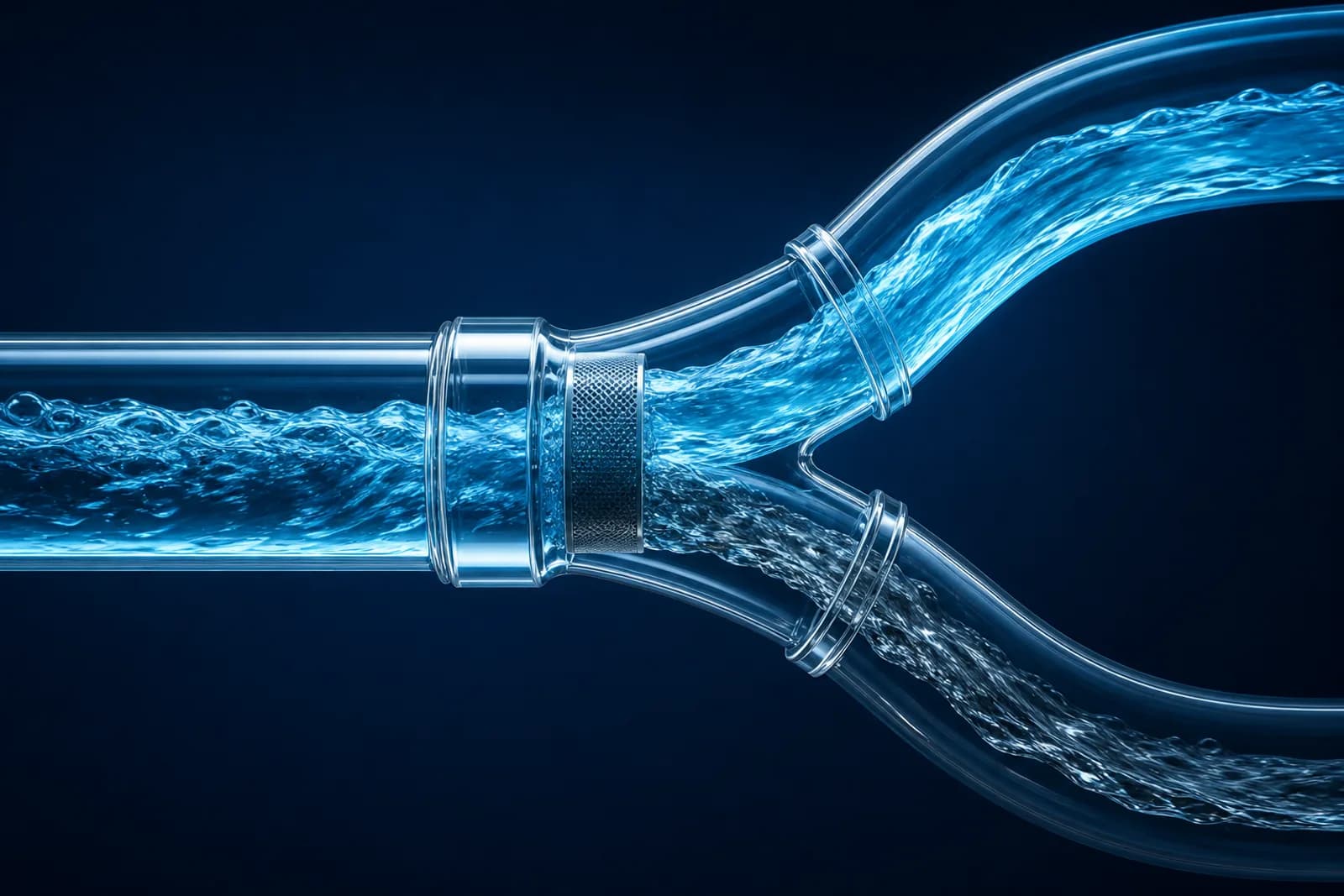
The waste is structural, not accidental. An RO membrane separates dissolved solids from water by allowing water molecules through under pressure while blocking ions and contaminants. The water that does not pass through the membrane — carrying the concentrated reject — must be continuously flushed away to prevent scaling on the membrane surface. Stop the flush and the rejected salts accumulate, foul the membrane, and end its useful life.
The full science of why that reject stream exists, and what affects how large it is, is covered in RO Wastewater Ratio Explained. For this article, the short version: older domestic RO systems on mains pressure alone are commonly reported to operate at a 3:1 or 4:1 ratio — three to four litres rejected for every one litre purified. That gives them a recovery rate of roughly 20–25%. Figures here are indicative — real-world ratios and tariffs vary; check your own meter and bill.
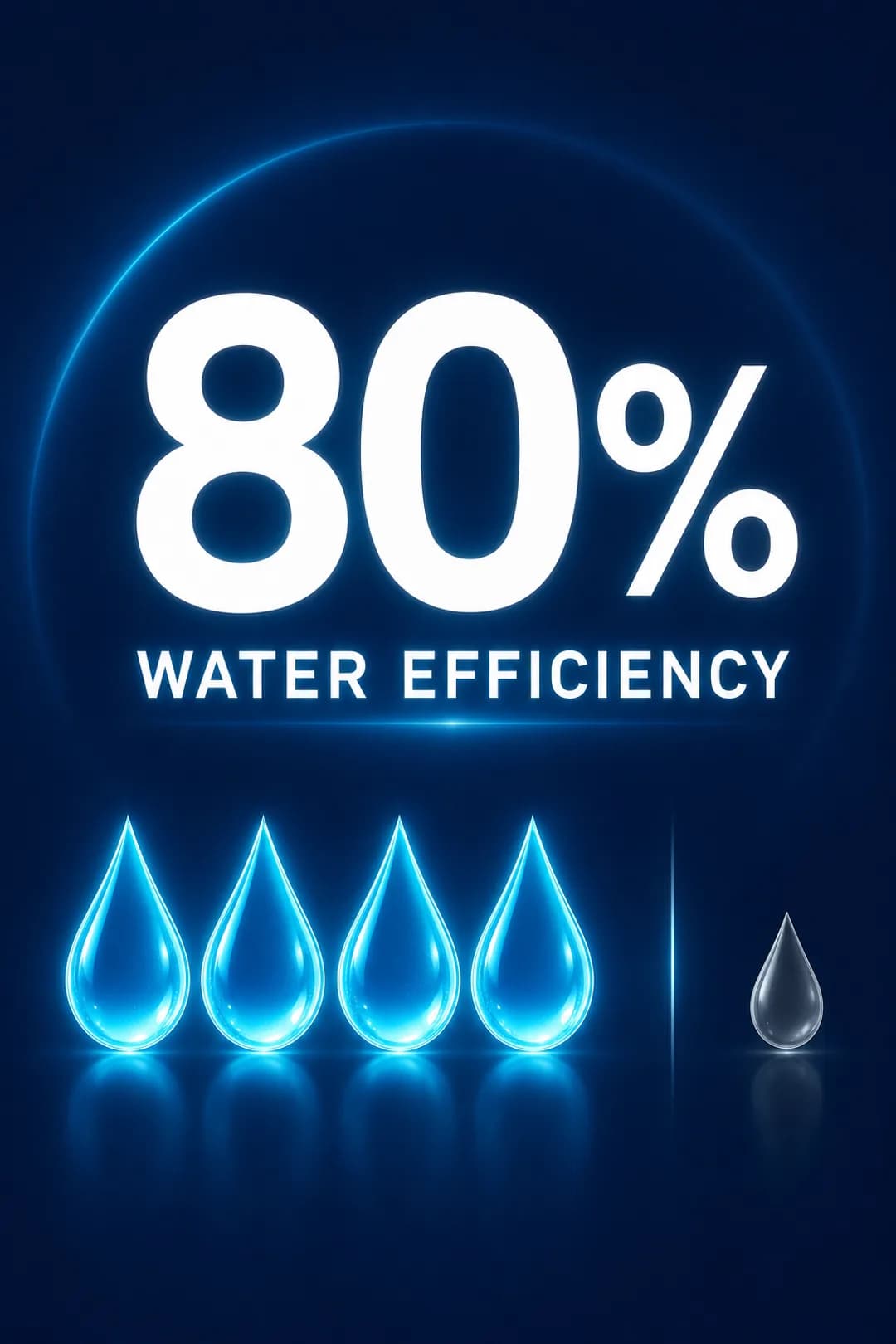
At 80% efficiency, the UR-S61096H recovers eight litres from every ten that enter. One litre goes to drain as reject; four litres in every five become purified water. Compared to a conventional 25% recovery system, this cuts the drain volume by roughly 60%.
Translating efficiency into volume
The saving is easiest to see in daily volume terms before attaching any price to it.
A typical household of four on Jakarta PDAM supply, using a purifier for drinking and cooking water, commonly runs through somewhere in the range of 8–15 litres of purified output per day. Take 10 litres as a working figure.
At 25% recovery (a 3:1 reject ratio, used here as a typical indicative baseline), producing 10 litres of purified water requires 40 litres of inlet water: 10 permeate + 30 reject.
At 80% recovery, producing the same 10 litres requires only 12.5 litres of inlet water: 10 permeate + 2.5 reject.
The difference is 27.5 litres of inlet water per day — water the household draws through the meter with the conventional system but does not draw with the high-efficiency unit. Over a calendar month of 30 days, that is approximately 825 litres saved.
| Conventional RO (25% recovery) | UR-S61096H (80% recovery) | |
|---|---|---|
| Purified output per day | 10 L | 10 L |
| Inlet water needed per day | 40 L | 12.5 L |
| Drain water per day | 30 L | 2.5 L |
| Monthly drain volume | ~900 L | ~75 L |
| Monthly inlet saving | — | ~825 L |
These figures use a fixed 10 L/day output as an illustrative baseline. Real household consumption varies, and the inlet saving scales proportionally: a household drawing 15 L/day of purified output would save roughly 1,200 litres of inlet water per month against a conventional system.
The PDAM bill angle
PDAM water tariffs in Indonesia are structured in ascending blocks — the more you use in a month, the higher the rate applied to each additional cubic metre. Exact tariff rates differ between PDAM authorities and are reviewed periodically, so no specific per-litre figure is used here.
What the volume saving above establishes is the order of magnitude: roughly 0.8–1.2 cubic metres per month that a household on the UR-S61096H does not pay for compared to an equivalent household on a conventional RO system. In Jakarta's block tariff structure, where higher-bracket rates apply to consumption above a threshold, this saving can arrive partly at the more expensive rate band — making the per-litre saving slightly higher than the base rate alone would suggest.
To calculate the saving for your household: look at your most recent PDAM bill, find the rate for the band your consumption falls into, and multiply it by the monthly litre saving that matches your actual purified output. The arithmetic is simple; the tariff document tells you the relevant rate.
For households that have also read Galon Delivery vs a Water Purifier, the water efficiency gain compounds the economic case: not only does a purifier replace the galon habit, but a high-efficiency one does it while drawing meaningfully less inlet water than the conventional alternative.
How the UR-S61096H achieves 80% efficiency
The high recovery rate is not a membrane trick alone — it requires adequate driving pressure at the membrane surface. Low inlet pressure is the primary reason conventional systems on mains-only supply perform poorly; when the pressure at the membrane drops, the system produces proportionally less permeate and more reject.
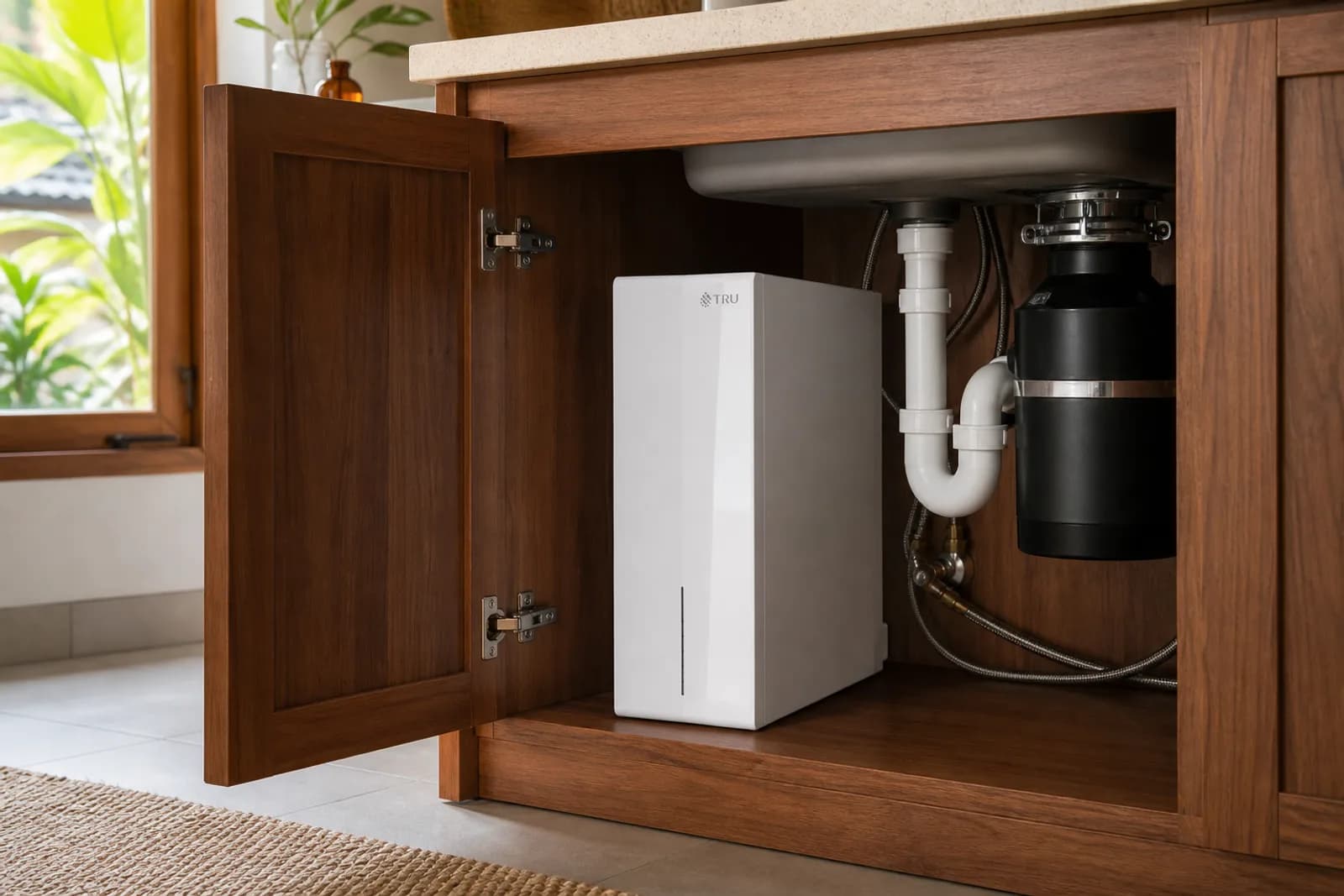
The UR-S61096H addresses this with a built-in booster pump that maintains operating pressure at the membrane regardless of PDAM supply variation. In Jakarta's distribution network, where mains pressure fluctuates — particularly in high-rise buildings or zones far from the trunk main — this matters in practice. The pump keeps the system working in its efficient operating range during peak morning demand hours as well as off-peak.
The 7-layer filtration stack also incorporates a patented anti-fouling membrane flush mechanism. At the end of each purification cycle, a short flush sweeps concentrated reject from the membrane surface rather than letting it sit and scale. Scaling suppression maintains membrane permeability, which in turn keeps the recovery rate high as the membrane ages. The rated membrane life is eight years — significantly longer than the two-year cycles typical of conventional domestic RO membranes — which sustains the efficiency advantage across the system's operational life rather than only when the membrane is new.
The 1000 GPD output and what it means for efficiency
A secondary factor in how efficiency feels day-to-day is output speed. Many entry-level RO systems in Indonesia run at 50–100 GPD, filling a glass in half a minute or more. Tankless systems at that speed often run for longer to keep up with demand, accumulating more total reject over a day than the per-litre ratio suggests.
At 1000 GPD — approximately 2.66 litres per minute — the UR-S61096H fills a glass almost instantly. The system runs briefly for each demand event, then stops. Shorter run time per litre of output means fewer seconds in which the membrane is simultaneously generating reject. The efficiency figure is constant per litre produced, but the actual daily reject volume is further reduced because the system is not running unnecessarily to keep pace.
Borehole households: a different calculation, same direction
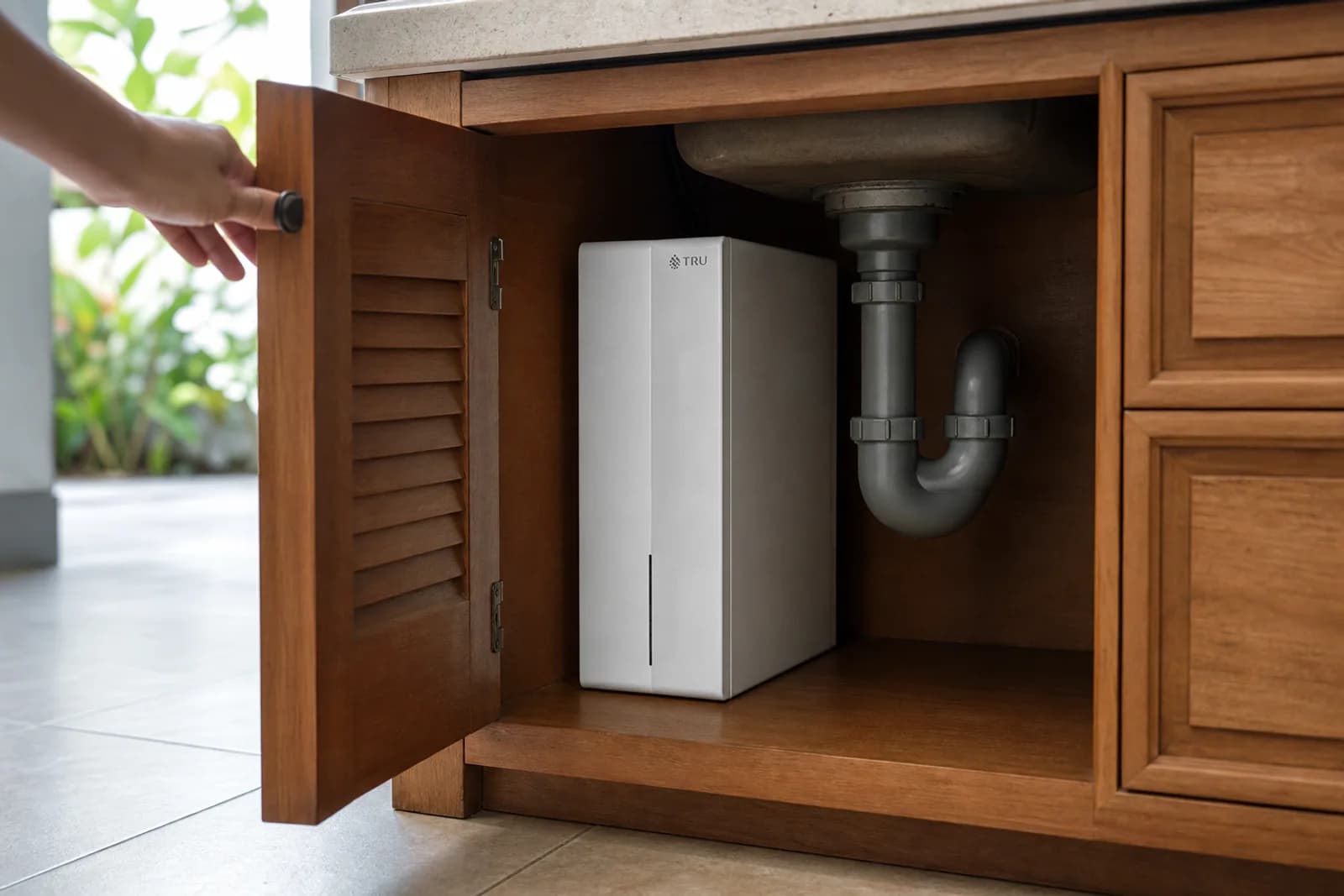
For homes drawing from a sumur bor rather than PDAM, the meter argument does not apply directly — but the efficiency gain still has a cost. A borehole pump runs every litre drawn. At 40 litres inlet per 10 litres purified, the pump cycles significantly more than at 12.5 litres. Over a month, the extra pump runtime translates into electricity and, progressively, into pump wear and shorter service intervals.
In areas where shallow borehole levels drop during Jakarta's dry season, higher draw rates also risk drawing the water table down faster, occasionally pulling in more sediment-laden water as levels fall. A system that uses 12.5 litres of inlet water per 10 litres purified, versus one using 40, draws the borehole significantly less hard over the course of a year.
What to check before assuming 80% in the field
The 80% efficiency figure is a rated specification under test conditions. Field performance depends on three variables that the household controls or can measure:
Inlet pressure. The booster pump compensates for low mains pressure, but the supply must still be live and connected. A closed supply valve or a severely restricted inlet will limit what any pump can work with.
Feed TDS. In coastal Jakarta and areas with saltwater intrusion, feed TDS can be high enough that osmotic back-pressure works against the pump, reducing actual recovery rate. If your incoming water tests above roughly 500 ppm TDS — a broadly cited threshold, though the exact point varies by membrane type and temperature — measure permeate volume against inlet volume periodically to confirm the system is operating near specification.
Membrane condition. The 8-year membrane life is the rated figure under normal conditions. If the pre-filter stages are not replaced on schedule — the sediment and carbon blocks are swapped more frequently than the membrane — heavy sediment loads can reach the membrane prematurely and reduce its permeability. Staying on the pre-filter schedule is the maintenance action that protects the efficiency claim over the long term.
The practical summary
The UR-S61096H's 80% efficiency specification means roughly 825 fewer litres of metered water going to drain each month, against a conventional RO system, for a household drawing 10 litres of purified output per day. At higher consumption the saving is proportionally larger. On a PDAM metered connection the saving appears directly on the water bill; on a borehole it appears in lower pump runtime and reduced draw on the water source.
The mechanism behind the figure — a booster pump that maintains membrane pressure regardless of mains variation, plus an anti-fouling flush that preserves membrane permeability over time — is what makes the specification meaningful in Indonesian field conditions rather than only in a controlled test environment. The rated eight-year membrane life extends that advantage across the system's operational life.
For households comparing the water efficiency claim to alternatives, the RO Wastewater Ratio Explained article gives a full account of why the reject stream exists and what drives the ratio in either direction. For the broader economic case — purifier cost against galon delivery over two to three years — Galon Delivery vs a Water Purifier runs the comparison with illustrative Indonesian figures.
Not sure which system fits your water?
Aright Marketing Indonesia can assess your supply and recommend the right Truliva system for your home or business in Indonesia.