RO Wastewater Ratio Explained: Why Reverse Osmosis Produces Reject Water and How to Reduce It
Reverse osmosis systems produce a reject stream alongside clean permeate. This article explains why the waste ratio exists, what worsens it, and practical ways to reduce it — with context for Indonesian homes on metered PDAM supply or borehole water.
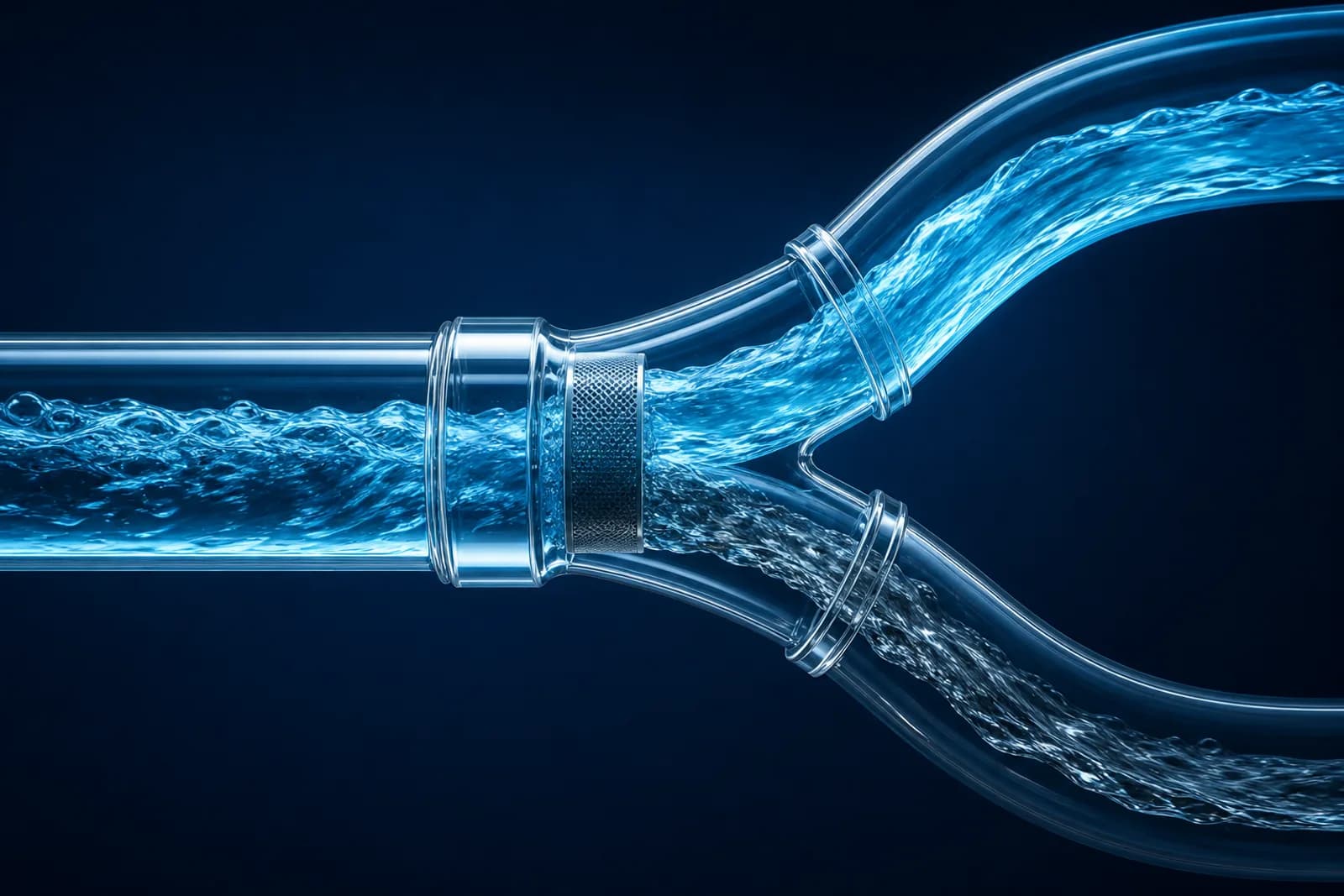
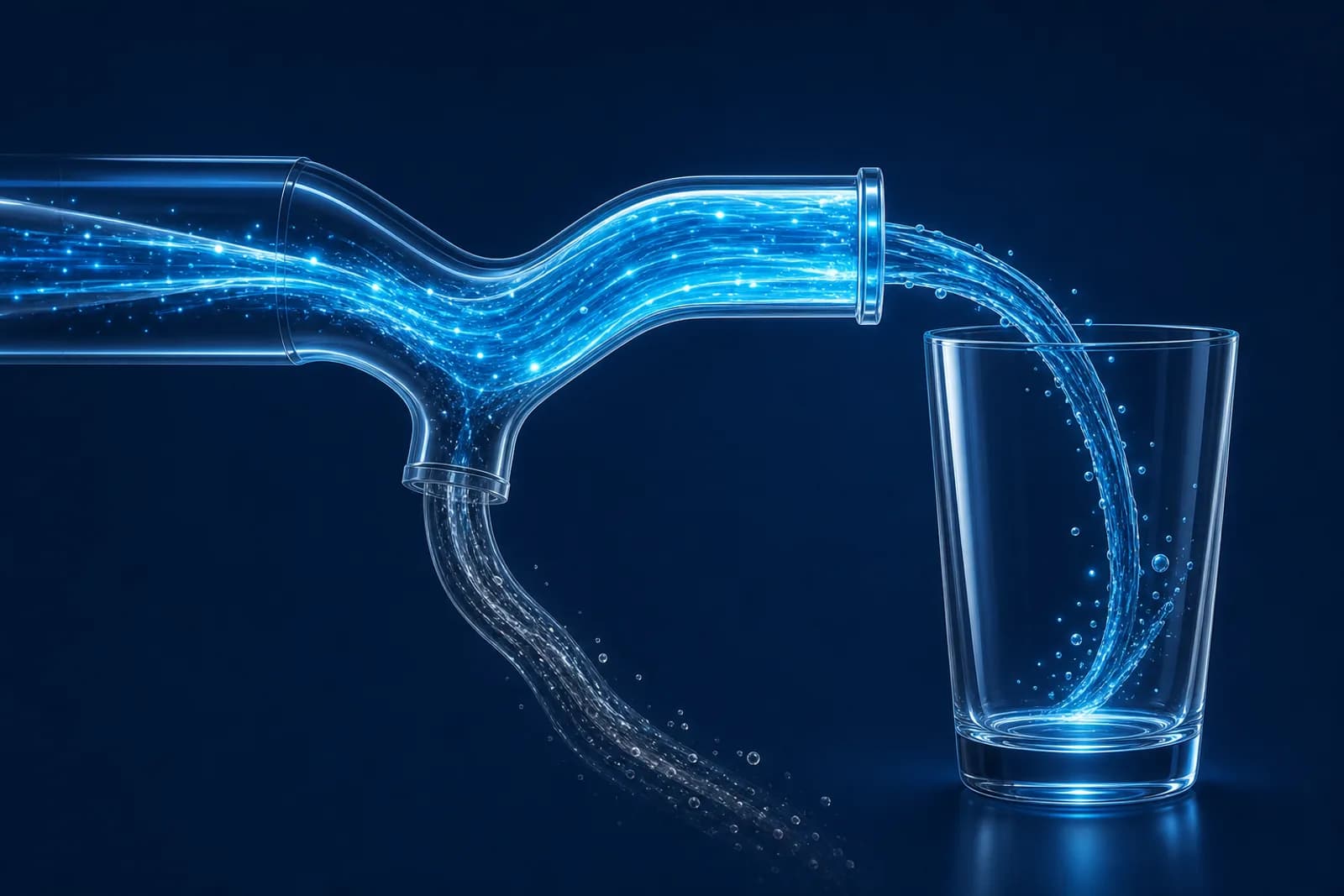
A reverse osmosis system does not send all incoming water to the tap. For every litre it produces as clean permeate, it discharges a second stream — the reject, sometimes called brine or concentrate — down the drain. This is not a design fault. It is a physical requirement of how the membrane works. Knowing why the reject stream exists, what makes it larger, and how to shrink it turns an abstract engineering fact into a practical decision for the household — especially where water is metered or drawn from a borehole.
Why the reject stream exists at all
The RO membrane separates water from dissolved solids by allowing water molecules to pass under pressure while blocking ions, salts, and most other dissolved substances. As feed water flows across the membrane surface, a fraction of it passes through as permeate; the rest carries away the rejected contaminants and exits as concentrate.
That exit flow is not incidental — it is structurally necessary. Without a continuous cross-flow of water sweeping the membrane surface, rejected solids would accumulate directly against the active polyamide layer. Concentration would build until scaling began: calcium carbonate, sulphates, and silica precipitating out of solution and blocking the membrane. A static system with no reject outlet would foul itself rapidly and irreversibly.
The reject stream is, in effect, a continuous self-cleaning mechanism. Its existence is the reason the membrane can sustain useful performance over months and years rather than fouling within days.
How the ratio is expressed
The relationship is typically stated as the reject-to-permeate ratio: how many litres of reject water the system produces for each litre of clean water it delivers. A 3:1 ratio means the system discharges three litres to drain for every litre that comes out of the tap.
The inverse measure — recovery rate — expresses the same thing from the other direction: the fraction of inlet water that becomes permeate. A recovery rate of 25% equates to a 3:1 reject-to-permeate ratio.
Neither ratio is fixed. It varies with inlet pressure, water temperature, feed TDS, and the membrane's age and condition. This matters: a number quoted in a brochure reflects controlled test conditions, not necessarily what a given system will deliver on your supply.
What the ranges actually look like
Older and simpler domestic RO systems — particularly those relying entirely on mains pressure without a booster pump — are commonly reported to operate in the range of 3:1 to 4:1 reject-to-permeate ratios under typical conditions. At these ratios, three to four litres are discarded for each litre produced.
Modern systems fitted with booster pumps, high-efficiency membranes, or internal recirculation circuits can achieve substantially better figures. Some manufacturers report ratios approaching 1:1 in optimised configurations, though real-world performance depends heavily on the feed conditions described below. No single ratio applies universally — treat any quoted figure as a starting point, not a guarantee.
The factors that worsen the ratio
Several variables push the reject stream higher relative to permeate output.
Low inlet pressure. The RO membrane needs adequate transmembrane pressure to drive water through its dense active layer against osmotic back-pressure. On mains supply, PDAM pressure in Indonesian cities varies considerably — and in many residential areas, particularly upper floors or zones far from the distribution trunk main, pressure during peak hours can drop to levels that reduce membrane efficiency. A booster pump addresses this directly by raising the pressure seen at the membrane regardless of mains conditions.
Cold feed water. Lower temperature increases water viscosity, making it harder for water molecules to pass through the membrane under a given pressure. Systems operating at 20–22°C (common in air-conditioned utility rooms) will typically produce less permeate per unit of reject than the same membrane at 25°C — the standard measurement temperature. In tropical Indonesia this is rarely the dominant factor, since ambient water temperatures commonly sit above 28°C in uninsulated pipe runs, but well water from deeper boreholes can be noticeably cooler.
High feed TDS. The more dissolved solids in the incoming water, the higher the osmotic back-pressure the membrane must overcome. Borehole water in parts of Jakarta and coastal areas can carry several hundred ppm TDS, and in zones affected by saltwater intrusion the figure can be considerably higher. Against a higher osmotic gradient, the membrane produces proportionally less permeate for a given driving pressure — worsening the ratio unless pressure is increased to compensate.
Ageing membrane. As a membrane accumulates fouling, scaling, or oxidative damage, its permeability declines. The system still pushes the same volume through the inlet but extracts less of it as clean output. If the purifier takes longer to fill its storage tank than it did when new, a worsening reject ratio is one likely cause — and a sign the membrane may be due for replacement.
Practical ways to improve efficiency
Install a booster pump. This is the most effective single intervention for systems on variable or low mains pressure. A pump raises the operating pressure at the membrane into the range the manufacturer optimised for, improving both permeate output and the reject-to-permeate ratio simultaneously. Many purpose-built domestic RO systems include a booster pump as standard; if yours does not, the operating pressure should be checked against the membrane specification.
Internal recirculation. Some systems partially recycle the reject stream back to the inlet, effectively re-processing water that would otherwise go straight to drain. This raises recovery rate — sometimes significantly — but requires careful design to avoid overconcentrating the feed stream and triggering scaling. It is a design-level feature to look for when selecting a system, not something retrofitted easily.
Replace pre-filters on schedule. A clogged sediment pre-filter or an exhausted carbon block adds resistance before the membrane, reducing the effective pressure available at the membrane surface. Pressure lost to clogged upstream stages is pressure that would otherwise have driven permeate production. Keeping the pre-filter stages current is the lowest-cost way to maintain the system at the efficiency it was designed for.
Monitor and act on TDS readings. If feed TDS is rising — as it can seasonally in areas relying on shallow groundwater that concentrates during the dry season — the membrane is working against a harder load. Tracking permeate TDS monthly also indicates whether membrane performance is degrading, which is the clearest prompt to investigate whether replacement is due.
Reusing the reject stream
Reject water is the portion of the input that did not pass through the membrane — not sewage, not chemically treated waste. But it is more concentrated than the inlet feed, carrying a higher load of the same minerals and dissolved solids that were already in the source water. That concentration matters: reject is not purified, only diverted. In most domestic situations it is still safe for uses where high mineral content does not matter.
Floor and surface cleaning. For mopping, flushing outdoor areas, or rinsing equipment, reject water works perfectly well.
Garden and potted plants. Whether reject water suits garden use depends on the mineral content of the source water. For Indonesian homes on PDAM municipal supply with moderate TDS, the reject stream typically remains in a range that most outdoor plants tolerate without issue. Sensitive plants or hydroponic setups are a different consideration — for those, direct the reject elsewhere and test if in doubt.
Toilet flushing. A container under the reject outlet, filled during the day's purification cycles, can refill a toilet cistern and recover a meaningful share of what would otherwise drain away. The piping is straightforward. On a metered PDAM connection billed by volume, every litre recovered is a direct saving.
Pre-rinse and appliance cleaning. Reject water can be used to soak filters, clean sink areas, or pre-rinse dishes before a dishwasher cycle. It requires no special handling beyond the awareness that it is more mineralised than tap water.
One constraint: reject water should not be stored for long periods, particularly in a warm climate. Bacterial growth in a sitting container of water is a practical concern; if collected, it should be used within the same day.
The Indonesia context: when waste ratio is a real running cost
For households drawing from a PDAM supply billed by cubic metre, the reject stream has a direct monthly cost. A family purifier running several hours daily at a 3:1 ratio is sending a substantial volume to drain over the course of a month — water the household has paid the utility for. In cities where PDAM tariffs have risen in recent years, and particularly in higher-consumption rate brackets, this is a line item worth calculating.
For homes on a borehole (sumur bor), the pump runs every litre drawn — and pumping hours translate into electricity cost and pump wear. A system that wastes three litres for every litre produced is cycling the pump harder than one operating at 1.5:1 or 1:1.
The dry season sharpens this. Borehole levels drop in some areas, and urban PDAM pressure can become less reliable, so a poorly optimised system suffers most when conditions are tightest. Here a booster pump is more than an efficiency upgrade. It keeps the system producing purified water steadily, rather than slipping into a low-pressure regime where the reject ratio worsens and membrane output falls.
The bottom line
Reject water is unavoidable. The cross-flow sweep that carries away rejected solids is what keeps the membrane working. But the ratio of reject to permeate is not fixed: it responds to inlet pressure, water temperature, feed TDS, and membrane condition. Systems built with booster pumps and efficient membranes consistently outperform simpler gravity-fed units, and keeping pre-filter stages current preserves the pressure margin the membrane needs. Where water costs money at the meter or runs through a borehole pump, the reject stream is a real running cost rather than an engineering footnote — and some of it can be recovered for secondary uses with no treatment at all.
Not sure which system fits your water?
Aright Marketing Indonesia can assess your supply and recommend the right Truliva system for your home or business in Indonesia.