Whole-House vs Point-of-Use Water Treatment: How to Choose
Central (whole-house) and point-of-use water treatment solve different problems. This guide covers the real tradeoffs — coverage, cost, water quality, installation, and Indonesia-specific conditions — so you can match the right approach to your home.
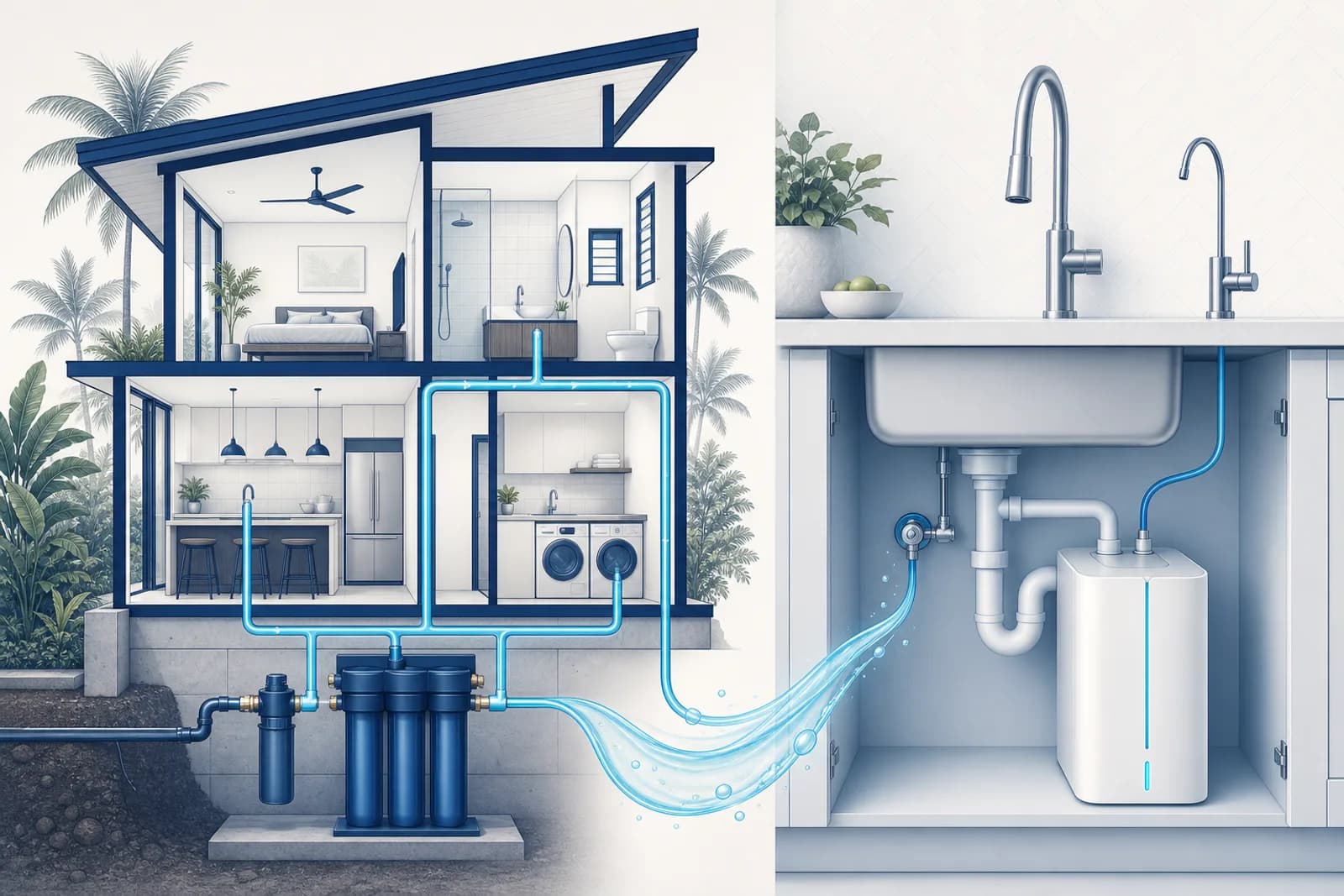
Treat water at the mains inlet — before it reaches every tap — or treat it only at the one tap where you drink. That choice defines the two approaches to home water quality, and getting it wrong is costly in either direction: overspend on whole-house coverage you do not need, or install a drinking-water filter while rust and sediment quietly damage your water heater, washing-machine seal, and shower head.
What the two approaches actually mean
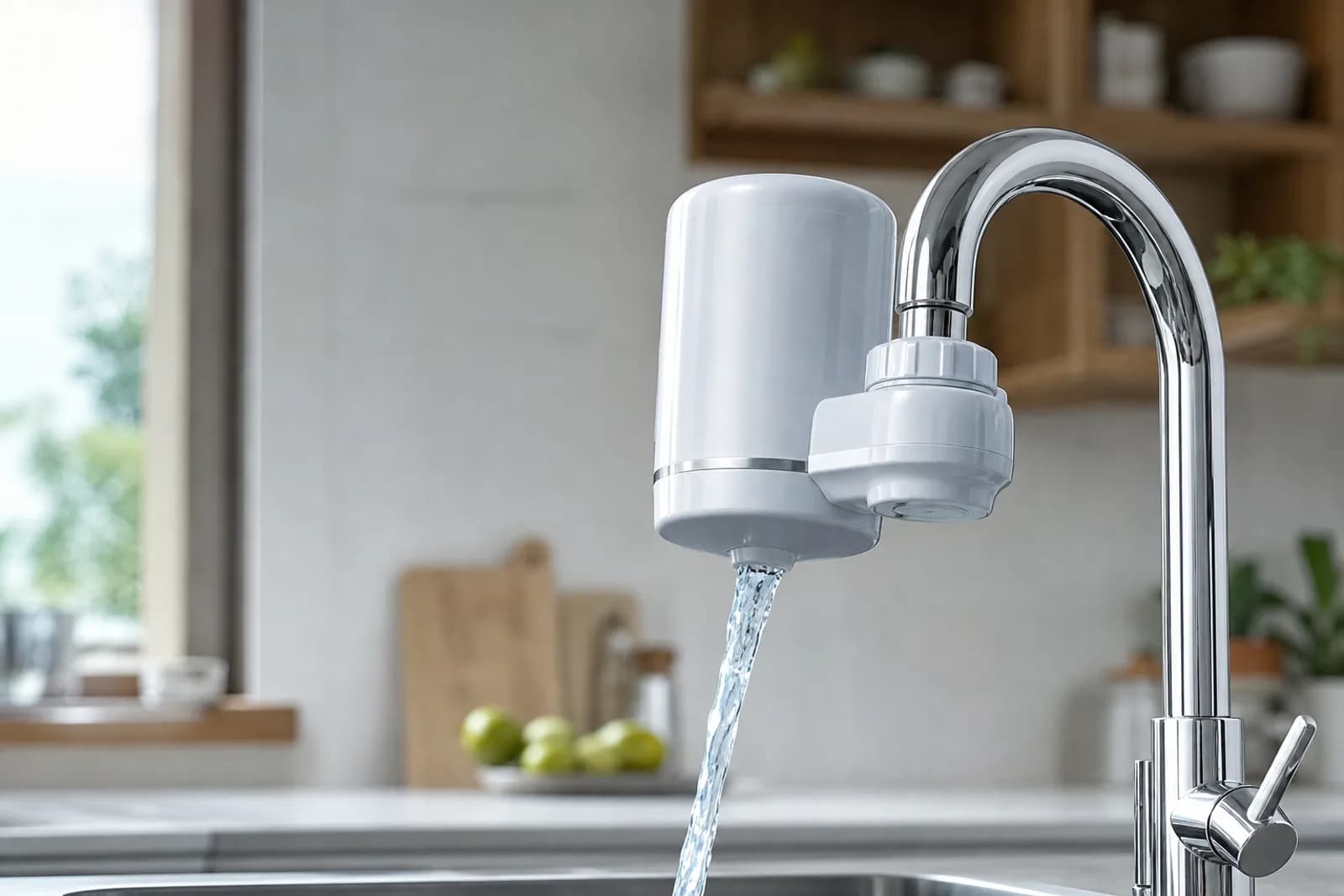
Point-of-use (POU) treatment sits at the final draw-off point: an under-sink RO unit below the kitchen sink, a countertop filter on the worktop, a faucet-mount filter. It treats only the water drawn from that specific tap. Bathrooms, the washing machine, and the water heater all receive untreated supply.
Point-of-entry (POE), or whole-house, treatment installs at the main water inlet before the supply branches to any fixture. Every litre entering the house passes through it first. It is also called a central purifier or whole-house filter, and it addresses water quality at every tap, appliance, and shower simultaneously.
Many homes end up using both: a central purifier at the inlet to protect appliances and pipes, and a dedicated RO under the kitchen sink where higher purity is needed for drinking and cooking.
When whole-house treatment is the right choice
In Indonesia, the most common whole-house problems are:
- Sediment and rust from ageing PDAM infrastructure. Distribution pipes in older city neighbourhoods shed rust particles and fine sediment that reach every tap. A pre-filter at the inlet catches these before they reach the water heater element, the washing-machine drum seal, and the shower head.
- Discolouration in sumur bor (borehole) water. Groundwater in many parts of Jakarta and coastal areas carries iron, manganese, and fine suspended solids that discolour laundry, stain bathroom tiles, and shorten appliance life. Point-of-entry treatment is far more practical than fitting individual filters at every tap.
- Saltwater intrusion into coastal aquifers. In northern Jakarta and other low-lying coastal areas, borehole water increasingly shows elevated TDS from saltwater intrusion. When the problem affects the entire supply, central treatment at the inlet is the logical response.
- Hard water and scale. Hard water — commonly reported in parts of West Java and East Java — builds scale on heating elements, taps, and tile grout throughout the house. A whole-house softener is the only practical answer; individual POU units do not protect the appliances behind them.
There is also a maintenance argument in larger homes: one service point covers the whole system instead of four or five separate cartridges on individual units.
When point-of-use treatment is the right choice
Where drinking-water purity is the goal, POU treatment is the sharper tool.
Reverse osmosis — the most thorough domestic filtration technology available — is not practical at whole-house scale in most Indonesian homes. The reject-water ratio, infrastructure cost, and flow rates required make large-scale RO prohibitively expensive for general household use. An under-sink RO sized for drinking and cooking costs a fraction as much and wastes far less water.
POU also handles microbiological risk more precisely. PDAM-treated water in Indonesian cities carries residual chlorine, which manages bacterial risk in the distribution system but cannot guarantee water quality at the tap after passing through building plumbing. A POU filter — RO or ultrafiltration — with a UV final stage provides a localised last line of defence at the point that matters: the water you drink.
For renters, POU is often the only practical option. A countertop RO or gravity UF filter requires no plumbing modification and moves with the tenant. A whole-house system is a property modification requiring the landlord's consent and significant installation cost.
Cost: how the numbers actually compare
Whole-house treatment has higher upfront cost and more complex installation. A central purifier requires a plumber to fit it at the main inlet with a bypass valve, pressure gauges, and isolation points. The installed cost will be meaningfully higher than a single POU unit. The trade-off is that you buy coverage for the entire house in one step.
POU treatment has a lower entry cost per unit, but the total compounds when you install multiple units — one in the kitchen, one in a second bathroom, one at the wet bar. By the third or fourth unit, the cumulative spend starts to approach whole-house costs, without the appliance-protection benefit.
Filter replacement follows a similar pattern. A whole-house central purifier rated at 150–300 tonnes of filter life — such as the Truliva SC-Q3210i — requires infrequent cartridge changes relative to the total volume processed, because it addresses sediment and general contamination rather than dissolved solids. An under-sink RO processes a much smaller volume but typically replaces multiple cartridges on a schedule that varies with usage and source water TDS — commonly quoted in manufacturer literature at roughly 6–12 months, though actual intervals depend on your supply. Neither is inherently expensive; they are different maintenance rhythms.
The SC-Q3210i in practice
The SC-Q3210i is a point-of-entry central purifier designed for residential installation at the main water inlet. It delivers 1.2–2.4 T/h of treated flow — comfortably covering simultaneous kitchen, bathroom, and laundry use in a typical Indonesian home — with a filter cartridge rated at 150–300 tonnes before replacement.
To put those numbers in context: at the upper end of its 300-tonne rating, a household drawing 1.5–2 tonnes per day could go well over a year between cartridge changes. At the 150-tonne lower bound — more typical with heavy sediment or borehole supply — changes would be more frequent. Actual intervals depend on source water quality and cannot be predicted precisely without knowing your supply.
The unit installs at point of entry (360 × 318 × 814 mm) and feeds every downstream fixture. It protects appliances, pipes, and fittings throughout the house, but is not a substitute for a dedicated drinking-water RO — it addresses particulate and general contamination at scale, not dissolved solids or microbiological risk at the final tap.
How to make the decision
Start with your source water and the problem you are actually trying to solve.
Sediment, rust, or turbidity at every fixture? Whole-house treatment at the inlet is the right first layer.
Drinking-water quality — dissolved contaminants, heavy metals, TDS above 200 ppm? A POU RO under the kitchen sink addresses this more cost-effectively and thoroughly than any whole-house system.
Groundwater with hardness, scale, or discolouration? Whole-house treatment is the only practical approach; the problem is in every litre entering the house.
For most Indonesian homes on PDAM supply, the practical answer is a two-layer system: a central purifier at the inlet to catch sediment and protect appliances, paired with an under-sink RO for drinking and cooking. Neither system has to do the other's job.
For borehole-dependent homes — still common in outer Jakarta, peri-urban areas, and provincial cities — the case for central treatment is stronger. Groundwater quality in Indonesia varies sharply by location and season, and a single point-of-entry system that brings the whole supply to a consistent standard simplifies everything downstream.
Flow rate: the one engineering check to do before you buy
Whole-house systems must handle peak simultaneous demand without a pressure drop that makes showers unsatisfying or washing machines slow to fill. A central purifier rated at 2.4 T/h handles a typical four-tap household without throttling the supply.
POU systems are sized for a single draw-off point. An under-sink RO rated at 600–1,000 GPD is more than adequate for drinking and cooking; it would be entirely inadequate as a whole-house solution.
Check your household's peak water consumption against the unit's rated throughput before committing to a purchase. It is a straightforward comparison and the single most useful sanity check in the process.
The short version
Whole-house and point-of-use treatment are not competing products. One protects the house and its appliances from the inlet in; the other delivers the highest purity at the tap where it matters most. The right choice follows from what your source water actually contains — not from a blanket preference for one approach over the other. In most Indonesian homes, the answer is both.
Not sure which system fits your water?
Aright Marketing Indonesia can assess your supply and recommend the right Truliva system for your home or business in Indonesia.