Choosing a Commercial and Office Water Purifier: Capacity, Hot/Cold, and Maintenance
How to choose a commercial or office water purifier in Indonesia: sizing by headcount, deciding between RO and UF, evaluating hot/cold dispensing, and setting up a filter maintenance schedule that holds.
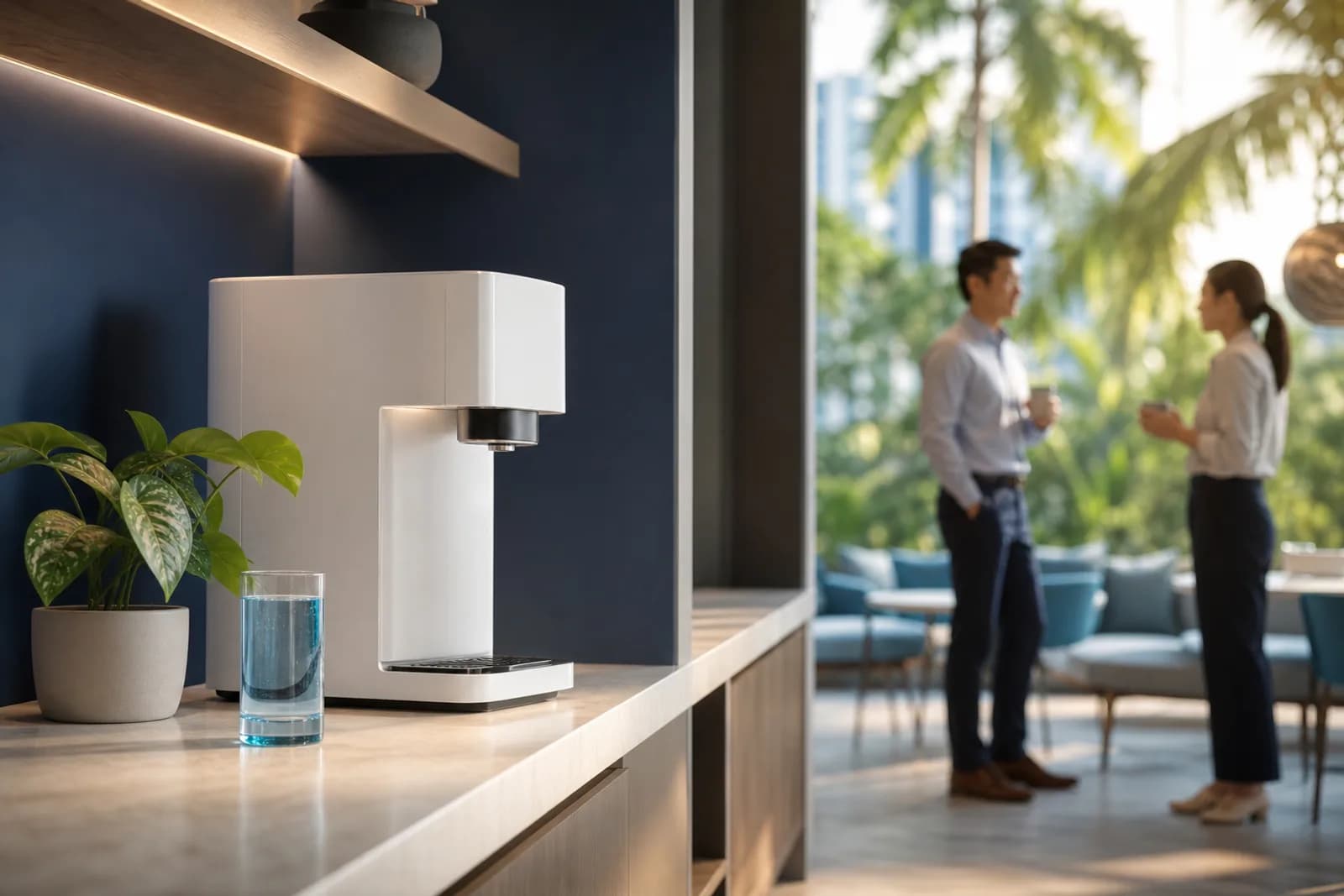
Most offices in Indonesia run on air galon. The five-gallon jug sits in a dispenser by the pantry, gets swapped every few days, and nobody thinks much about it — until someone does the maths. A 50-person office consuming 2 litres per person per day needs 100 litres daily: roughly 20 galon jugs a week. Add delivery logistics, storage space, variable refill-depot quality, and the single-use plastic question, and the economics of a permanent purification system look different from month two onwards.
This guide covers the decisions that matter when specifying a water purifier for a commercial or office setting: how much output you need, whether hot/cold dispensing makes sense, what your source water demands, and how to build a maintenance schedule that survives staff turnover.
Calculate capacity before you look at products
The most common mistake in commercial purifier selection is sizing by the machine's GPD or litre-per-minute rating without connecting it to real consumption.
A widely used rule of thumb: plan for 2–3 litres per person per working day for drinking and hot-beverage use. A 30-person office lands around 60–90 litres a day; 100 people, 200–300 litres. These figures scale if you have a café function, a commercial kitchen, or a server-room cooling loop — but for a standard pantry, the range holds.
Flow rate matters separately from daily output. A system rated at 2 L/min sounds fast until you picture the morning coffee queue: five people waiting 90 seconds each. For a single-point pantry serving up to roughly 30–50 people, 2 L/min is workable. For larger headcounts or high-traffic serving points, 5 L/min or above avoids the queue problem entirely.
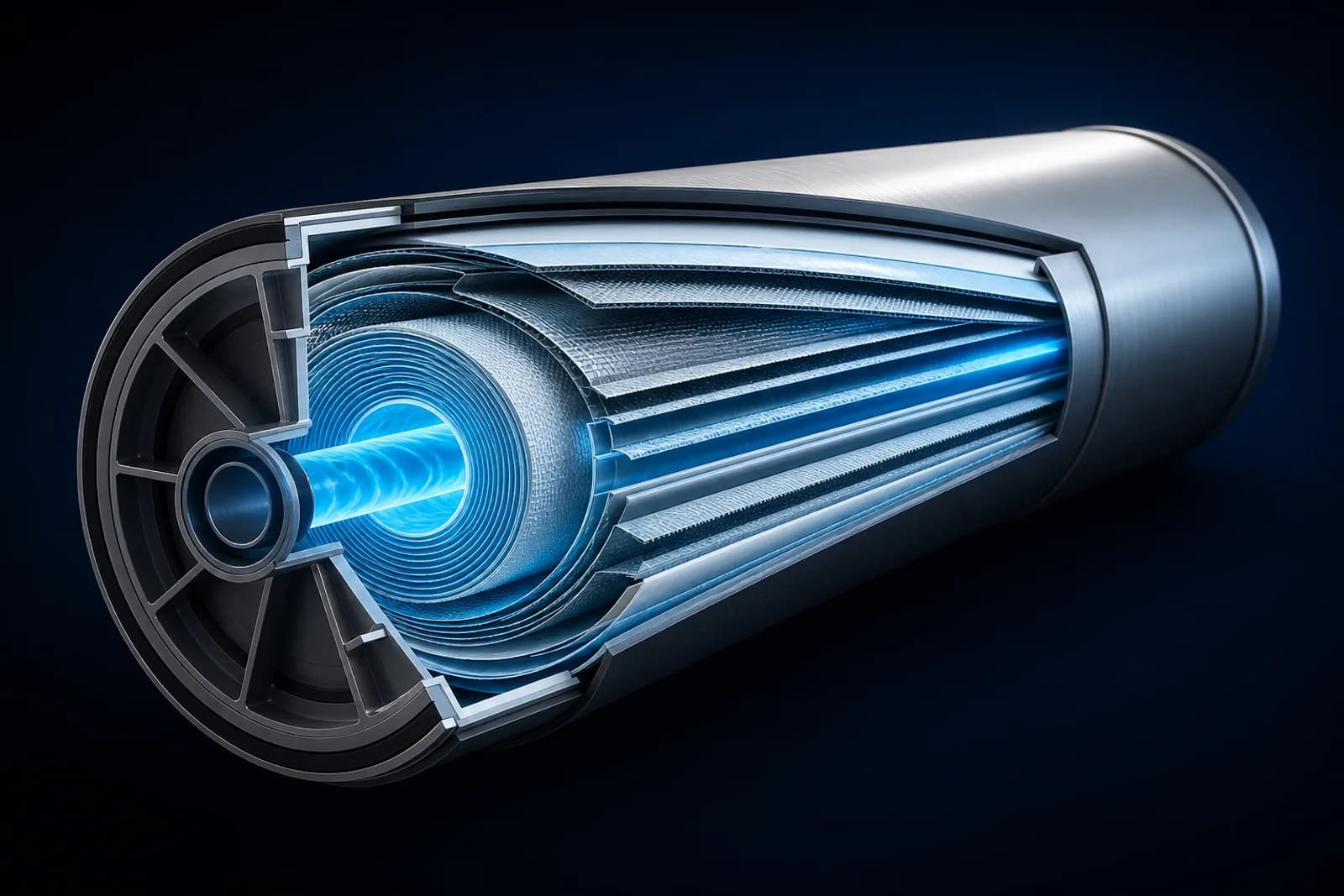
The QS-ZRW-L58 — Truliva's floor-standing commercial RO — runs at a constant 2 L/min through a five-stage path (PP / PGP / CTO / RO / CTO), with a rated cartridge capacity of 8,000 litres before filter replacement. At 100 litres per working day, that is roughly 80 working days of throughput per filter cycle — a reasonable match for quarterly servicing. Footprint: 580 × 530 × 1,730 mm, about the floor area of a large filing cabinet.
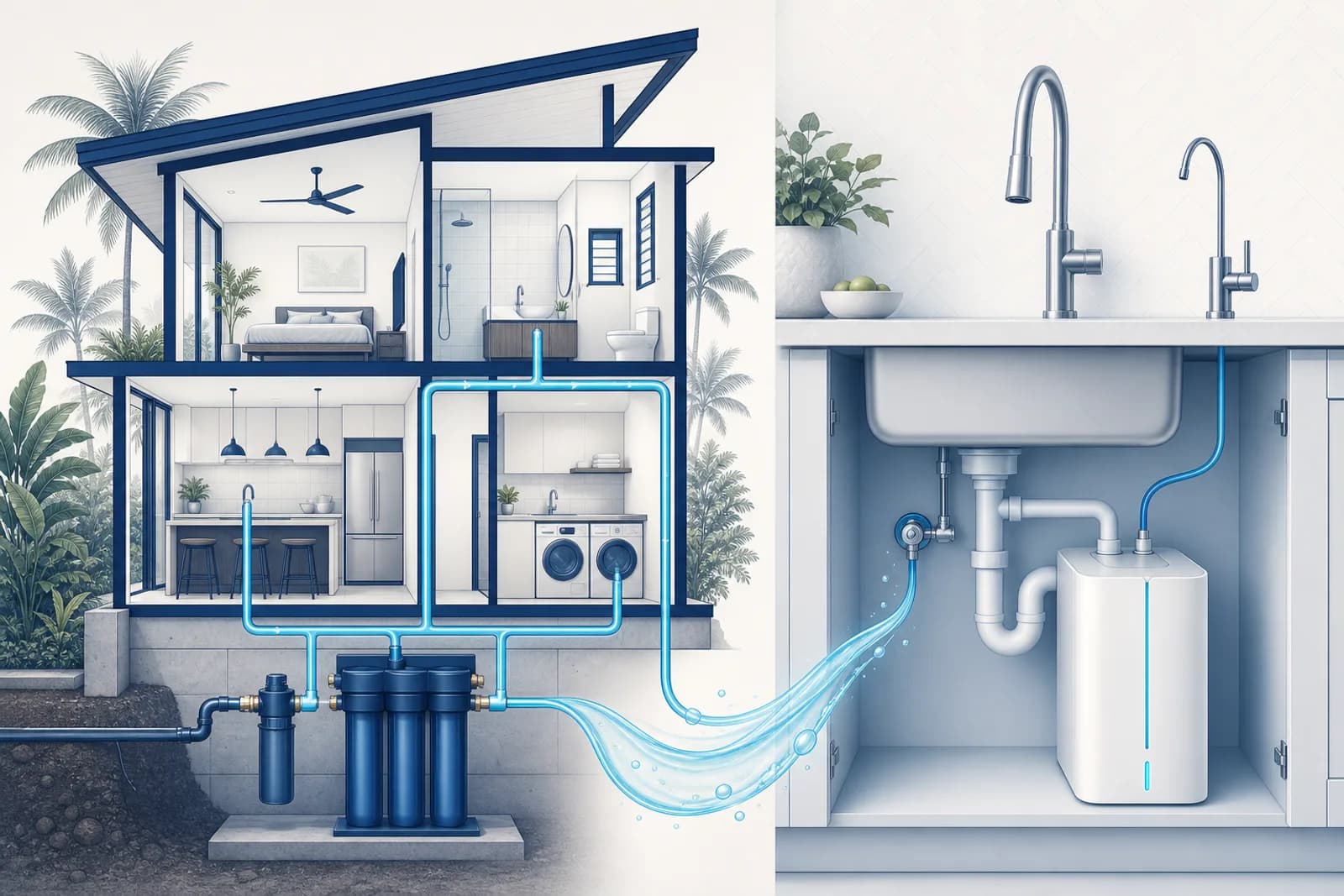
Where flow rate takes priority over RO-level dissolved solids removal, the QS-U3-BK300-13 offers a different profile: a three-cartridge under-counter ultrafiltration system (PP / CTO / UF) rated at 5.5 L/min constant flow and 6,000 litres per filter cycle. UF removes bacteria and particulates while retaining dissolved minerals — well-suited to offices on reliable PDAM supply where TDS is not a concern but throughput is. Compact under-counter form factor (420 × 142 × 468 mm) leaves the serving area clear.
RO or UF: the source water decides
The choice between reverse osmosis and ultrafiltration is not about brand preference — it is determined by what is in your water.
RO membranes reject dissolved salts, heavy metals, and virtually all dissolved organic load. They are the right technology when TDS is elevated, when supply comes from a borehole (sumur bor), or when the building sits in a coastal area where saltwater intrusion is a documented issue. Jakarta's northern districts and much of the coastal belt around Surabaya, Semarang, and Makassar face this intermittently. A TDS reading above roughly 300–400 ppm in your tap or borehole supply is a commonly used practitioner signal to consider RO; above roughly 500 ppm, RO becomes hard to avoid if consistent water quality is the goal. These thresholds are approximate guides, not regulatory limits — treat them as starting points for your own measurement.
PDAM piped supply in most Indonesian cities meets a microbial standard but not a dissolved-solids one. TDS varies by city and by the age of the building's internal pipework. Where TDS is moderate and the principal concern is bacteria, residual chlorine, and sediment from aging plumbing, UF with a pre-carbon stage handles the job adequately and at higher flow rates than most commercial RO units.
The practical test: measure tap TDS with an inexpensive inline meter, and commission a heavy-metals test if the building is more than 15–20 years old or if the supply source is unclear. A 10-minute reading beats months of uncertainty.
Hot and cold dispensing: practical rather than aspirational
Hot-and-cold capability is almost always worth specifying for office use, and the reason is behavioural as much as practical. Offices with hot water at the purifier see higher uptake versus galon alternatives: staff can make instant coffee and tea without a separate kettle. A purifier people actually use replaces galon dependence; one that gets ignored does not.
The questions worth asking before specifying hot/cold are:
What heating technology? Instant-heat systems use a small reservoir that heats water on demand; tank-style systems maintain a hot reservoir. In commercial settings with sustained demand, a properly sized tank system avoids the wait between pours. Instant-heat units are better suited to lower-demand pantries where the queue is short.
What temperature range? Most office use cases — coffee, instant noodles, powdered drinks — require water at 85–95°C. Verify the rated output temperature under load, not the peak specification. Some systems quote a maximum temperature that the unit reaches only under low-flow conditions.
Cooling method? Compressor cooling reaches genuinely cold water — typically in the 5–10°C range — and holds that temperature under repeated dispenses. Thermoelectric (Peltier) cooling costs less but generally brings water down to only around 12–15°C in a tropical ambient environment, a ceiling that is noticeable in Jakarta pantries where ambient temperatures commonly sit at 28–32°C without dedicated aircon. This is a generalisation across Peltier-type dispensers in that temperature band; actual performance varies by unit and ventilation. For offices where cold water uptake matters, compressor cooling is worth the premium.
Power and ventilation? A compressor-cooled, instant-hot commercial unit typically draws somewhere in the 800 W–1.5 kW range under load — this is a category generalisation, not a rated figure for a specific model, so verify the actual specification before circuit planning. The QS-ZRW-L58 floor-standing unit is a standalone RO with ambient-temperature output; pairing it with a separate hot/cold dispenser module downstream is the standard configuration for this category.
Building infrastructure: what to check before installation
An office purifier installation is a minor plumbing and electrical job, but the pre-work prevents most commissioning problems.
Feed water pressure. PDAM supply in most Indonesian cities nominally delivers around 0.1–0.3 MPa (1–3 bar) at the building inlet — a corridor figure for local conditions, not a guaranteed minimum. Pressure at an upper-floor pantry tap can be lower, sometimes below 0.1 MPa during peak-demand hours. RO systems typically require 0.2–0.5 MPa at the feed port; below this, output flow drops and the reject ratio worsens. Commercial RO units usually include a booster pump to compensate, but confirming actual tap pressure at the installation point with a simple pressure gauge saves surprises.
Drain access. RO systems produce a concentrate stream — roughly one to two litres to drain per litre of product water, depending on recovery design; see the unit's own specification for the exact ratio. Commercial units require a nearby floor drain or connection into the building waste line. Under-counter UF systems like the QS-U3-BK300-13 produce no drain water at all, which simplifies installation in pantries without direct drain access.
Electrical supply. A dedicated 10-amp circuit with a ground-fault outlet is the minimum for a system combining RO filtration with heating or cooling. Do not run a commercial purifier off an extension strip shared with other appliances.
Inlet water quality. If the building uses a ground-floor header tank (tangki penampung), check when it was last cleaned. Tanks that sit for weeks accumulate sediment and can introduce bacteria that an under-counter purifier must then handle. A whole-building pre-filter at the inlet, or at minimum a sediment pre-stage on the purifier feed line, protects the unit's internal cartridges from heavy sediment loads.
Maintenance: the part that actually determines total cost of ownership
Filter replacement is where commercial purifier economics are most often miscalculated. The machine cost is visible; the servicing cost over three to five years is frequently underestimated.
Both Truliva commercial units have defined cartridge capacities — 8,000 litres for the QS-ZRW-L58 and 6,000 litres for the QS-U3-BK300-13. At 100 litres per working day, those figures translate to roughly 80 and 60 working days of service respectively before the filter set reaches its rated throughput. In practice, filter replacement intervals are commonly set by time (quarterly or bi-annual) rather than by counted litres, because most installations do not have a litre counter. The conservative approach is quarterly replacement for high-traffic commercial settings; the performance-based approach is to measure TDS and flow rate monthly and replace when either degrades measurably.
A few maintenance principles worth building into any commercial deployment:
Pre-stage protects the RO membrane. On the QS-ZRW-L58's five-stage sequence (PP / PGP / CTO / RO / CTO), the PP sediment and CTO carbon stages upstream of the membrane do the protective work. Letting those stages exhaust before replacement sends sediment and residual chlorine into the RO membrane, which degrades much faster and costs substantially more to replace than a cartridge. Replace pre-stages on schedule; do not wait for visible output degradation.
Sanitise the dispenser and housing. Internal wetted surfaces, dispensing nozzles, and tap fittings accumulate biofilm over time even with filtered water flowing through them. A quarterly wipe-down of external surfaces and a periodic internal sanitisation cycle (following the manufacturer's procedure) keeps microbial counts low.
Document service dates. Offices change facilities staff. A physical log on the unit and a calendar reminder in the facilities management system means the replacement schedule survives personnel turnover, which is the most common reason commercial purifiers are serviced 18 months late.
Budget forward. Cartridge costs vary by model and supplier. As a rough planning figure, commercial filter sets in Indonesia have generally been available in the Rp 300,000–Rp 800,000 range per replacement cycle, plus technician time under a service contract; pricing shifts with supply and model, so treat this as an order-of-magnitude input rather than a quote. Build the full servicing cost into a three-year total cost of ownership comparison with galon delivery — at most headcounts, the installed purifier wins on cost per litre from year two onwards even after scheduled maintenance.
Matching the brief to the building
The decision tree is not complicated once you have the numbers.
High headcount, F&B or kitchen use, borehole or coastal supply, or tap TDS above the 300–400 ppm range: a floor-standing RO sized to daily volume is the right starting point. The QS-ZRW-L58 fits this profile.
Moderate headcount on reliable PDAM supply, under-counter installation required, or peak flow rate the priority: commercial UF is the simpler, lower-footprint answer. The QS-U3-BK300-13 at 5.5 L/min handles a busy pantry without drain infrastructure.
In both cases, the decision that most determines two-year performance is not the machine itself — it is committing to a documented maintenance schedule at the point of purchase, not as an afterthought six months later.
Not sure which system fits your water?
Aright Marketing Indonesia can assess your supply and recommend the right Truliva system for your home or business in Indonesia.