Water Quality in Bali: A Practical Guide for Homeowners and Villa Operators
Bali's water picture varies enormously by location and source — from coastal borehole salinity to agricultural contamination. Here is how to assess what you have and choose treatment that actually fits.

Bali's water supply has not kept pace with its growth. The island draws millions of visitors a year, and the southern tourism belt — Kuta, Seminyak, Canggu, Uluwatu — has expanded fast enough to put serious pressure on the groundwater beneath it. If you own, rent, or operate property here, what comes out of the tap is not a minor detail. It shapes guest health, appliance life, and plumbing longevity.
How Bali's water actually reaches most properties
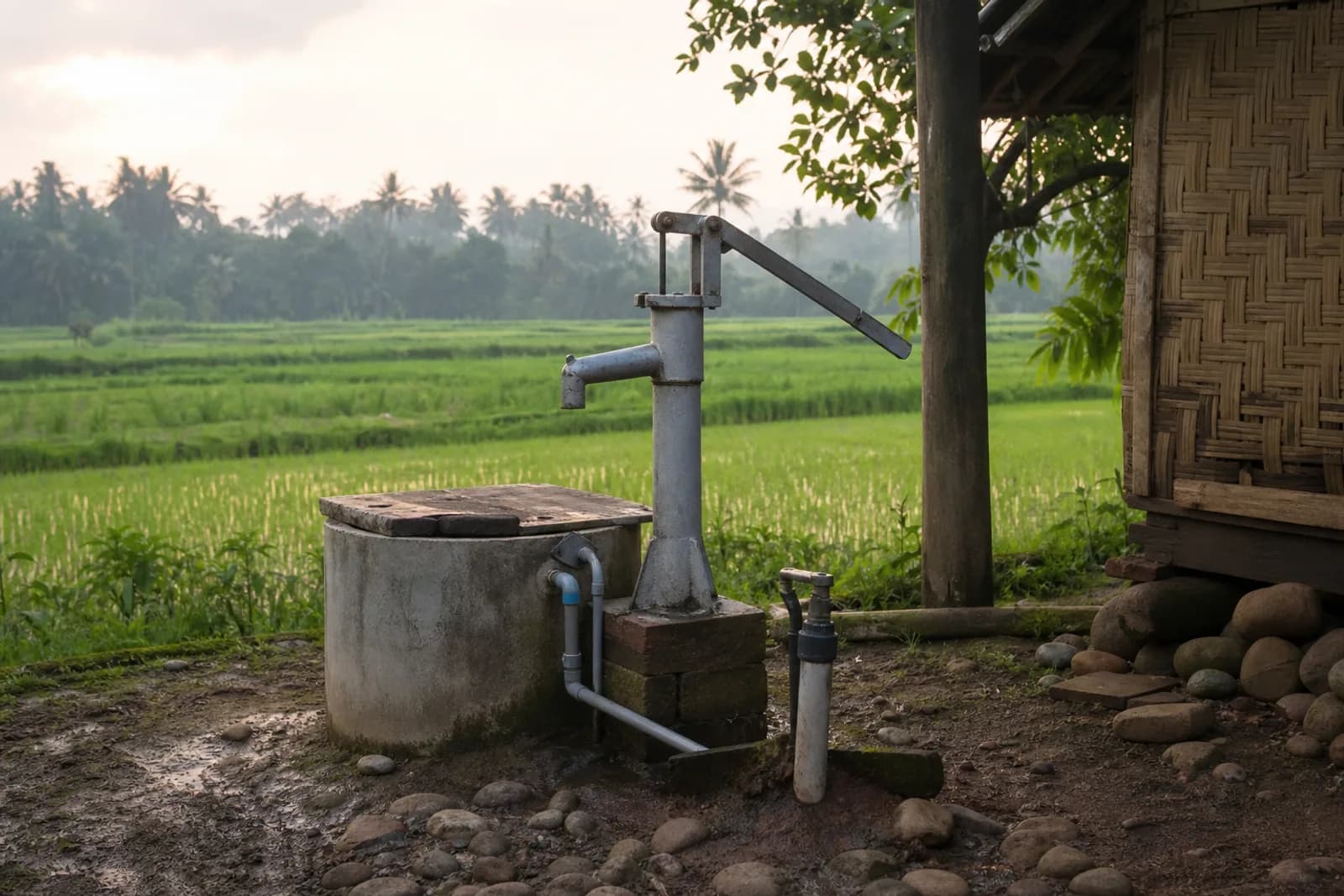
Outside a handful of urban areas, Bali lacks the widespread piped municipal supply that major Indonesian cities depend on. PDAM coverage exists in parts of Denpasar and reaches some built-up areas, but it is patchy and reliability varies. So a large share of villas, guesthouses, and private homes — especially in the fast-developing western and southern coastal areas — rely on one of three sources: a private borehole (sumur bor), water tanker delivery, or both when the borehole runs low or tests poorly.
This matters because each source carries different risks, and two neighbouring properties on the same street can have noticeably different water. There is no single answer for Bali water. There is only an answer for your water.
The specific pressures on Bali's groundwater
Heavy extraction is the central problem. Tourism infrastructure — hotels, villas, spas, laundries, restaurants — places continuous demand on the aquifer, and that demand concentrates in the south. Where an agricultural region uses water seasonally, the tourism belt draws it year-round. Wet-season recharge cannot fully compensate, and the water table in some areas is commonly reported to have dropped over recent decades, though specific figures vary by location and study.
Two consequences follow, and both matter to every property owner.
Saltwater intrusion in coastal areas. The mechanism that affects North Jakarta also operates in Bali's coastal south. Where heavy extraction lowers the freshwater table, the denser saltwater wedge from the ocean moves inland to fill the gap. Boreholes in lower-lying coastal areas near Kuta, parts of Seminyak, and sections of the Bukit Peninsula around Uluwatu and Jimbaran are commonly reported to yield brackish or saline water — high TDS (total dissolved solids), a salty or mineral taste, and corrosion on copper fittings and appliances. Severity depends on how close the borehole is to the coast and how deep it reaches. A neighbour's borehole 200 metres inland may produce far better water than yours. The only way to know is to measure.
Contamination in dense or agricultural zones. Canggu and the surrounding north-west of the tourism corridor sit among rice paddies and increasingly dense residential development. Shallow wells in this kind of landscape face contamination risk from agricultural runoff — pesticides and fertilisers — and from septic systems where there is no proper sewage infrastructure. This contamination is not always visible. Water can look and smell clean while carrying a bacterial load or dissolved chemical residues.
What tanker water actually is
Tanker delivery (air tanker) is a practical fallback for many properties, but it is not a quality guarantee. Tanker suppliers in Bali draw from various sources — sometimes PDAM, sometimes private wells, sometimes dedicated processing facilities. The treatment applied, if any, is usually not disclosed or independently verified. Container hygiene matters too: trucks that are not cleaned regularly accumulate biofilm. A villa that relies entirely on tanker water and stores it in a rooftop tank, without UV treatment or chlorination, adds another variable between source and tap.
Hardness and scale: a problem beyond taste
Parts of Bali, particularly areas with limestone geology, have naturally hard water — high in calcium and magnesium. Hard water is not a direct health hazard, but it has practical consequences. Scale builds up on heating elements, in instant water heaters, and inside pipes. It shortens appliance life and reduces heating efficiency. For villa operators who replace water heaters and washing machines sooner than expected, hardness is often the cause, even when the water tests acceptable on other parameters.
A basic hardness test or TDS reading will flag this. Very hard water that otherwise tests clean may warrant a water softener upstream of the hot water system, separate from any drinking water treatment.
What to test and why testing first matters
The single most useful thing any homeowner or villa operator can do is take a baseline measurement before choosing equipment. A handheld TDS meter — around Rp 50,000–150,000 at electronics retailers or online — gives an immediate dissolved-solids reading. It is not a complete water test, but it is a fast indicator:
- Below 300 ppm: generally indicates a reasonably low dissolved-solids load; treatment focus is more likely on microbiology and taste
- 300–800 ppm: elevated; worth investigating the source, particularly salinity versus mineral hardness
- Above 800 ppm: significant dissolved solids; on coastal boreholes, suspect saltwater intrusion; RO is almost certainly the right treatment for the drinking water supply
For a fuller picture, a basic laboratory panel covering bacteria (E. coli and total coliforms), turbidity, hardness, and key ions tells you whether the problem is microbial, chemical, or both. Several Bali-based water testing services offer this, and international laboratories operating in Indonesia can also process samples. The cost is modest relative to a treatment system, and it prevents buying a UF system for a salinity problem, or an RO unit for a source that only needed a carbon block.
Matching treatment to the actual problem
Given the variety of sources and conditions across Bali, there is no single correct answer. The logic is:
High TDS / coastal borehole with salinity: reverse osmosis. RO is the only household technology that removes dissolved salt and ions at scale. Mechanical filters — sediment cartridges, activated carbon blocks, even ultrafiltration membranes — cannot reduce dissolved ions, however fine their pore size. Dissolved salt exists at molecular scale, far smaller than any UF pore. If your borehole tests above 500–800 ppm with a saline character, the drinking and cooking supply needs RO. An under-sink RO unit on the kitchen supply is the most practical format for most properties.
Microbiological concern on a lower-TDS source: UF plus carbon. If your source water is not saline but carries microbial risk — dense neighbourhood, shallow well, agricultural surroundings — ultrafiltration removes bacteria, viruses, and suspended particles while keeping the water's natural mineral content. A carbon stage upstream removes chlorine taste if the source has been treated; a carbon or KDF stage downstream improves flavour. This suits properties on PDAM supply or deeper inland boreholes that test well on dissolved solids but still warrant a microbiological barrier.
Turbid, sediment-heavy well water: pre-filtration first. Any borehole that runs cloudy after rain, or when the pump starts, needs sediment pre-filtration before anything else. Sending turbid water straight to a carbon block or RO membrane clogs cartridges fast and shortens membrane life. A 10–20 micron sediment filter upstream protects everything after it, cuts cartridge replacement costs, and is the first step in any well-water treatment train.
Hard but otherwise clean water: softening or scale inhibition. For properties with known hardness but acceptable TDS and no salinity, a water softener on the hot water line, or a scale inhibitor on the whole-property supply, addresses the appliance and plumbing problem without running RO across the entire property.
Most properties in the southern tourism belt need a combination: a sediment pre-filter protecting an RO stage for drinking and cooking, plus a whole-property sediment filter protecting the plumbing.
Villa operators: the guest dimension
A private homeowner can set their own tolerance for water quality. A villa operator cannot. Guests who fall ill during a stay — whatever the real cause — associate it with the property, and online reviews say so directly. For any villa above budget accommodation, every guest-facing tap should produce water safe to drink and free of obvious taste problems.
This does not mean RO at every tap. A practical setup is RO or well-maintained UF at all drinking, cooking, and ice points, a sediment filter protecting the whole property, and UV disinfection on the rooftop tank if the property uses tanker delivery and gravity storage. The cost is proportionate to any serious villa budget, and the alternative — a single bad review citing sick guests — costs more.
The starting point is simple
Bali's water is neither uniformly bad nor uniformly safe. It varies by location, depth, season, and how heavily the surrounding area draws on the same aquifer. A property in Ubud on a deep well may produce excellent water. A beachside villa in Canggu may be drawing brackish water at a high TDS reading. Neither assumption is safe without evidence.
Measure first. A TDS reading and, where warranted, a basic laboratory test tell you what category of problem you have. From there, the treatment choice follows. The common mistake is buying a filter on marketing claims rather than on what the water actually contains — then finding out six months later that it solves a different problem entirely.
Clean water at every tap is achievable for any property in Bali. It just requires knowing your source before you treat it.
Not sure which system fits your water?
Aright Marketing Indonesia can assess your supply and recommend the right Truliva system for your home or business in Indonesia.