Water Hardness and Scale: What They Are and Why They Matter
Water hardness — calcium and magnesium dissolved in your supply — is the root cause of limescale on heating elements, taps, and appliances. This article explains the chemistry, the damage, and what to do about it in an Indonesian household.
Hard water does not look different from soft water. It does not smell different and, in moderate concentrations, it does not taste noticeably different. The damage it causes is slow and cumulative: a water heater that needs replacing after four years instead of ten, a shower head that drips unevenly, a kettle element coated in chalky crust. Understanding where that damage comes from — and where it is actually a problem in Indonesian households — makes it much easier to decide whether you need to do anything about it.
What hardness measures
Water hardness is a measure of dissolved calcium and magnesium ions. Both are alkaline-earth metals that dissolve readily when water moves through limestone, chalk, or dolomite formations. The harder the geology, the more of these ions the water picks up along the way.
Hardness is commonly reported in one of three units depending on the country and the testing equipment:
- mg/L or ppm (parts per million): the most common unit in laboratory reports and consumer test kits. One ppm equals one milligram of calcium carbonate equivalent per litre.
- dH (German degrees): frequently seen on European softener specs; 1 °dH ≈ 17.8 ppm.
- gpg (grains per gallon): used in American product literature; 1 gpg ≈ 17.1 ppm.
As a general guide, water below roughly 60 ppm is considered soft, 60–120 ppm moderately hard, 120–180 ppm hard, and above 180 ppm very hard — though these thresholds vary slightly between classification systems.
Where the calcium and magnesium come from in Indonesia
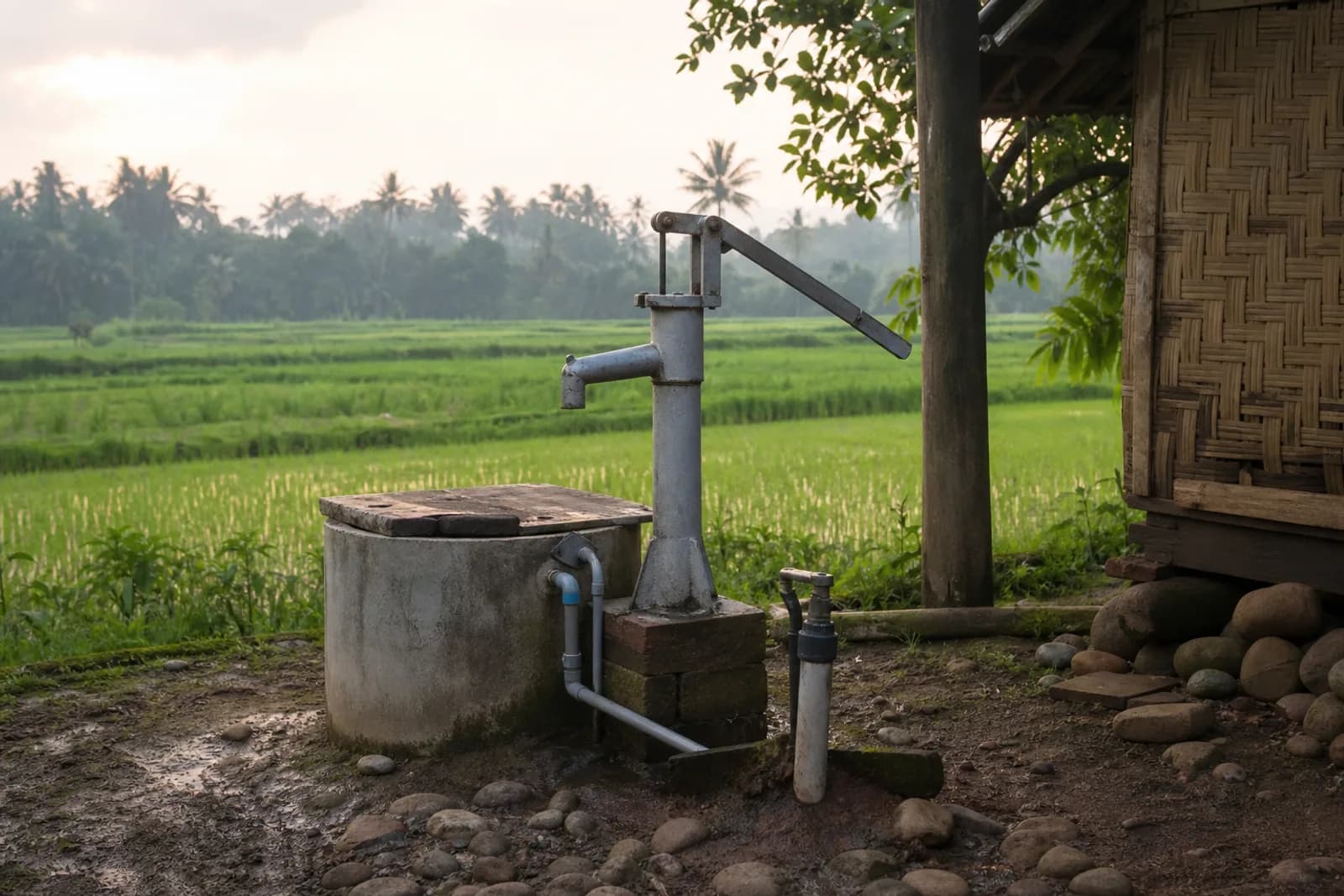
Indonesia's geology is varied, and hardness levels in Indonesian water supplies reflect that. Groundwater drilled from limestone-bearing formations — common in parts of Java, Sulawesi, and the Nusa Tenggara islands — can be moderately to very hard. Borehole water (sumur bor) in coastal areas carries an additional complication: saltwater intrusion adds sodium and other dissolved solids on top of whatever hardness is already present from the local rock.
PDAM piped supply is generally treated and, in most major cities, sits in the low-to-moderate hardness range. But PDAM water reaches the tap only after passing through aging distribution pipes that may add rust and sediment; hardness is the least of many concerns in older networks. Households in peri-urban and rural areas relying on private boreholes are more likely to encounter genuinely hard water, particularly if the local geology includes significant carbonate formations.
The only reliable way to know your actual hardness is to test. Basic hardness test strips — available at aquarium shops and water filter dealers — will give a rough reading. A laboratory water test provides a full mineral profile when precision matters.
How scale forms
Calcium and magnesium stay dissolved in water without trouble at ambient temperatures. The problem begins when water is heated.
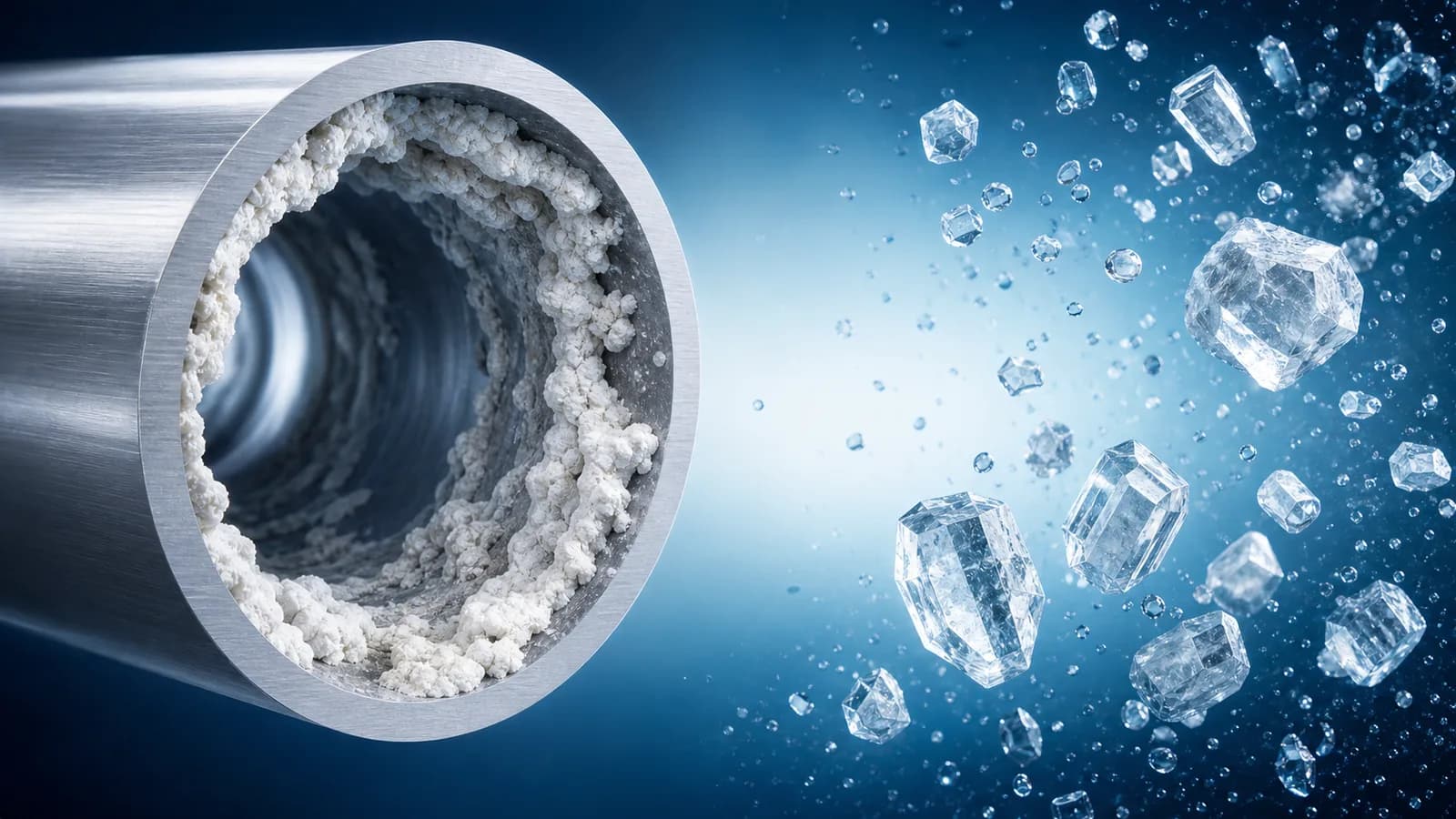
Calcium bicarbonate — the form in which calcium most commonly travels dissolved in water — is relatively soluble in cold water. When the water is heated, the bicarbonate ion breaks down, releasing carbon dioxide and converting the calcium into calcium carbonate, which is far less soluble. Because the calcium carbonate has nowhere to go in liquid form, it precipitates as a solid and deposits on whatever surface it encounters first: a heating element, the inner wall of a pipe, a tap aerator, a shower head nozzle.
This is called temporary hardness, and it is the dominant mechanism behind most household scale. There is also permanent hardness, caused by calcium and magnesium sulphates and chlorides, which do not precipitate on heating in the same way — but these compounds contribute to the overall dissolved-mineral load and can deposit under evaporation conditions, such as on taps and countertops.
The result in both cases is a hard, white-to-yellowish crust. Its formal name is calcium carbonate scale, though in everyday use it is called limescale, mineral scale, or simply kerak air in Indonesian.
Where scale causes real damage
Water heaters and boilers. This is where hard water does the most expensive damage. Electric heating elements (pemanas air listrik) transfer heat efficiently to surrounding water when clean. Scale is a thermal insulator: as deposits build up, the element runs hotter and draws more electricity to deliver the same output, and fails earlier than its rated life. In a hard-water area, accumulation inside a daily-use tank can become significant within a year or two.
Kettles and beverage appliances. The same chemistry applies at smaller scale. A kettle element coated in carbonate deposits boils more slowly and draws more power. Coffee and tea machines with narrow heating tubes are particularly susceptible — scale blockages are a common cause of failure.
Shower heads and tap aerators. Calcium carbonate blocks the nozzle holes in shower heads, producing uneven spray. Tap aerators trap scale and sediment together, reducing flow and harbouring bacteria. Both are cheap to replace but inconvenient when they need replacing frequently.
Washing machines. Hard water reacts with soap, forming insoluble calcium-soap compounds that reduce lathering and leave grey residue on laundry. Commonly reported figures suggest hard-water households may use significantly more detergent to achieve equivalent wash results, though the amount depends on water temperature, detergent type, and actual hardness level.
What hardness does not do
Hard water is not a health hazard. Calcium and magnesium are nutritional minerals, and modest amounts dissolved in drinking water are considered harmless by health authorities. The World Health Organisation has no guideline value for water hardness, finding no evidence of adverse health effects within the ranges encountered in normal drinking water. Some research points to a weak inverse association between cardiovascular health outcomes and drinking-water calcium content, though this is not established to a level that drives public health recommendations.
The problem with hard water is mechanical and economic — not biological.
Measuring hardness: what TDS tells you and what it does not
A TDS meter measures the total concentration of all dissolved solids in water. Calcium and magnesium contribute to TDS, so very hard water will tend to read higher on a TDS meter than soft water from the same source. But TDS is not a hardness measurement. High TDS can reflect elevated sodium, chloride, sulphates, or any number of other dissolved minerals, not necessarily calcium and magnesium. Low TDS does not guarantee soft water if other dissolved solids are low but hardness minerals are present.
For hardness specifically, use a purpose-made hardness test — either a drip-titration kit or test strips graduated in ppm or dH. TDS is a useful first screening tool, but it cannot substitute for a hardness-specific reading if you are trying to size a softener or diagnose scale problems.
What can be done about it
Water softeners are the standard whole-house solution. A conventional ion-exchange softener passes hard water through a bed of resin beads charged with sodium ions. Calcium and magnesium ions have a stronger affinity for the resin, so they bind to it and release sodium in their place. The resin must be regenerated periodically with a salt brine flush — an ongoing cost in water and salt, but one that protects every appliance downstream.
The Truliva Whole-House Softener (SS-Q3110i / SS-Q3210i) is designed for point-of-entry installation, bringing output hardness below 30 ppm at flow rates up to 2 T/h with a rated resin life of 5,000 to 10,000 tonnes. Installed at the mains, it protects every appliance and tap in the household — not just the drinking outlet.
Descaling agents — citric acid, acetic acid, commercial descalers — dissolve existing deposits and are the standard approach for appliance maintenance. They address the symptom rather than the source, so in a hard-water household they need to be applied on a regular schedule.
Reverse osmosis at the drinking tap removes virtually all calcium and magnesium in the product water, solving the hardness problem for drinking and cooking. It does not protect the water heater, washing machine, or any other appliance on the same supply — those still receive unsoftened water.
Starting point for Indonesian households
If you refill air galon from a depot, hardness is unlikely to be your concern — treated refill water is typically soft. If you are on PDAM supply in a major city, moderate hardness is possible but rarely severe enough to warrant action before testing. If you are on borehole water in an area with limestone geology or coastal saltwater intrusion — and you are already seeing white deposits on taps, early appliance failures, or poor soap lathering — a hardness test is the sensible first move.
Hardness test strips from an aquarium or filter dealer (generally under Rp 50.000) give a working reading. The number tells you whether scale is likely to cause real ongoing damage, and whether investing in a softener makes economic sense against the cumulative cost of descaling and premature appliance replacement.
Not sure which system fits your water?
Aright Marketing Indonesia can assess your supply and recommend the right Truliva system for your home or business in Indonesia.