Microplastics in Drinking Water: What the Evidence Says and How Filtration Helps
Microplastics turn up in tap water, bottled water, and air galon refills. Here is what they are, how they get into your water, what the current health research actually shows, and which filter technologies physically exclude them.

Microplastics have been detected in drinking water sources on every continent, including in bottled water and in tap water drawn from treated municipal supplies. That much is established. What remains unsettled is what, if anything, that means for human health at the concentrations typically found in drinking water. This article covers both: the physical reality of plastic particles in water, the honest state of the health evidence, and the filtration approaches that remove them.
What microplastics and nanoplastics are
Microplastics are solid plastic fragments smaller than 5 millimetres and larger than 1 micron (0.001 mm). Below 1 micron — down to the nanometre range — they are called nanoplastics. The size distinction matters for filtration: a 5 mm fragment is visible to the naked eye; a 1-micron particle is roughly the same scale as a bacterium; a nanoplastic particle smaller than 100 nanometres is closer in size to a large virus.
Both categories are fragments of larger plastic materials rather than anything manufactured at those scales. They carry the same polymer chemistry as the material they came from — polyethylene, polypropylene, polystyrene, PET — and may also carry surface-adsorbed contaminants such as plasticisers, colourants, or environmental chemicals picked up over time.
How they enter drinking water
The routes are multiple, and they differ depending on your source.
Environmental degradation. Plastic objects exposed to UV light, mechanical abrasion, and weathering fragment progressively over years. Rivers that run through heavily littered catchments — including many urban waterways in Java and Sumatra — carry a measurable load of plastic fragments into reservoirs and groundwater recharge zones. Indonesia's rivers handle an extraordinarily high volume of plastic waste relative to collection infrastructure, which means raw source water for municipal treatment plants can carry a significant particle load before treatment begins.
Distribution and storage. Even water that leaves a treatment plant in acceptable condition can pick up particles in transit. Older PVC distribution pipes shed material as they age. Storage tanks lined with certain plastics, or plastic fittings at the household level, contribute smaller quantities. The amount is generally lower than what enters from the source, but it is not zero.
Plastic packaging itself. This is the most direct route, and the one most relevant to daily consumption in Indonesia. Studies of commercially bottled water — including large-format galon bottles — have consistently detected microplastic particles, and the concentrations reported for bottled water are, in some analyses, higher than those for tap water from the same region. The particles are thought to come from the packaging itself: the bottle neck, cap, and dispenser components all shed small quantities when handled and filled. Each time a galon is loaded onto a dispenser, the pressure mechanism produces some particle abrasion.
Water dispensers and refill stations. Air galon refill stations — the network of small kiosks that produce filtered water for retail in returned bottles — vary considerably in what their filtration achieves. A station running a basic carbon filter removes chlorine and taste compounds but does nothing about plastic particles. The returned bottles themselves, reused many times over and showing surface degradation, are a probable additional source.
The health evidence: honest and hedged
Research into the health effects of microplastics and nanoplastics in drinking water is active but not yet conclusive. Any article written on this topic should be clear about that — both alarm and dismissal outrun the current evidence.
What is established: microplastic particles do appear in human tissues. They have been detected in blood, lung tissue, and more recently in coronary artery plaques and placental tissue in studies published over the past few years. The presence itself does not prove harm; the body continuously encounters and processes foreign particles of many kinds.
What remains uncertain: whether the concentrations typically encountered through drinking water cause adverse health outcomes, and if so, at what exposure level and over what timeframe. Most animal studies showing biological effects from microplastics use doses orders of magnitude higher than realistic human dietary exposure. Epidemiological data linking drinking water microplastic exposure to specific health outcomes in humans is limited. Major health bodies, in their assessments to date, are commonly reported to treat the risk from microplastics in drinking water as a concern warranting continued research rather than an established hazard at current exposure levels — while noting that the evidence base is still developing rapidly.
The practical implication: reducing exposure where feasible is a reasonable precaution. It is not a response to a proven crisis.
Where they show up in Indonesian conditions
Tap water drawn from PDAM supply in Indonesian cities is reported to contain microplastics — research to date on Jakarta and other urban centres is consistent with global findings, though the figures vary between studies. Concentrations depend on source water quality and the treatment steps the utility applies.
Groundwater from sumur bor (boreholes) is not necessarily cleaner in this regard. Shallow wells in peri-urban areas where open dumping is common can show contamination from plastic degradation in the surrounding soil.
The more significant local factor is the near-universal reliance on bottled and galon water as the primary drinking source. Indonesian households that bypass tap water entirely to drink from galon dispensers may actually be consuming more microplastic particles per litre than they would from filtered tap water — depending on the treatment applied at the refill station and the condition of the container. This is not an argument against all bottled water, but it is an argument against assuming that plastic-packaged water is automatically cleaner in every dimension.
What filtration actually does
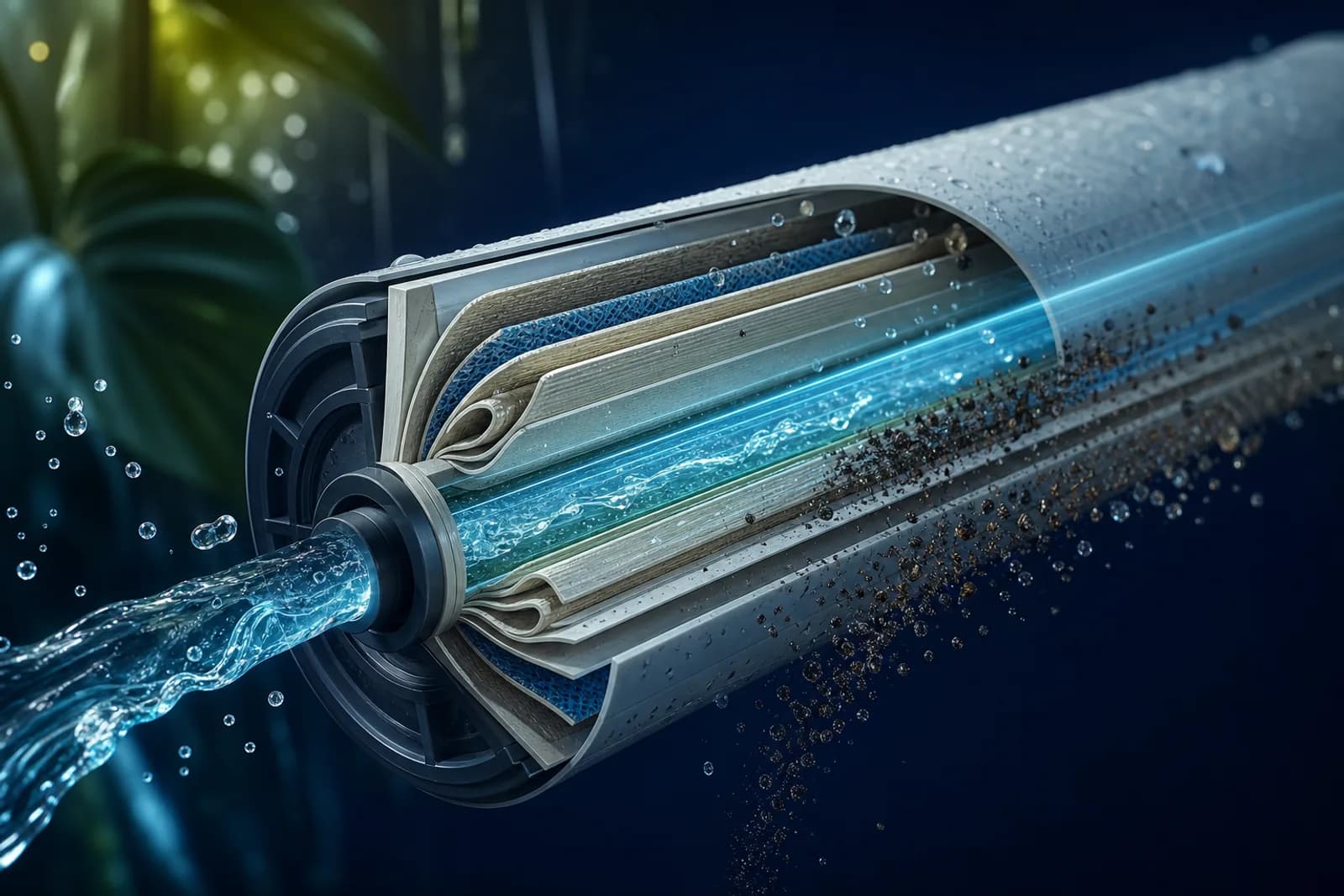
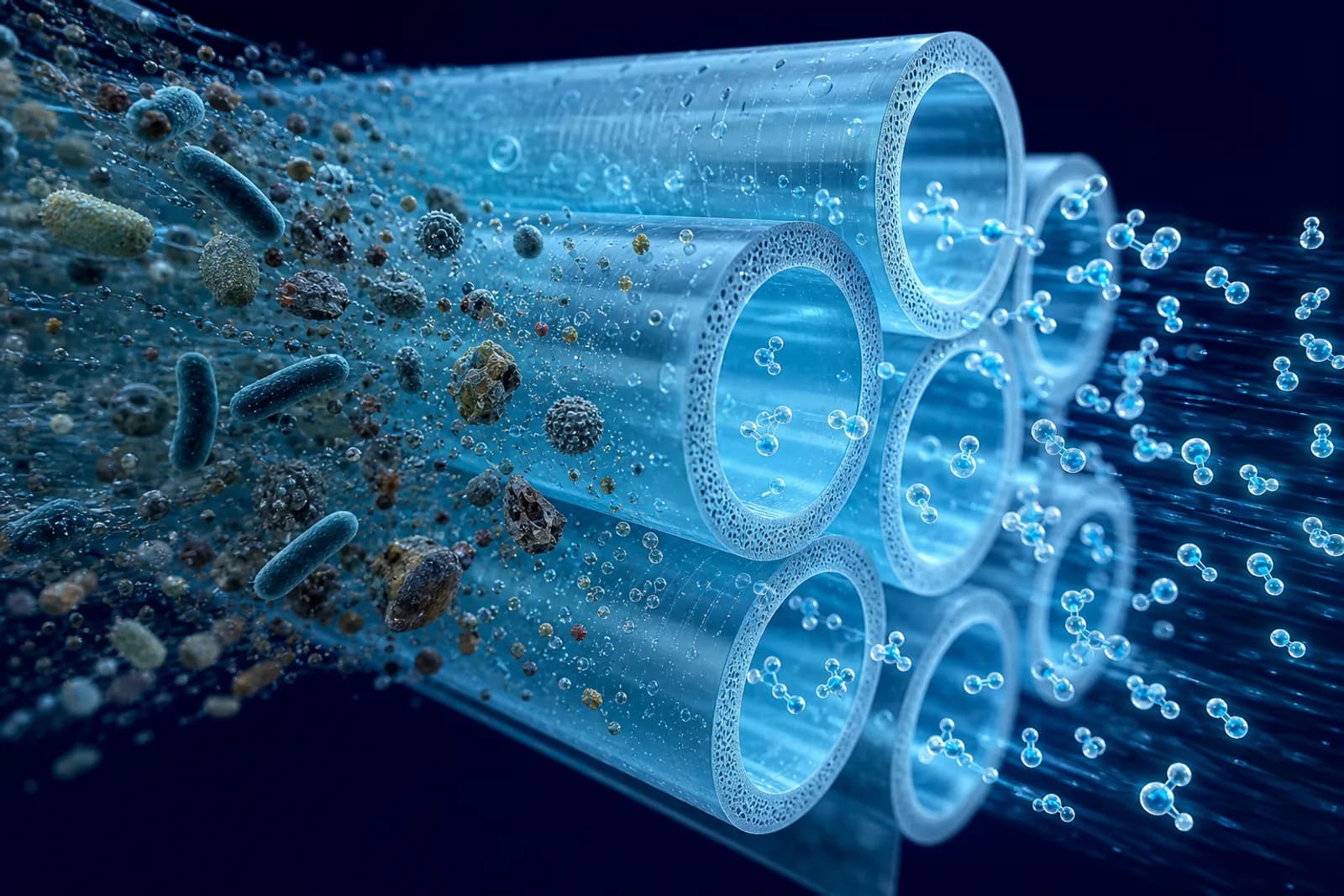
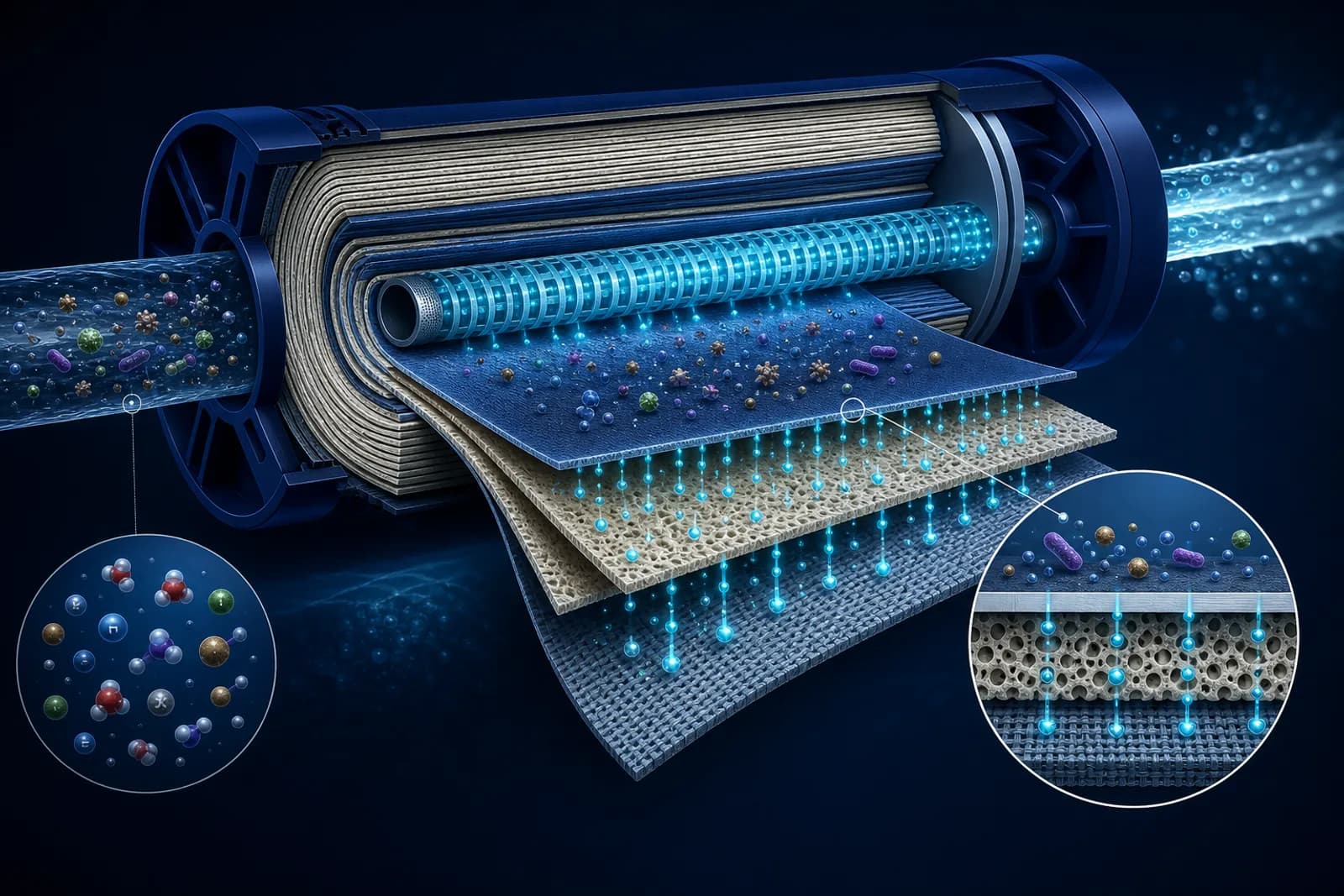
Microplastic and nanoplastic particles are physical objects. They can be removed by physical filtration — provided the filter pore size is small enough and the filter is working correctly.
RO membranes operate at a nominal pore size of roughly 0.0001 micron (0.1 nanometre). This is far smaller than the smallest plastic particles detected in drinking water studies. An intact, functioning RO membrane physically excludes microplastics and nanoplastics. This is not a special feature; it follows from how tight the membrane is. A membrane that rejects dissolved sodium ions rejects plastic particles by an even wider margin.
Ultrafiltration (UF) membranes operate at a larger pore size — typically in the range of 0.01 to 0.1 microns. This is still small enough to block most microplastic particles in the size ranges commonly reported in drinking water (particles above 1 micron). Nanoplastics at the lower end of the size range may pass through a UF membrane, though the practical significance of this depends on the particle size distribution in your source water.
Activated carbon filters — the type used in countertop pitchers and basic under-sink systems — do not remove microplastics through their primary mechanism. Carbon filtration is an adsorption process: it captures dissolved chemicals that have chemical affinity for the carbon surface. Plastic particles do not adsorb onto carbon in the way that chlorine or certain organic compounds do. Some carbon block filters with very dense, fine-pored block structures may trap some particles mechanically, but this is not the design intent and performance is inconsistent.
Boiling does not remove microplastics. Boiling is highly effective at killing pathogens, but it leaves all dissolved and suspended solids — including plastic particles — behind in the water. The only effect boiling has on plastic particles is to concentrate them slightly as water volume reduces through evaporation.
Ceramic and hollow-fibre membranes used in some gravity and pressurised systems can remove particles depending on their pore rating, but performance varies considerably between products. A certified pore size of 0.1 microns or finer is the relevant threshold for meaningful particle exclusion.
Putting it together
If removing microplastics from drinking water is a priority, the filter technology that does it most thoroughly is reverse osmosis. A multi-stage RO system with a functioning membrane and maintained pre-filters produces permeate from which plastic particles above nanometre scale are physically excluded. Ultrafiltration covers most of the size range relevant to typical drinking water exposure, at lower cost and without the wastewater that RO produces.
Basic carbon pitcher filtration and boiling do not address this category of contamination at all.
For Indonesian households that currently rely on galon dispensers as their primary drinking source, the relevant question is what the refill station's filter actually achieves. A station running RO produces water that is essentially free of microplastics. A station running basic activated carbon does not remove them — and the galon bottle adds its own contribution. Knowing the treatment process behind your water source matters more than the format it comes in.
The science on health effects is still being written. The physics of filtration is not.
Not sure which system fits your water?
Aright Marketing Indonesia can assess your supply and recommend the right Truliva system for your home or business in Indonesia.