Understanding TDS in Drinking Water
A TDS meter measures dissolved solids, not safety. Here is what the number really tells you, what it misses, and why low TDS does not always mean clean.
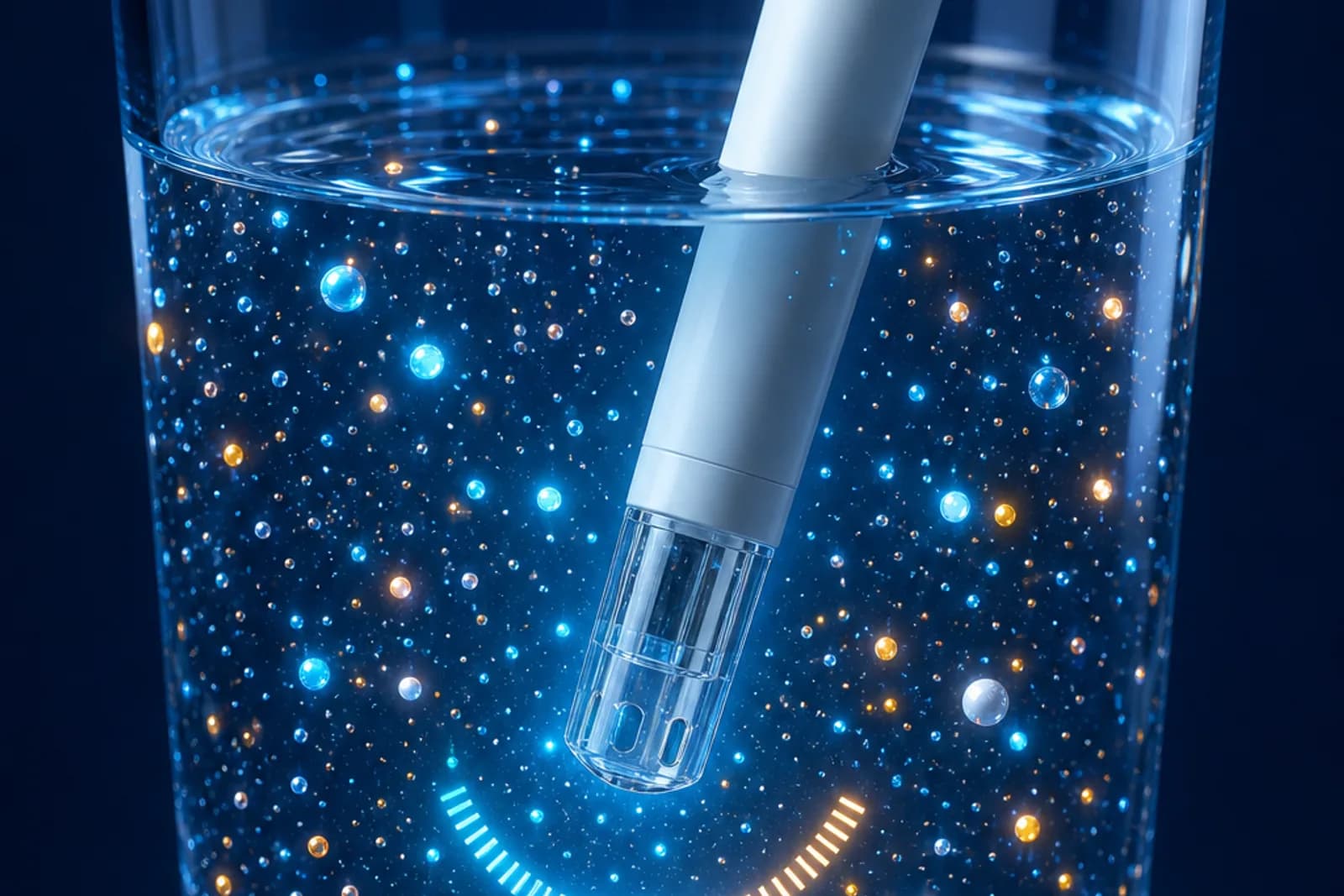
A TDS meter measures one thing: the total amount of dissolved solids in your water, reported in parts per million (ppm). It does not measure whether the water is safe to drink. Those two ideas get confused constantly, and the confusion sells a lot of filters that solve the wrong problem. Knowing exactly what the number means — and what it cannot tell you — makes you a far better judge of your own water.
What TDS actually measures
Total Dissolved Solids is the combined weight of everything dissolved in the water: minerals, salts, and metals broken down into ions too small to see or filter out with an ordinary sieve. A TDS meter does not measure these directly. It measures the water's electrical conductivity, because dissolved ions carry a charge and let current flow, then converts that reading into an estimated ppm value.
That conversion is an approximation. The meter cannot tell calcium from sodium, or harmless minerals from a dissolved metal you would rather avoid. It reports a total, not a breakdown.
What TDS does NOT tell you
This is the part that matters most, so it is worth being blunt.
- TDS is not a safety reading. Bacteria, viruses, and protozoa do not register on a TDS meter at all — they are not dissolved solids. Water that gives you a low TDS number can still make you sick.
- TDS does not identify contaminants. A high reading could be harmless dissolved limestone, or it could include something you want gone. The meter cannot tell the difference.
- Low TDS is not proof of purity. Distilled water reads near zero and could still be contaminated by something the meter does not see, such as certain dissolved organics or pathogens.
A TDS meter is a thermometer, not a diagnosis. It is useful, but only for the one thing it measures.
Typical ranges
As a rough guide, drinking water commonly falls into broad bands:
- Below ~50 ppm — very low, typical of RO-treated or distilled water.
- ~50–300 ppm — common for many treated and piped supplies; often considered a pleasant range.
- ~300–600 ppm — higher mineral content, frequently from groundwater.
- Above ~600 ppm — noticeably high, common with saltwater intrusion or hard groundwater, and often where taste turns brackish.
The World Health Organization has noted that water is generally considered to have good palatability below roughly 600 ppm. Treat these as orientation, not hard safety thresholds — palatability and safety are different questions.
Why a TDS meter is still useful
A meter earns its place for what it does well:
- Spotting change. A sudden jump in your tap reading is a signal worth investigating — a seasonal shift, saltwater intrusion, or a problem upstream.
- Choosing technology. A high reading points toward reverse osmosis, the only common household method that removes dissolved solids. A low reading suggests UF may be enough.
- Checking RO performance. Comparing TDS before and after an RO membrane tells you the membrane is working. A reject ratio that drifts over time is an early sign the membrane is ageing.
Used this way, the meter is a genuinely good diagnostic. The mistake is treating its number as a verdict on whether the water is safe.
How RO lowers TDS and UF does not
The two main membrane technologies behave very differently on the TDS scale, and this surprises people.
- Reverse osmosis (RO) uses pores tight enough to block dissolved ions. It removes most of the dissolved load, so the TDS reading drops sharply — often to a fraction of the source value.
- Ultrafiltration (UF) uses larger pores that stop bacteria and particles but let dissolved minerals pass straight through. UF can produce microbiologically clean water with a TDS reading almost identical to the source.
So a low TDS reading after UF would actually be a red flag that the membrane was not doing its job, while the same low reading after RO is exactly what you expect. The number only makes sense once you know which technology produced it.
The mineral-water misconception
A common worry is that RO water is "dead" because its TDS is low and its minerals are removed. The dissolved minerals in drinking water — calcium and magnesium mostly — do contribute to your intake, but for most people the great majority of dietary minerals comes from food, not water. A balanced diet covers the difference comfortably.
If you prefer the taste of mineral-bearing water, that is a legitimate reason to choose UF over RO, or to add a remineralising stage after RO. Just frame it honestly: it is a taste and preference decision, not a rescue from a health risk. And remember the reverse — a high-TDS reading is not a health benefit either. It only tells you there is more dissolved material present, not what that material is.
The takeaway
A TDS meter is a fast, cheap, useful tool that answers exactly one question: how much dissolved solid is in this water. It does not answer whether the water is safe, what is in it, or whether it is good for you. Use it to detect change, to choose between RO and UF, and to check that your RO membrane still works. For everything else — bacteria, specific contaminants, real safety — you need the right barrier and, where it matters, a proper water test.
Not sure which system fits your water?
Aright Marketing Indonesia can assess your supply and recommend the right Truliva system for your home or business in Indonesia.