Remineralisation Explained: Why Minerals Are Added Back After RO
RO strips minerals along with contaminants, leaving water flat in taste and slightly acidic. Here is why that happens, what mineral cartridges actually do, and what they cannot do.
Reverse osmosis does its job too well. The same membrane that stops lead, nitrates, and arsenic also stops calcium and magnesium — the dissolved minerals that give water its characteristic taste, body, and buffering capacity. What comes out the other side is chemically clean, but flat in flavour and, without carbonate minerals present, often slightly acidic. A remineralisation stage corrects both. Understanding why it works requires a short detour into the chemistry that RO disrupts.
Why RO water tastes flat
Tap water and bottled mineral water owe their character not just to what is in them, but to the balance of what is in them. Calcium, magnesium, sodium, bicarbonate, and sulphate are the main dissolved players. Their relative concentrations determine whether water tastes crisp, soft, chalky, or refreshing. Municipal tap water from PDAM supply in most Indonesian cities has a TDS (total dissolved solids) commonly in the range of 100–400 ppm, depending on the catchment and treatment process. Borehole water can run considerably higher.
An RO membrane operating at normal recovery rejects roughly 95–99% of that dissolved load. The product water that passes through typically lands below 50 ppm, sometimes as low as 10–20 ppm on a well-maintained membrane at favourable feed conditions. At those levels, the mineral character is largely absent. For people switching from bottled mineral water or heavily mineralised tap water, the difference is noticeable — not harmful, but distinct.
This is not a flaw in the membrane. It is the membrane operating exactly as designed. The question is whether you want the output to stay that way, or whether you want to restore some of what was removed.
Why RO water turns acidic
Pure water has a neutral pH of 7.0. Water that has been cleaned of dissolved load can end up acidic — a result that catches many people off guard.
The explanation lies in dissolved carbon dioxide and the loss of carbonate buffering.
Water drawn from the tap or a borehole contains dissolved bicarbonate ions — the product of carbon dioxide dissolving in water and reacting to form carbonic acid, which then partially dissociates. These bicarbonate ions act as a buffer: they absorb both acid and base additions without large pH swings. Tap water's typical pH of 6.5–8.5 is maintained partly by this buffering capacity.
The RO membrane rejects bicarbonate ions along with everything else. Carbon dioxide, being a dissolved gas rather than an ion, passes through freely. In the product water, CO₂ is present without the bicarbonate that would normally buffer it. The CO₂ reacts with water to form carbonic acid, and with no carbonate minerals present to resist the drop, the pH falls. RO product water commonly reads between pH 5.5 and 6.8 — the exact value depends on CO₂ levels in the specific installation, but acidic rather than neutral is the typical result.
This matters more for taste and practical use than for health. Coffee and tea prepared with slightly acidic water can taste different from those made with neutral or slightly alkaline water. More practically, very low-pH water is marginally more aggressive to copper or zinc fittings over extended contact — a minor concern for household point-of-use dispensing, but one that plumbing engineers factor in for larger installations.
For most domestic users, the pH shift is a taste and quality consideration, and one that a well-designed remineralisation stage corrects cleanly.
How mineral cartridges work
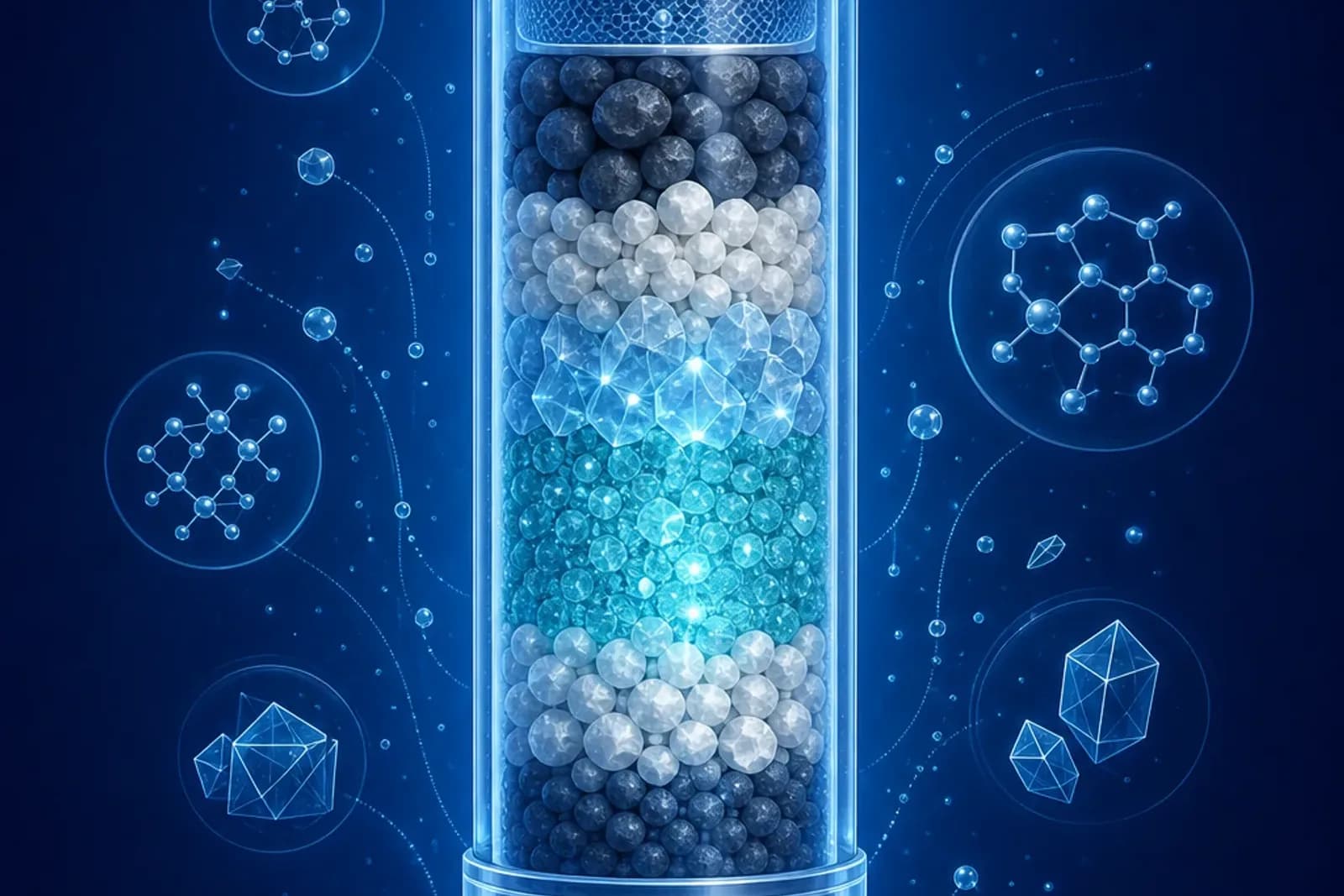
A remineralisation cartridge sits downstream of the RO membrane, usually as the final post-stage before the tap. It contains a bed of mineral media — most commonly calcite, maifanite, or a blend of both — through which the RO product water flows slowly enough to dissolve a controlled amount of mineral content back into it.
The mechanics are straightforward: the media dissolves slightly as water passes over it. Calcium and magnesium carbonate enter the water in ionic form. The carbonate fraction raises pH by adding bicarbonate buffering capacity. The calcium and magnesium fraction raises TDS modestly and adds the mineral body that distinguishes still mineral water from distilled water.
Dissolution rate depends on contact time, flow rate, water temperature, and the initial pH of the feed water. Slower flow and lower initial pH both increase dissolution. This means the cartridge self-regulates to a degree: very acidic RO water dissolves more media, raising pH toward neutral, at which point dissolution slows. A well-designed system targets output at roughly pH 7.0–7.5 and TDS in the 50–150 ppm range — enough to restore character without producing obvious hardness.
The two main media types
Calcite is crushed calcium carbonate — essentially the same mineral composition as limestone. It is inexpensive, well-characterised, and effective at raising pH and adding calcium. Most remineralisation cartridges use calcite as the primary or sole medium. One practical limitation: calcite dissolves relatively quickly under acidic conditions (Le Chatelier's principle — lower pH drives the equilibrium toward dissolution), so cartridges may need replacement sooner if the incoming RO water sits consistently at the low end of pH.
Maifanite (also written maifan stone, from the Chinese 麦饭石, màifànshí) is a silicate mineral of volcanic origin, composed mainly of feldspar and quartz with trace amounts of calcium, magnesium, potassium, sodium, and various trace elements. It releases these minerals more slowly than calcite and is commonly used alone or blended with calcite to moderate dissolution rate and broaden the mineral profile. The trace element contribution is real but modest — actual release varies by stone provenance and grain size, and maifanite is not a supplement delivery system.
Some premium cartridges also include small amounts of dolomite (calcium-magnesium carbonate) or aragonite (a crystalline form of calcium carbonate) to adjust the calcium-to-magnesium ratio in the output. These are refinements rather than requirements. In practice, most domestic remineralisation cartridges are calcite or calcite-maifanite blends, and differences in output quality between formulations are subtle.
What remineralisation does not do
A remineralisation cartridge adds back calcium, magnesium, and bicarbonate. It does not restore what the RO membrane correctly removed.
The minerals in your groundwater or PDAM supply came packaged with everything else in that water — including the contaminants you installed the RO membrane to remove. The cartridge is not restoring your original source water; it is adding clean, food-grade mineral media to clean RO product water. The output is mineralised water without the contaminants, not mineralised water with them.
It also does not provide significant quantities of minerals by weight. A litre of water passing through a standard calcite cartridge might pick up approximately 20–50 mg of calcium — a highly variable figure depending on contact time, flow rate, and cartridge formulation, but in all cases a fraction of the 600–800 mg daily intake reference for adults (some guidelines cite higher values; the Indonesian MOH figure should be the working reference for local health context). Water contributes to dietary mineral intake; it is not the primary source. This does not diminish the value of remineralisation — it keeps the expectation accurate.
The Indonesia context
Most households in Indonesia encounter one of a few water scenarios, each of which changes the remineralisation calculus slightly.
PDAM piped supply in cities like Jakarta, Surabaya, or Bandung typically has moderate TDS and is treated with chlorine. After RO, the low-TDS, slightly acidic product is the most common trigger for adding a remineralisation stage. Many users notice the taste difference compared to air galon (bottled gallon water) and find remineralised RO output closer to the mineral character they are accustomed to.
Borehole water (sumur bor) in coastal or peri-urban areas often runs at high TDS with calcium and magnesium hardness, plus the risk of saltwater intrusion and agricultural nitrate contamination. After RO strips this completely, remineralisation is a common add-on because users coming from hard groundwater are particularly sensitive to the flat taste of demineralised water.
Air galon refill stations (depot air isi ulang) typically use RO or UV treatment, but practices vary widely. Some stations skip the remineralisation step; others include it as a selling point. Consumer taste preferences in Indonesian cities have converged around slightly mineralised water partly because the dominant bottled brands — which carry TDS broadly in the range of 40–100 ppm — train the palate toward that profile.
Cartridge lifespan and maintenance
A remineralisation cartridge depletes as the mineral media dissolves. Replacement intervals vary by manufacturer and usage volume; six to twelve months is the commonly cited range for domestic use at typical household consumption rates. High-volume households or those with consistently low-pH RO feed water will deplete cartridges faster.
Unlike a carbon block, which can degrade by saturation and become a contamination source if neglected, a depleted mineral cartridge simply stops contributing minerals. The practical sign of depletion is a return to the flat taste and low pH of straight RO water. TDS and pH testing at the tap, using an inexpensive meter and test strips, is more reliable than guessing by calendar.
Remineralisation as a deliberate choice
Adding a remineralisation stage is a quality decision, not a correction of a safety deficiency. RO water at 20 ppm is safe to drink; the minerals are a preference and a comfort consideration, not a health requirement for most adults on a varied diet. But the difference between flat, slightly acidic RO water and gently mineralised output at neutral pH is noticeable to most people who experience both side by side.
For households that previously relied on air galon or bottled water, remineralisation closes the gap without reintroducing what the membrane correctly removed. The mechanism is simple — mineral media dissolving slowly into clean water — and the chemistry explains clearly both what it achieves and what it does not.
Not sure which system fits your water?
Aright Marketing Indonesia can assess your supply and recommend the right Truliva system for your home or business in Indonesia.