Under-Sink vs Countertop vs Wall-Mounted Purifiers
Form factor shapes every day you own a purifier. A practical comparison of under-sink, countertop, and wall-mounted water purifiers for Indonesian kitchens, renters, and tighter budgets.
Pick the filtration first — RO or UF, sized to your water. After that, the decision that shapes every day you own the machine is the form factor. An under-sink unit hides in the cabinet and never touches your worktop. A countertop sits in full view and moves when you do. A wall-mounted dispenser becomes part of the kitchen and pours at a height you can actually reach. None of the three is universally right. The correct one depends on your kitchen layout, whether you rent or own, and how much space you are genuinely willing to give up.
The three form factors, plainly described
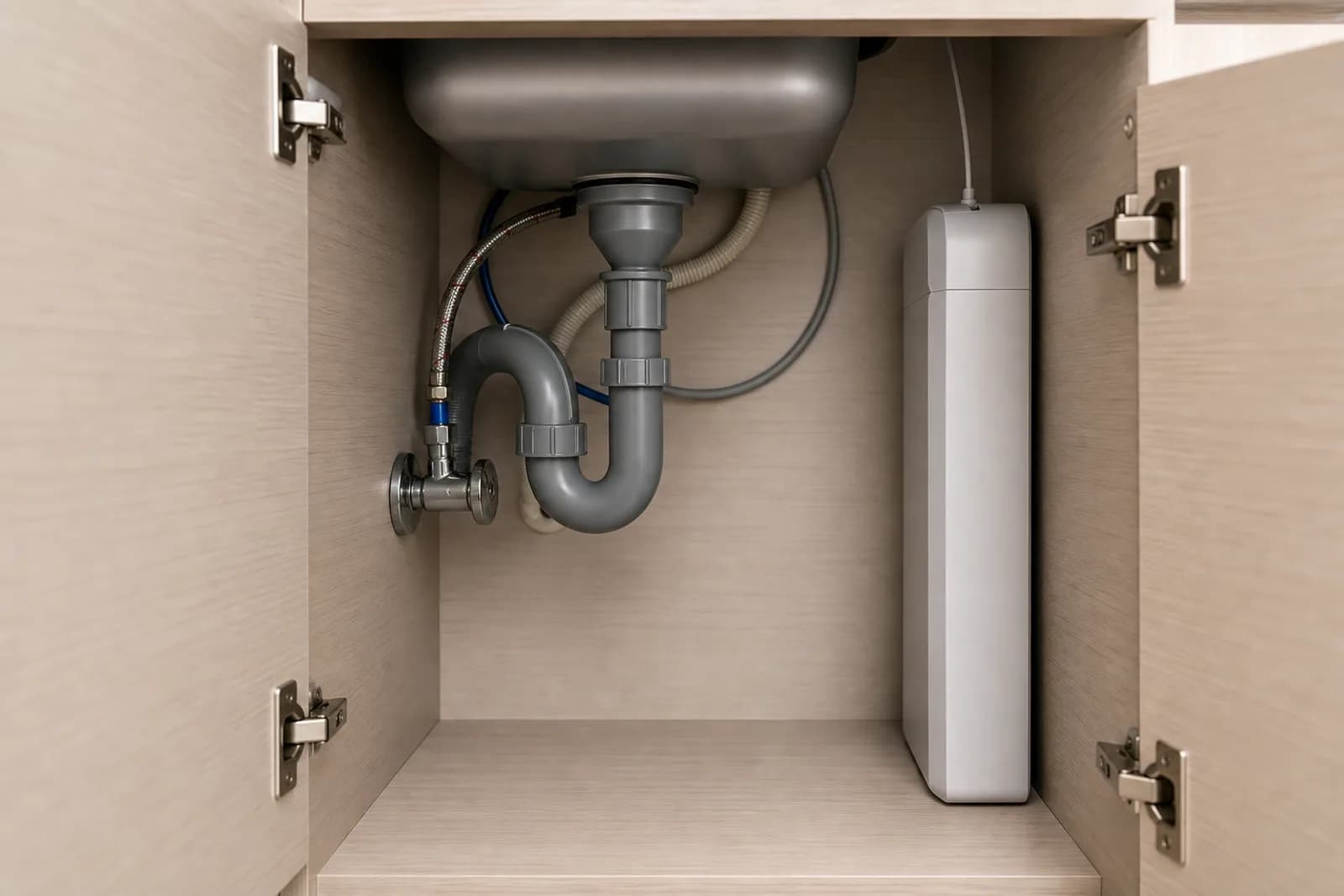
Under-sink. The unit mounts inside the cabinet beneath the kitchen sink. Water runs through the filter and up to a dedicated tap — sometimes a side-hole on the existing tap body, sometimes a separate slim faucet drilled through the worktop. From the outside, the only sign the purifier exists is that second tap. On RO models, the membrane and cartridges all sit in the cabinet; tankless designs free up the space a storage tank would otherwise take.
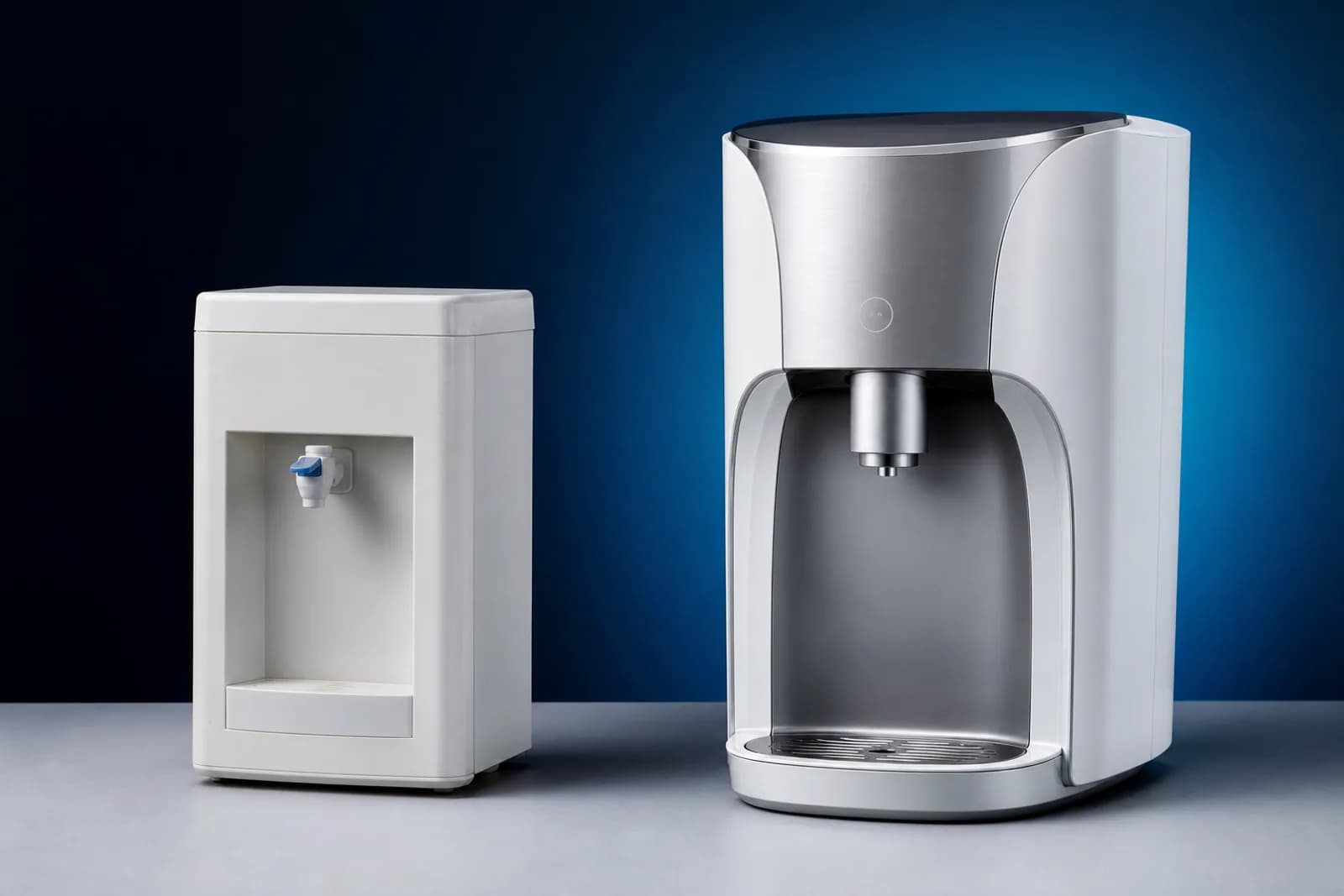
Countertop. A self-contained unit that sits on the worktop. Most plug-in models connect with a diverter on the tap or pour from a built-in reservoir, so no plumbing or drilling is needed. Gravity UF versions need no power at all. Many countertop RO units are hot-and-cold dispensers, which means one appliance replaces both the filter and the kettle.
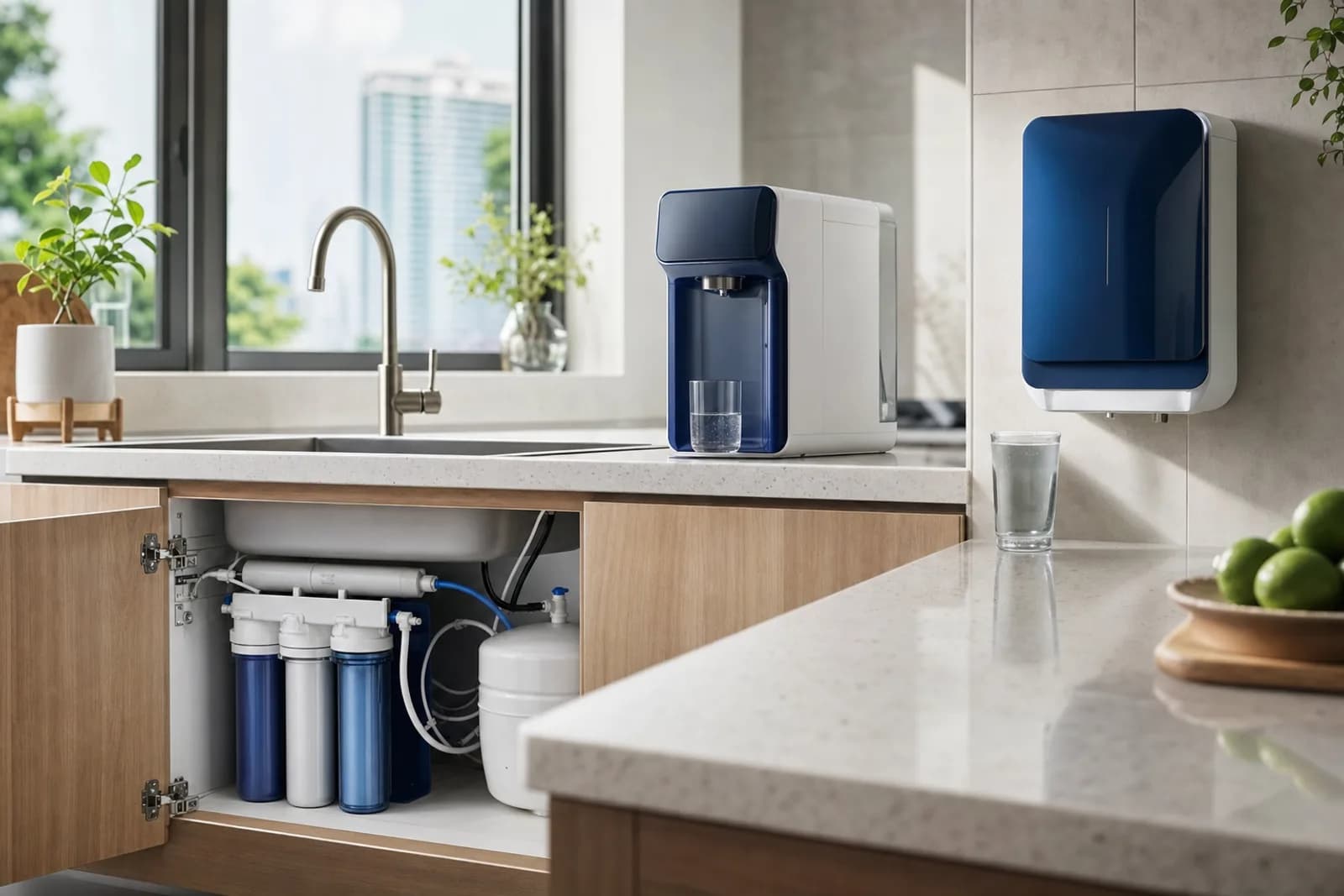
Wall-mounted. A slim dispenser bolted to the wall, usually beside or above the sink, pouring from a built-in spout at standing height. On the TRULIVA configuration, the wall unit is the dispenser and a compact RO core sits under the sink feeding it — so you get the reach of a countertop with most of the bulk hidden in the cabinet. These are typically hot-and-cold units built for Indonesian and wider Southeast Asian kitchens.
Under-sink: clear worktop, bigger commitment
This form suits households that own the space, have a conventional under-sink cabinet, and want every square centimetre of worktop free.
Advantages:
- Nothing shows except the dedicated tap. The counter stays clear.
- Steadier cold-water taste in humid Indonesian kitchens, because the cartridges sit out of direct heat and sunlight.
- Room for a larger RO storage tank where the model uses one — useful for families of four or more who draw water in bursts.
Constraints:
- You drill a hole in the worktop or tap body. In a rental, that is a landlord conversation.
- RO needs a drain connection tapped into the waste pipe under the sink. Measure the cabinet before you buy: the filter housings, any tank, and enough clearance to swap cartridges all need room.
- Changing cartridges means opening the cabinet and working in a confined space. It is routine, but easier on some designs than others.
Suits: Owner-occupiers, larger families, high-TDS borehole or coastal groundwater where under-sink RO does the most work, and kitchens where worktop space is a genuine priority.
The TRULIVA under-sink range runs the full RO sequence — folding PP, front activated carbon, PP, RO membrane, non-woven, post carbon, and UV — removing up to 99.9% of 104 contaminants. Output runs from 600 GPD on the essential models up to 1200 GPD for heavy household demand.
Countertop: portable, renter-friendly, no drilling
This is the default for renters, and a sensible choice for owners who would rather not modify the kitchen.
Advantages:
- No drilling, no waste-pipe tapping, no landlord approval.
- Portable. It moves with you to a new apartment or a holiday house.
- Gravity UF versions run without electricity — useful where power is unreliable, or for anyone who wants the simplest maintenance.
- Most installs are a diverter on the existing tap or a direct connection, done in under ten minutes.
- Many countertop RO models dispense hot and cold on demand, retiring the separate kettle.
Constraints:
- The unit takes worktop space. A countertop RO with a hot-cold reservoir has a real footprint — judge it honestly against a small Indonesian kitchen or a shallow pantry counter.
- A hot, humid spot near the stove or in afternoon sun shortens the life of the carbon stages.
- Hourly output can sit below a large under-sink system with a dedicated tank. For a household of five or more drawing water often, check the GPD rating before buying.
Suits: Renters, temporary accommodation, smaller households, and anyone who values flexibility over a permanent fitting.
TRULIVA countertop options come in both RO and UF. The RO units cover full dissolved-solids removal with hot-and-cold dispensing; the UF unit gives a microbiological and particle barrier while keeping natural minerals. If your PDAM supply is reasonably clean and you want to keep minerals, the countertop UF is the most practical, lowest-maintenance choice in this category.
Wall-mounted: best reach, fixed installation
Wall-mounted purifiers are more common in Indonesian and wider Southeast Asian kitchens than in Western designs, for practical reasons. A typical Type-36 or Type-45 apartment — or a landed home with a wet-and-dry kitchen — often has a wall run that suits a mounted dispenser better than a dedicated tap squeezed onto the bench.
Advantages:
- The spout sits at a natural height for filling bottles, glasses, and pots. No bending, no reaching under a cabinet.
- Hot-and-cold dispensing comes built in, so one wall unit replaces both the kettle and a separate cooler.
- The dispenser becomes part of the kitchen, which suits owners who would rather see a purposeful appliance than hide one.
- Almost no worktop footprint once the unit is on the wall.
Constraints:
- You need wall clearance, a nearby power point, and a feed-water connection — and on the TRULIVA layout, cabinet room for the RO core that feeds the dispenser. So it asks for both wall space and some under-sink space.
- A fully tiled backsplash makes the wall fixing a harder job.
- Not portable. A wall-mounted unit stays when you move out, so it is better for owners than renters unless the landlord provides one as a fixture.
Suits: Owner-occupiers who want hot-and-cold on demand, kitchens with more wall than bench, and households folding a separate kettle and dispenser into one unit.
TRULIVA wall-mounted models pair a slim hot-and-cold dispenser with an under-sink RO core, treating water at the point of use and delivering it at the temperature you need. They suit the same high-TDS and borehole scenarios as under-sink RO.
How to decide: three questions
Three questions clear most of the uncertainty.
1. Do you own or rent? Renters should start at countertop and move up only if the landlord agrees to modifications. Owners have the full range open to them.
2. How much water do you draw, and how fast? A couple filling two litres a day is well served by a countertop UF. A family of five filling a 5-litre pot for cooking and drawing cold water through the evening needs a larger tank and a higher GPD rating — which points to under-sink or wall-mounted RO with output to match.
3. What does your kitchen actually look like? Measure the cabinet under the sink. Check for wall clearance beside or above it. Estimate the bench area you are genuinely willing to give up. Most purifier regrets come not from the wrong technology but from a physical fit that was never checked.
Quick comparison
| Under-Sink | Countertop | Wall-Mounted | |
|---|---|---|---|
| Worktop space used | None | Medium–large | None |
| Drilling required | Yes | No | Yes (wall fixings) |
| Under-sink space needed | Yes | No | Yes (RO core) |
| Portable | No | Yes | No |
| Suits renters | No | Yes | No |
| Hot-and-cold option | Uncommon | Common (RO) | Standard |
| Installation effort | Moderate | Low | Moderate |
| Best with | RO (high TDS) | RO or UF | RO (high TDS) |
A note on Indonesian kitchens
Many apartments in Jakarta and other large cities are compact, and the cabinet under the sink is already shared with cleaning supplies and the waste trap. Measure twice before ordering anything that lives down there — under-sink RO and the core behind a wall-mounted dispenser both need that room. Borehole households outside the city centres, where TDS is commonly high and saltwater intrusion adds to the dissolved load, tend to gain the most from RO, which makes under-sink or wall-mounted the stronger investment. For PDAM households with reasonable source water and a rental arrangement, a countertop UF is usually the cheapest sensible start — with a move to countertop RO if a TDS meter reads higher than expected.
Form factor is not a cosmetic choice. It decides where the system fits, whether you can install it at all, and how easily you maintain it for years. Get that right alongside the filtration, and the machine will quietly do its job.
Not sure which system fits your water?
Aright Marketing Indonesia can assess your supply and recommend the right Truliva system for your home or business in Indonesia.