Budget vs Premium Water Purifiers: What You Are Actually Paying For
Sticker price tells you almost nothing. Here is what actually separates a cheap water purifier from a premium one — and how to judge value over five years, not just at the point of sale.
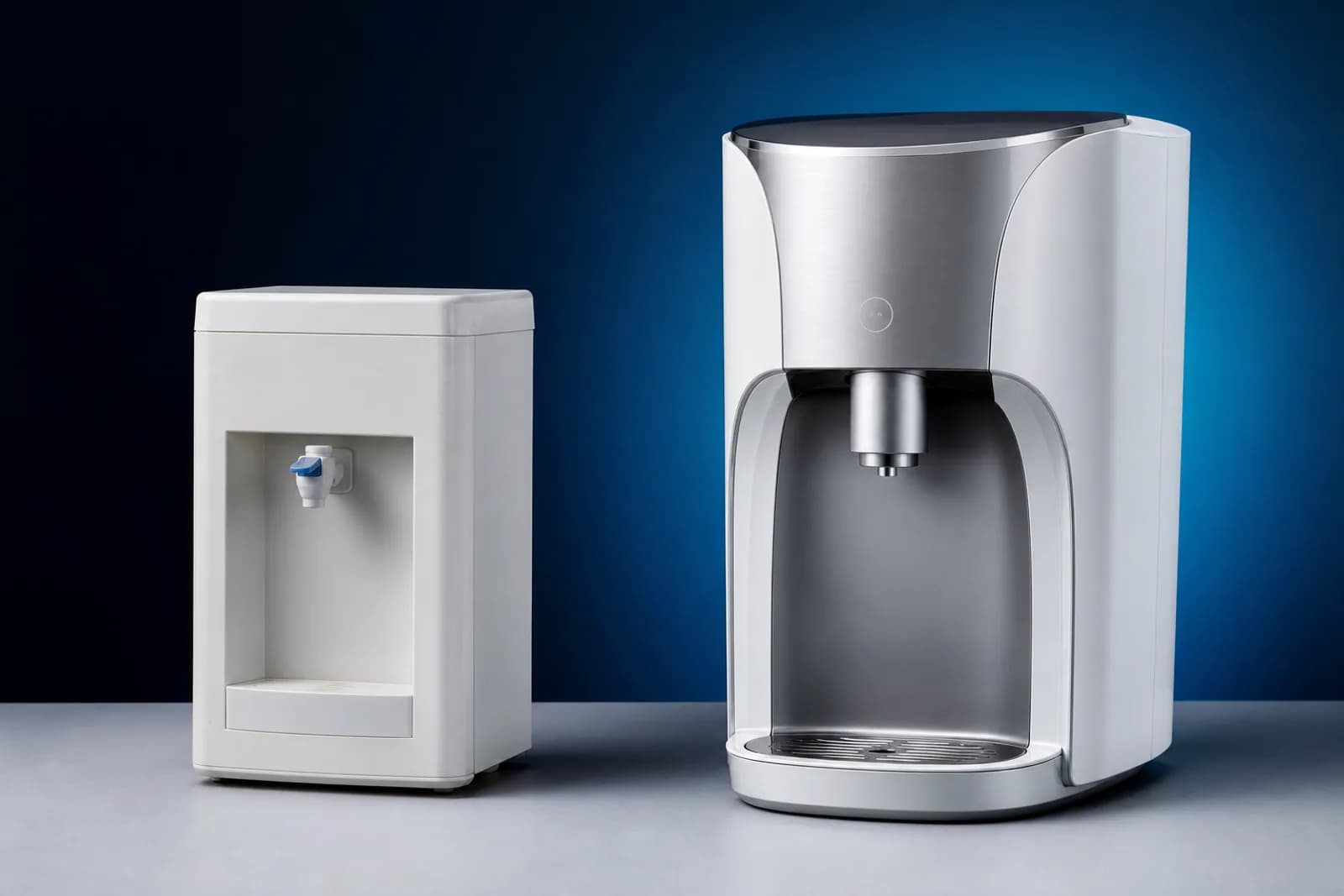
A water purifier that costs a fraction of another can carry the same label: "RO purifier." The gap is not just margin. It is membrane grade, pump engineering, fitting quality, and crucially, whether anyone will still sell you a replacement cartridge in three years. Understanding what that price difference buys is the only honest way to compare two units.
Membrane and pump quality
The reverse-osmosis membrane is the core of any RO system. Budget units commonly use membranes rated at lower rejection rates — the percentage of dissolved solids the membrane blocks. A membrane rated at 97% rejection and one rated at 99.9% look almost identical on a spec sheet, but they produce meaningfully different water when your source carries high dissolved solids, heavy metals, or nitrates.
Longevity matters just as much. Entry-level membranes are commonly rated for one to two years under normal conditions. Premium membranes — such as the eight-year long-life RO membranes reported on higher-tier systems — spread the cost of the most expensive cartridge over a far longer service life. Over five years, that difference compounds.
The booster pump is where many budget units cut quietly. Without a pump, the membrane relies on your tap's mains pressure to push water through. Indonesian PDAM supply can be intermittent and pressure-variable, and groundwater installations depend on pump pressure that fluctuates. A system without its own pump slows sharply when mains pressure drops, and slow throughput means bacteria have more time to colonise stagnant lines. Premium units include a dedicated pump and hold steady output regardless of feed pressure.
Build quality: where leaks come from
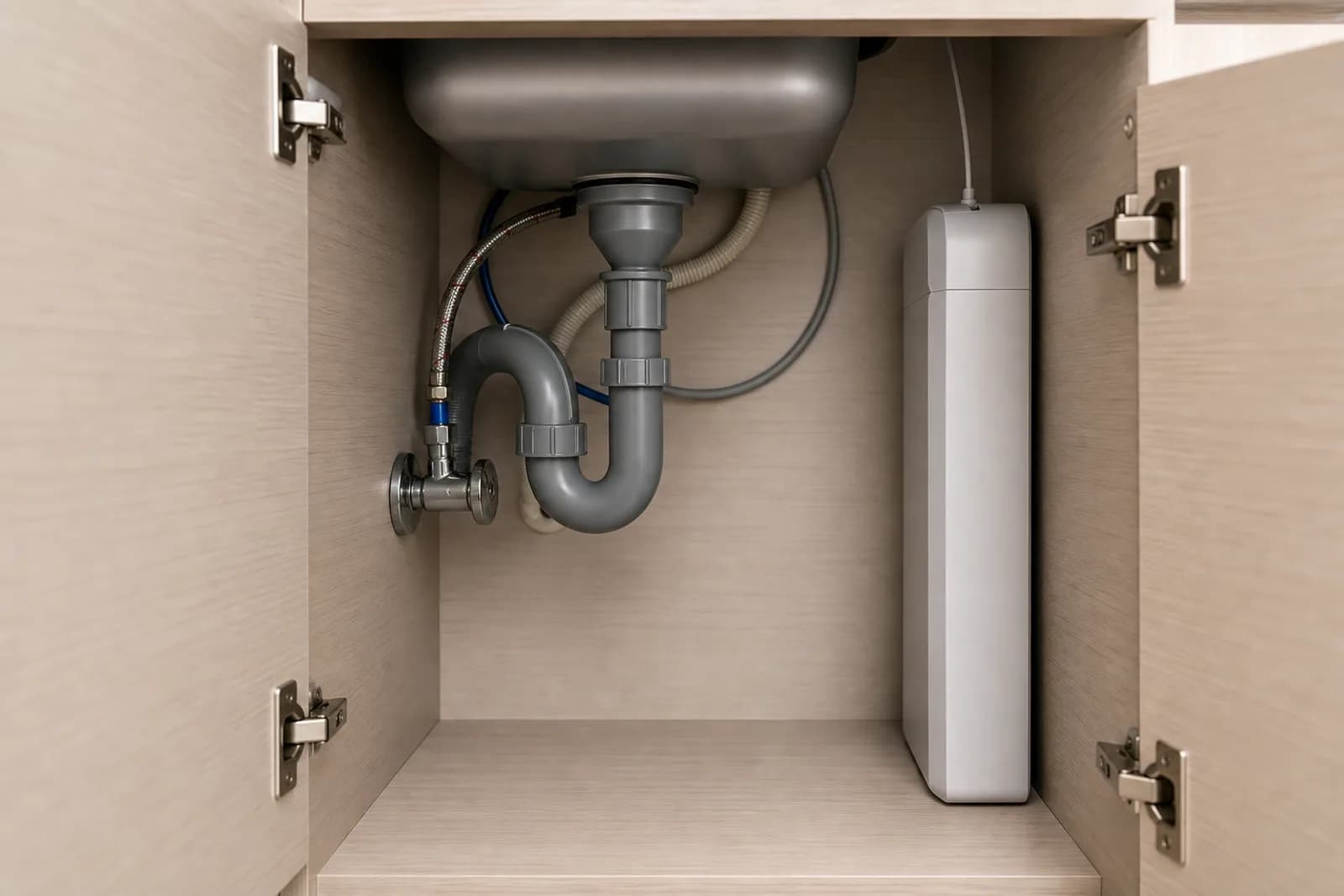
A water purifier runs continuously, under pressure, for years. The fittings, housings, and valves sit under constant low-level stress. Budget units frequently use push-fit fittings made from recycled or low-grade plastics. These hold at first. After a commonly reported twelve to eighteen months of thermal cycling — Indonesian kitchens get warm — micro-cracks appear at the ferrule seats, and slow leaks follow. Under-sink units are not always in plain sight, so a slow leak can run unnoticed for weeks.
Premium builds use rated food-grade components throughout. Cartridge housings are thicker-walled and rated for higher burst pressure. Shut-off valves and flow restrictors are machined, not injection-moulded at the cheapest tolerance. None of this is visible at the point of purchase, which is why brand reputation and service network matter so much in the Indonesian market.
Filtration completeness and honest claims
A cheap unit advertising "7-stage filtration" may duplicate stages rather than address the full contaminant spectrum. Common padding includes multiple layers of plain PP fibre listed as separate stages, or a carbon block split into two positions when one serves the purpose. What matters is whether each stage removes something specific: sediment, chlorine, chloramines, heavy metals, bacteria, dissolved solids, and taste compounds are distinct targets that need distinct media.
Vague marketing language — "removes harmful substances," "purifies thoroughly" — is a consistent marker of lower-tier units. A credible specification names contaminants: lead, mercury, arsenic, nitrate, E. coli, TDS reduction percentage. If a manufacturer's spec sheet cannot tell you what the unit removes and at what rejection rate, treat that gap as a red flag.
The same scrutiny applies to added claims. UV sterilisation, fitted as a final stage, is a genuine extra barrier against bacteria and viruses; on premium systems it complements the RO membrane rather than replacing it. On cheap units, a small, underpowered UV lamp is sometimes listed as a feature while delivering too little UV dose at the unit's rated flow rate. Check whether the UV lamp is rated for the flow.
Features: genuine value versus cosmetic additions
Instant hot and cold. A genuine value-add for a kitchen that uses the purifier as a drinking station. The heating element and insulated tank require engineering to do safely — a thermostat that fails open can scald. Premium versions carry safety certifications; very cheap versions may not.
Tankless (direct-flow) RO. Traditional RO systems fill a pressurised storage tank; the tank sits idle and its lining can harbour bacteria if not maintained. Tankless designs produce water on demand without a stored reserve. This is a real engineering improvement, not cosmetic — it removes a maintenance task and a potential contamination point.
Smart filter indicators and app connectivity. Useful when accurate, cosmetic when not. A good smart indicator measures actual water quality or flow volume to estimate cartridge life; a cheap version counts only time elapsed, which misses the fact that a high-TDS source exhausts carbon faster than a clean source. Evaluate whether the indicator logic accounts for actual usage, not just a calendar countdown.
Mineral-addition stages. These remineralise RO-treated water, which is stripped of natural minerals. Whether this matters to you is a personal call — it changes taste and mineral intake modestly. It is a genuine stage with a function, but it is not a filtration upgrade; do not pay for it as though it were.
Filter availability and cost over the life of the unit
This is the most commonly overlooked part of the decision, and the most punishing to get wrong.
A cheap unit with proprietary cartridges — designed so that only the original brand's filters fit — locks you in. If that brand reduces its Indonesia distribution, stops stocking a particular model's filter, or simply raises prices, you have limited options. Units whose cartridges follow standard industry dimensions (10-inch or 12-inch housings, standard TFC membrane sizes) can be serviced with filters from multiple suppliers.
As a rule of thumb, work out the annual filter cost before you buy. Replacement cost varies widely by brand and model: standard-dimension, competitively sourced cartridges sit at the lower end, while short-life proprietary stages run much higher. Over five years, the running cost of a cheap unit with expensive or scarce proprietary filters can exceed the total five-year cost of a premium unit with longer-life, widely available cartridges.
Ask the retailer, directly and specifically: where do replacement filters come from, what is the current price per set, and are they stocked locally or imported to order? A hesitant answer is informative.
After-sales service in Indonesia
A purifier is a pressurised appliance in permanent contact with your drinking water. It will need at minimum an annual filter change, and at some point it will need a service call — a dripping valve, a UV lamp replacement, a membrane that has reached end of life early. What happens next depends entirely on whether the brand has a working support network where you are.
Indonesia is a large and geographically complex market. A brand with strong distribution in Jakarta may have almost no presence in Surabaya, Medan, or Makassar. An authorised service technician matters: someone who carries genuine parts, knows the unit's pressure settings, and can confirm the membrane seal was replaced correctly. A technician from a general appliance repair shop is cheaper, but has no access to rated components or factory-trained knowledge of the unit.
Before purchasing, verify: Is there an authorised service centre in your city? What is the warranty period and what does it actually cover — parts, labour, or both? Is there a hotline or response system, and does it answer? These are questions worth putting to the retailer before the sale, not after the fitting leaks.
An orphaned unit — one whose manufacturer has exited the market or whose distributor has moved on — is the worst case. You are left with a machine that works but cannot be reliably serviced, and a filter hunt that gets harder every year. This is a real pattern in the Indonesian market, where imported-brand units from less established distributors appear and disappear.
The balanced read
The cheapest unit on the market is rarely the best value once you account for filter running costs, potential service bills, and the realistic possibility of a shortened service life. But the most expensive unit is not automatically right either — a premium feature set designed for severe groundwater contamination is oversized for an apartment on well-maintained PDAM supply.
The productive frame is this: match the filtration specification to your actual water source, verify that annual filter cost fits your budget as an ongoing expense, and confirm the service network before committing. A mid-tier unit from a brand with a genuine Indonesia service structure and standard-dimension cartridges will almost always serve you better than either extreme — the bargain unit with no parts availability, or the over-specified flagship for water that does not need it.
Sticker price is where the comparison starts. Total cost of ownership and after-sales confidence are where it ends.
Not sure which system fits your water?
Aright Marketing Indonesia can assess your supply and recommend the right Truliva system for your home or business in Indonesia.