Treating Borehole Water at Home in Indonesia
Treating sumur bor (borehole water) at home starts with testing, not buying. This guide covers how to read TDS, sediment, iron, hardness, and coliform results — and how to match each result to the right treatment stage.
Borehole water — sumur bor — is the primary drinking-water source for a large share of Indonesian households outside the urban PDAM network, and a supplementary source for many within it. Unlike PDAM supply, which is treated at the plant, borehole water arrives at the tap having passed through whatever the local geology contains: fine clay, iron compounds, mineral salts, or, where septic systems are nearby, biological contamination. Treating it correctly is not complicated, but it requires working from your actual water quality rather than guessing.
Why borehole water is not a fixed problem
The most common mistake with sumur bor treatment is buying a filter before testing the water. Borehole water quality in Indonesia varies significantly by depth, by soil type, and by what is happening above ground within a few hundred metres of the well. A shallow borehole in a densely populated kampung carries a different risk profile than a deeper one in a peri-urban area, and a coastal borehole in North Jakarta or Medan is a different problem again from an inland Javanese well. Treatment that would be adequate for one might be entirely inadequate for the other.
What to look for before you commit to any system:
- TDS (total dissolved solids). A TDS meter costs under Rp 100,000 and gives you an immediate reading. Borehole water above roughly 500 mg/L is elevated; readings in the thousands indicate mineral salt load that only RO can address. Coastal groundwater in low-lying parts of Jakarta, Semarang, and Surabaya routinely shows very high TDS from seawater intrusion.
- Colour and odour. Orange-brown colour points to dissolved iron and manganese. Sulphurous smell suggests hydrogen sulphide from anaerobic conditions at depth. Neither is necessarily dangerous in small quantities, but both indicate chemistry that needs specific treatment stages.
- Hardness. Hard water leaves scale on kettle elements and fixtures. A simple test kit, available at aquarium suppliers, gives you a rough hardness reading. Borehole water in Java and parts of Sumatra is commonly quite hard due to limestone-rich geology.
- Microbiological risk. A lab test for total coliform or E. coli at a provincial health laboratory or Puskesmas typically runs in the range of Rp 150,000–250,000, though fees vary by province and test type — treat that as an indicative figure rather than a fixed tariff. It is worth doing at least once, particularly for shallow boreholes in urban or peri-urban areas where septic tank proximity is uncertain.
The treatment sequence: matching stages to problems
A properly designed borehole treatment system works in stages, each targeting specific contaminants before the water reaches the stage downstream. A single-cartridge counter-top filter on a high-TDS, iron-rich source will not produce clean water; it will produce a fouled filter and false confidence.
Stage 1 — Coarse sediment at the inlet. Borehole water carries fine clay and sand particles that PDAM supply — which has already been through sedimentation tanks — typically does not. These particles do not just affect taste; they abrade pump seals, clog valve seats, and blind RO membranes rapidly if they reach downstream equipment uninterrupted. A whole-home pre-filter at the main inlet, upstream of any branch, handles this.
The P-Q7712 is rated at 40 µm with a 7 T/h flow capacity and electronic automatic flushing. For borehole supply, the auto-flush function matters more than it does on PDAM supply: sediment loading from a borehole is typically higher and less consistent, so a filter that relies on someone remembering to open a manual flush valve will gradually accumulate a blockage that reduces pressure and eventually passes breakthrough sediment downstream. The automatic controller eliminates that variable.
Stage 2 — Iron and manganese (where present). Dissolved iron is among the most common borehole water problems across Indonesia. It stains sinks, laundry, and fittings rust-brown, makes water taste metallic, and fouls RO membranes and carbon filters if left untreated. The problem is that dissolved iron in its reduced (ferrous) state passes straight through mechanical filters. Treatment requires oxidation first — converting soluble ferrous iron to insoluble ferric iron that a sediment stage can capture. Aeration followed by filtration handles moderate iron levels; for higher concentrations, a dedicated iron-removal cartridge upstream of the RO is the appropriate approach. Sending high-iron water directly into a pre-carbon block fouls that stage well ahead of its rated life.
Stage 3 — Activated carbon for organics and odour. A carbon block stage adsorbs dissolved organics, removes hydrogen sulphide (the source of the rotten-egg smell found in some deep boreholes), and reduces any residual disinfectant if you are blending borehole and PDAM supply. It also protects the RO membrane from organic fouling that accumulates slowly and cannot be flushed out once established.
Stage 4 — RO membrane for dissolved salts and complete treatment. Where TDS is elevated — and for borehole water that is the common case — reverse osmosis is the only common household technology that lowers the dissolved mineral load. UF removes bacteria and particles but leaves dissolved salts entirely untouched. If your borehole TDS reading is above roughly 300–400 mg/L, or if you are near the coast where saltwater intrusion is a real risk, RO is not optional: it is the correct tool.
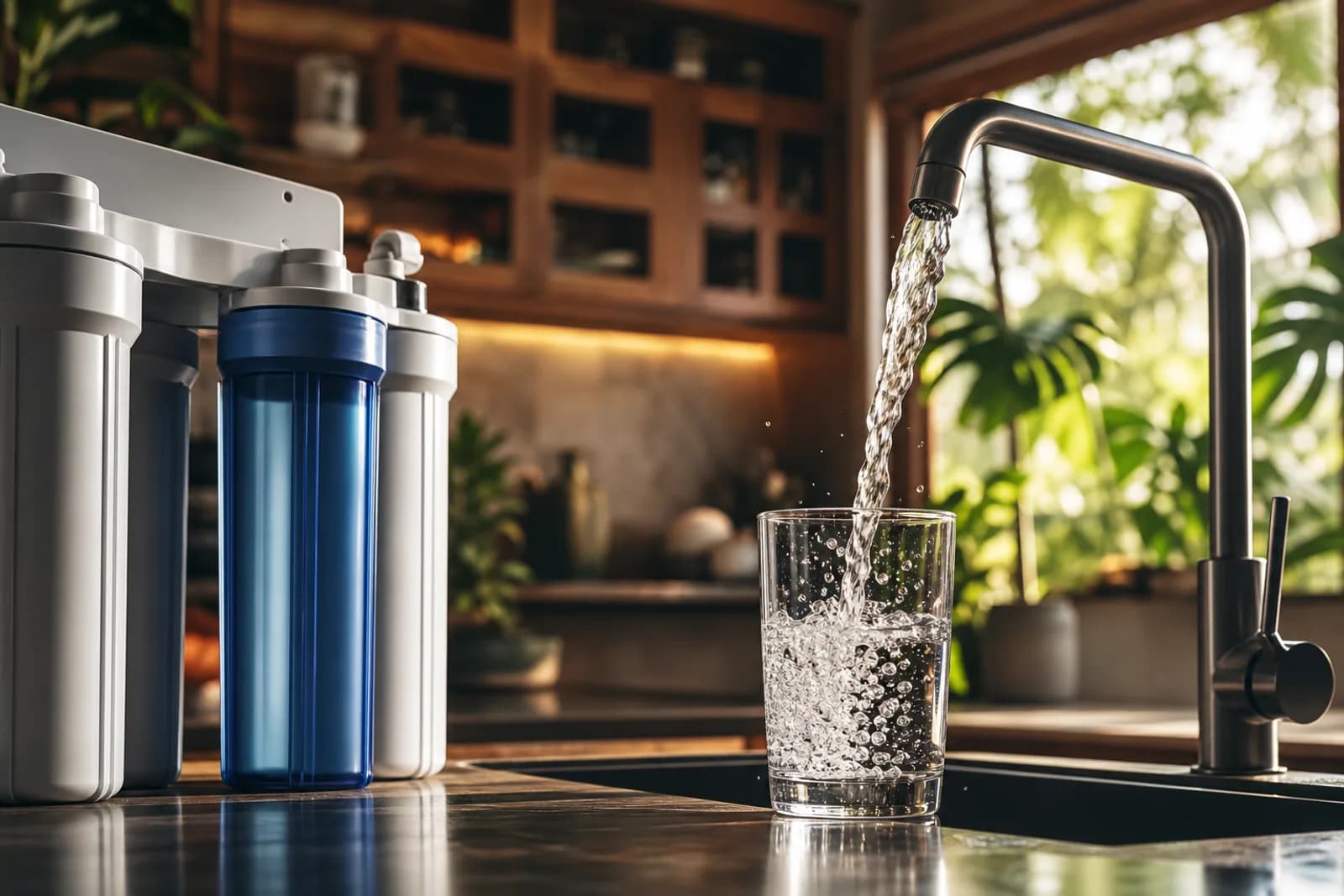
An under-sink RO system at the kitchen tap covers drinking and cooking water, where most of the quality concern sits. The UR-Q3626 is a 4-layer under-sink RO at 1.5 L/min and 600 GPD — a practical size for a family kitchen. For heavier household use, or where membrane longevity matters, the UR-S61096H runs at 1000 GPD and 2.66 L/min with an 8-year membrane and 80% water efficiency. That efficiency figure matters on borehole supply: every litre sent to drain is water pumped from the ground.
Hard water: a specific decision point
Hardness deserves separate attention because treatment for it differs from treatment for other borehole water problems.
RO removes hardness minerals at the kitchen tap, but does nothing for the shower head, washing machine, water heater, or pipes. If your borehole water is hard, scale accumulates in every appliance in the house. For that, a whole-house softener at the main inlet works alongside the RO rather than replacing it. A softener exchanges calcium and magnesium ions for sodium, lowering hardness across all household uses. The SS-Q3210i brings output hardness below 30 ppm at up to 2 T/h — adequate for most family homes. The RO at the kitchen tap then handles what the softener does not: dissolved salts, heavy metals, and microbiological safety.
A softener alone does not make borehole water safe to drink. An RO system alone does not stop scale building in the water heater. Households with genuinely hard borehole supply usually need both.
Biological contamination: test before you assume
Shallow boreholes — typically under 15–20 metres — in densely populated areas carry the highest faecal contamination risk. The geology provides little natural filtration at those depths, and the horizontal distance between a septic tank and a well on a typical urban Indonesian plot is often less than the 10 metres commonly cited as a minimum safe separation in WASH guidelines (the actual safe distance depends on soil permeability and groundwater flow direction, so that figure is a starting point, not a guarantee).
E. coli contamination is invisible; a well that looks and smells fine can still fail a coliform test. Boiling kills bacteria and viruses reliably but is impractical at household scale and does nothing for dissolved solids or iron. A well-maintained RO membrane provides dissolved-solid removal and a microbiological barrier in a single stage. For added redundancy — particularly where the borehole is shallow or the area is densely built up — a UV lamp as a final post-stage disinfects any organisms that might pass through a membrane with a small defect or age-related reduction in rejection.
Maintenance on borehole supply
Borehole water puts more stress on filter cartridges than clean PDAM supply. A PP sediment stage rated at six months on mains water may need replacement in three or four months on high-sediment borehole supply. A noticeable drop in flow rate before the rated interval is up is an early warning that the upstream stages are working hard.
The RO membrane depends on pre-stages being maintained on schedule. A pre-stage running past its service life passes sediment or iron that the membrane was not designed to handle on its own, and the resulting fouling is not recovered by flushing. On borehole supply, the margin for deferred maintenance is narrower than on clean mains water.
Matching the system to the source
The treatment sequence you actually need depends on what the tests show:
- High TDS (above ~400 mg/L) or coastal location: RO at the kitchen tap is essential.
- Visible iron or rust colour: Oxidation and iron removal before the carbon and RO stages.
- Scale on appliances and fittings: A whole-house softener upstream of the RO, sized for your flow rate.
- Shallow borehole in a dense urban or peri-urban area: Lab test for coliforms; RO plus UV if any biological risk is found.
- High sediment load: A pre-filter at the main inlet before anything else.
None of these stages are interchangeable. Work from coarsest to finest — sediment, chemistry, dissolved solids, biology — and each stage does a defined job. Skip one, and the stage downstream absorbs the gap until it fails. Testing first costs a fraction of what a mis-specified system costs in premature cartridge replacements and fouled equipment.
Not sure which system fits your water?
Aright Marketing Indonesia can assess your supply and recommend the right Truliva system for your home or business in Indonesia.