Tankless vs Tank RO: Which Design Suits Your Kitchen?
A clear tradeoff guide to tank and tankless reverse osmosis systems — comparing flow experience, footprint, water freshness, power use, waste ratio, and cost so you can choose the right fit.
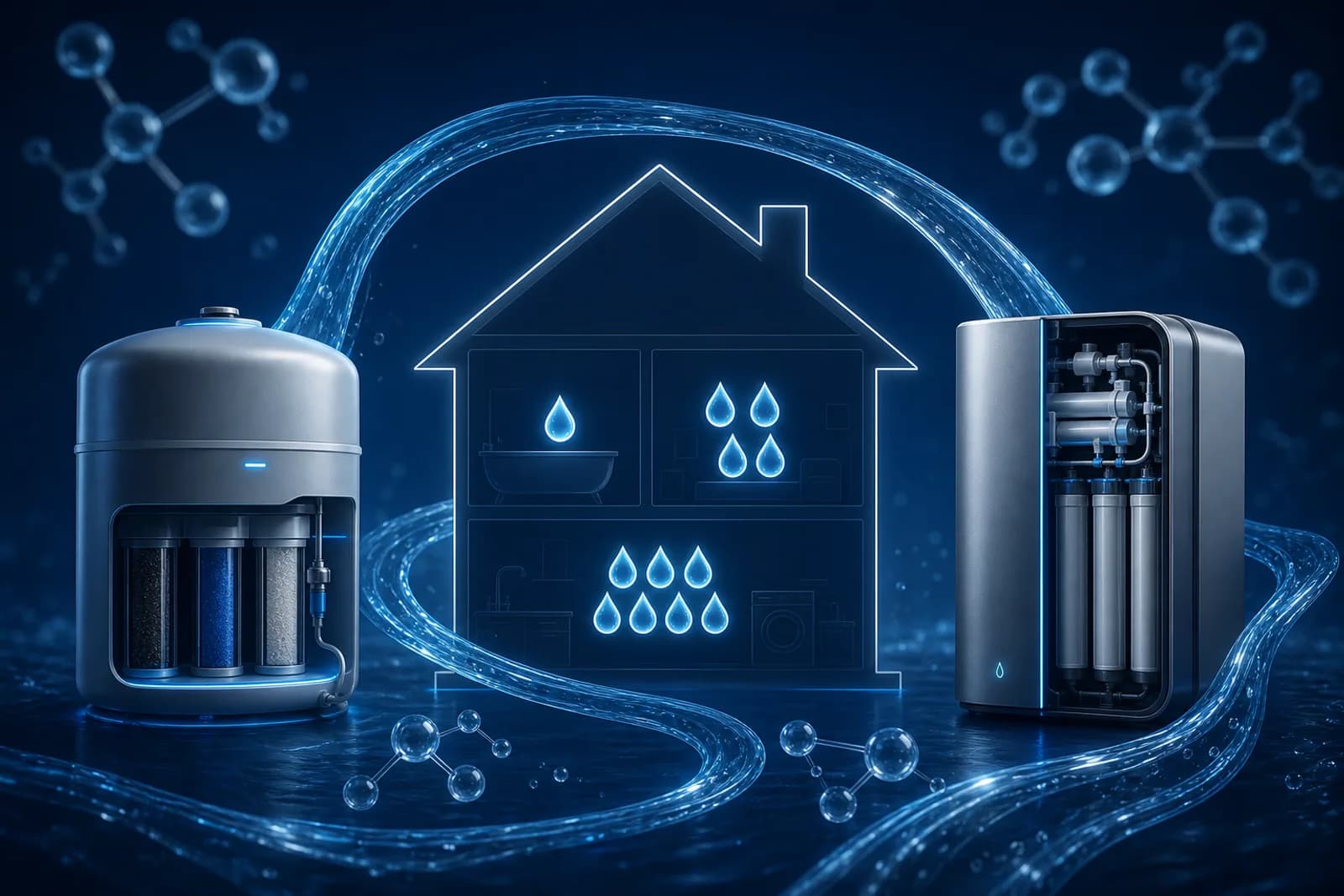
Reverse osmosis systems split into two storage designs — tank and tankless — and the choice shapes how your kitchen works every day. Both produce the same RO-quality water. What differs is how that water travels from the membrane to your glass, and what that path costs you in space, freshness, power, and money.
How each design works
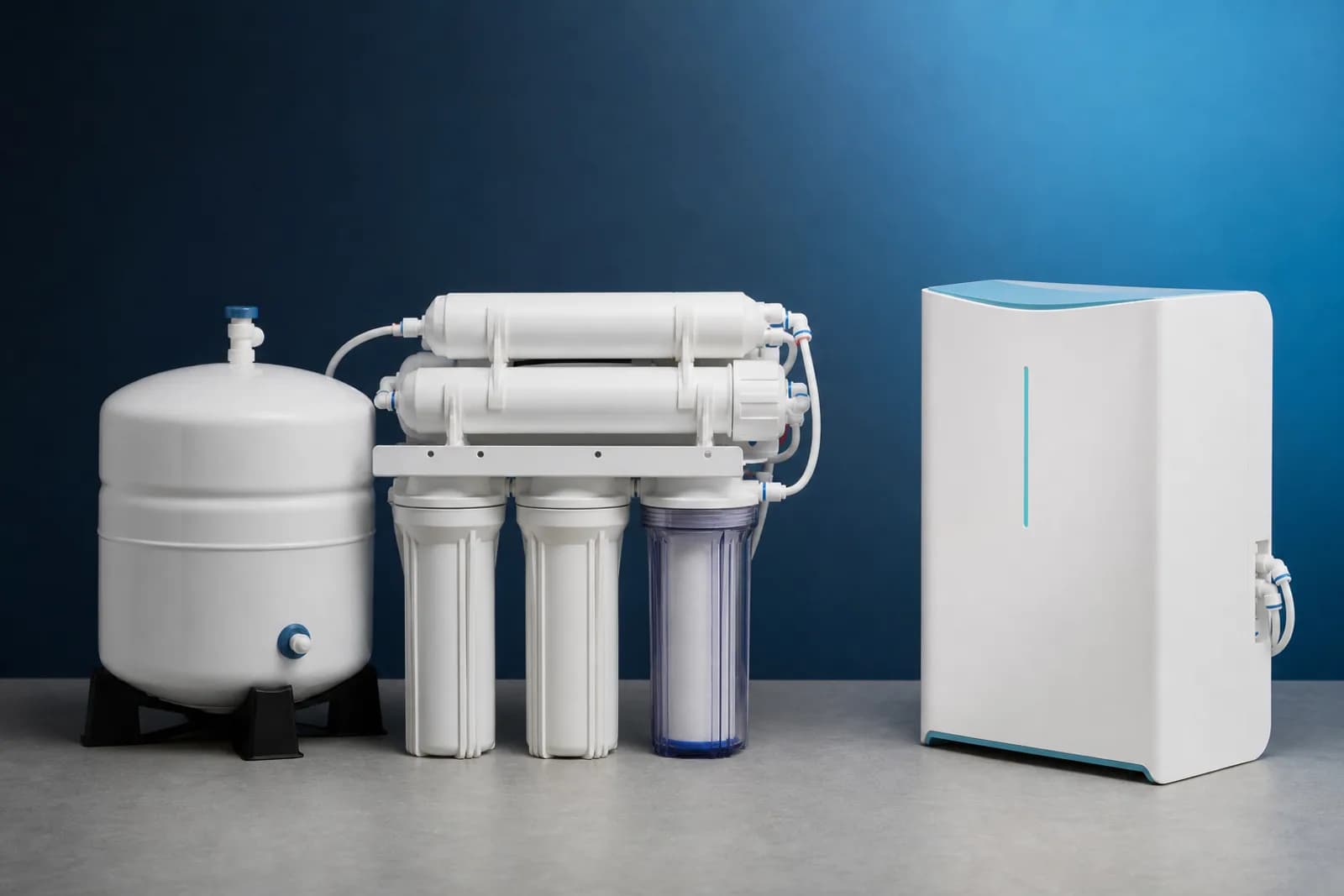
Tank RO stores filtered water in a pressurised vessel, typically between 3 and 8 litres of usable capacity. The membrane runs at a low flow rate — commonly 50 to 100 GPD on budget domestic units — refilling the tank slowly between uses. When you open the tap, water is pushed out by compressed air in the tank's lower bladder, giving a fast, immediate draw. The system mostly runs when the tank is low, which is often at night.
Tankless RO (also called on-demand or direct-flow RO) has no storage vessel. It pairs a higher-capacity membrane — typically 400 to 800 GPD, sometimes more — with a built-in booster pump. Water is produced and delivered almost at once: open the tap, the pump engages, and permeate flows within a second or two. Nothing is stored between uses.
Neither design wins outright. It is a genuine engineering tradeoff.
Flow experience
A well-charged tank system delivers a strong, consistent flow the moment the tap opens. If the tank is full, you can fill a 1.5-litre pot in under a minute without the pump cycling at all. The experience is similar to drawing from the mains — no delay, no ramp-up.
A tankless system's flow depends on what the membrane and pump produce in real time. A generously specified unit at 600 GPD or above gives flow most households find perfectly adequate. A cheaper or undersized unit can feel sluggish next to a charged tank, especially when filling large pots or running back-to-back draws. If you regularly fill a rice cooker, a tall kettle, and a glass in quick succession, the pump has to keep pace.
For most Indonesian kitchens where demand is concentrated around two or three daily cooking sessions, either design is workable — but size the tankless system generously if you cook for a large family.
Footprint and installation
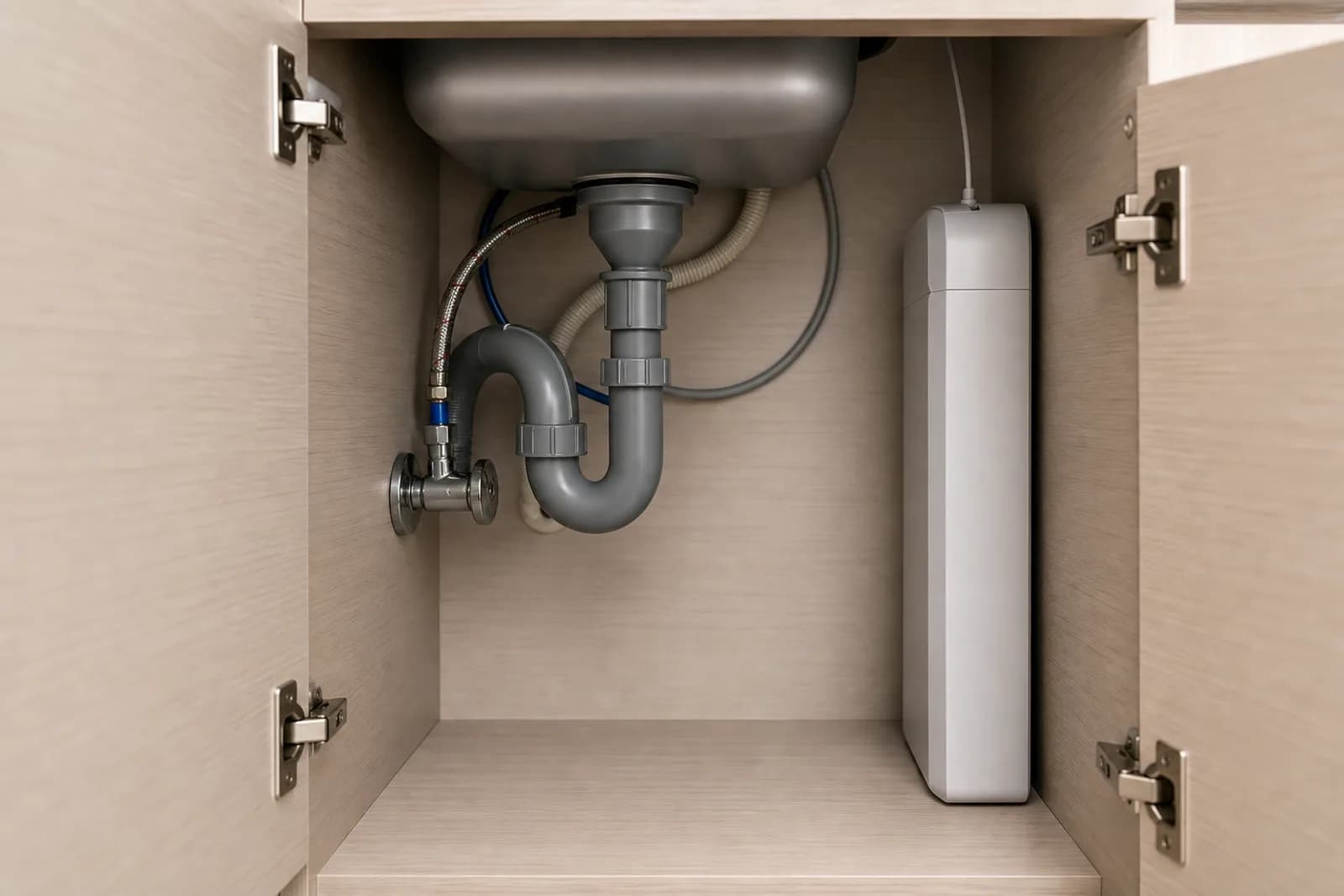
Tank systems occupy meaningful space. The tank itself — commonly around 25 to 30 cm in diameter — sits alongside the filter housing under the sink. In Jakarta apartments where kitchen cabinets are narrow and shallow, this can be a tight fit. If you are measuring cabinet depth before buying, account for the tank, the multi-stage filter housing, the drain saddle connection, and clearance to replace cartridges without dismounting everything.
Tankless units have no separate tank vessel. The entire assembly is typically a compact inline unit, and some designs mount on the inside of the cabinet wall rather than sitting on the floor. In smaller kitchens — particularly those in Type 36 or Type 45 housing — the space saving is a practical advantage, not just a cosmetic one.
Both types need a drain connection, a cold-water feed, and a power supply. Neither is a simpler installation in that sense.
Water freshness and standing-water hygiene
This is where tankless designs have a structural advantage. Water in a pressurised tank can sit for hours between uses — overnight, through a workday, over a long weekend. Over time, standing treated water can develop a flat or slightly stale taste. The tank's rubber bladder can also off-gas faintly if it is an older or lower-grade unit. Periodic tank sanitisation — typically every six to twelve months — is part of the maintenance routine for this reason.
With a tankless system, the permeate travels straight from membrane to tap. There is no reservoir where water waits, so each glass is produced fresh. For households particular about taste — or where someone notices subtle flavour changes — this benefit is real, though not dramatic against a well-maintained tank.
The counter-argument: a properly sized and sanitised tank shows no meaningful taste difference under normal use. If you maintain the tank interval, freshness is not a practical problem. It only becomes one when maintenance is skipped.
Power dependence
Both tank and tankless systems use electricity — the booster pump runs in both cases. The difference is in when it runs.
A tank system's pump cycles on and off as the tank depletes and refills, usually for short bursts. During a power outage, you can still draw the water already stored in the tank until it empties.
A tankless system's pump must run continuously while the tap is open. No power means no water. In areas with frequent PLN interruptions — rural districts, or parts of the outer islands — this matters. If your power supply is uncertain, a tank gives you a buffer.
For urban households in Jakarta, Surabaya, or Bali, the distinction is usually marginal. Outages there are short enough that the difference in usability is minimal.
Waste water ratio
RO systems reject a portion of feed water as concentrate — the stream that carries away the contaminants the membrane removes. The ratio of permeate to reject is one of the more meaningful efficiency figures to compare.
Conventional tank systems paired with low-GPD membranes commonly produce 1 litre of purified water for every 3 to 4 litres of reject, or worse, depending on the membrane grade and operating pressure. This ratio is partly a function of the low operating pressure typical in systems designed around stored water.
Tankless systems with higher-GPD membranes and dedicated pumps generally achieve better ratios. Well-specified units commonly reach 1:1 or better (meaning equal or more permeate than reject), and some designs incorporate reject-water recycling loops that improve the ratio further. For households mindful of water use — or in buildings where the water bill is metered — the difference adds up over a year.
This is one area where newer tankless designs have improved meaningfully over the conventional tank approach, though the exact ratio depends on the specific unit and feed-water conditions.
Cost
Tank systems carry a lower upfront price. Entry-level under-sink tank RO units are widely sold in Indonesia at the affordable end of the market, and their spare parts — pre-filter cartridges, tank bladders — are stocked everywhere and often interchangeable across brands.
Tankless systems generally carry a higher upfront cost. The higher-capacity membrane, the booster pump, and the electronics for flow management all add to the build, and the retail price reflects that. Budget accordingly.
Running costs are broadly comparable: both need pre-filter cartridges replaced every six to twelve months and an RO membrane replaced every two to three years under normal conditions. Tankless systems add occasional pump servicing to that list. The tankless system also consumes slightly more electricity, though the difference is modest given how short the active pump run times are.
Maintenance differences
For a tank system, the maintenance schedule includes everything standard to RO — sediment filter, carbon block, membrane, post-carbon — plus periodic tank sanitisation. If the tank's air pressure has drifted (a common occurrence on older units), the bladder needs re-pressurising with a bicycle pump or compressor to the manufacturer's specified pressure, typically around 6 to 8 psi when empty. A tank that has lost air pressure produces a weak, dribbling flow even when full — a common complaint that is usually a simple fix.
Tankless systems skip the tank-related items but add a pump. Pumps are reliable in quality units, but they are a moving component that tank systems simply do not have. On rare occasions a pump may need replacement — a cost and job that tank users never face.
Neither maintenance profile is substantially more demanding than the other. The tank adds a sanitisation step; the tankless adds pump awareness.
Choose tank if…
- Cabinet space is adequate and you want the lowest upfront cost.
- You want fast, powerful flow even from a modest membrane.
- Power supply is occasionally unreliable and you want water in reserve during outages.
- You are comfortable with the periodic tank sanitisation routine.
- Replacement parts availability matters — tank components are stocked everywhere in Indonesia.
Choose tankless if…
- Your cabinet is small or you are fitting into a compact kitchen.
- Fresh-tasting water on demand is a priority and you would rather not schedule tank sanitisation.
- You want a better waste ratio and are monitoring water consumption.
- You are happy paying more upfront for a more elegant under-sink installation.
- Your power supply is consistent and stable.
The tank design earned its place in millions of homes by being reliable, affordable, and easy to service. The tankless design solves real problems — space, freshness, waste ratio — but asks more from your budget and your power supply. Neither is the right answer in every kitchen.
Measure your cabinet, assess your cooking habits, and check your power situation. Those three factors will almost always point clearly to one or the other.
Not sure which system fits your water?
Aright Marketing Indonesia can assess your supply and recommend the right Truliva system for your home or business in Indonesia.