How to Size RO Capacity (GPD) for Your Household
GPD is the most-quoted spec on any RO system, yet most buyers misread it. This guide explains what GPD actually means at the tap, how to match membrane capacity to real household demand, and where tank versus tankless design changes the calculation entirely — with concrete scenarios for Indonesian homes.
Gallons per day — GPD — is the number printed most prominently on every domestic RO system, yet most buyers cannot say what it means at the tap. A 600 GPD unit does not fill 600 gallons of glasses per day; it describes the membrane's maximum rated output under specific laboratory conditions that differ substantially from the warm, variable-pressure reality of a home in Jakarta or Surabaya. Understanding that gap is what sizing is actually about.
What GPD actually measures
The GPD rating comes from a test at standardised conditions: 25°C feed-water temperature, 0.35 MPa (approximately 3.5 bar) inlet pressure, and feed TDS of around 500 ppm. Real installations deviate on all three.
Temperature matters because membranes produce less permeate as feed water cools. At 15°C, output commonly falls to roughly 75% of the rated figure — though the exact derating varies by membrane type and construction. At 10°C, the drop is steeper. In Indonesia this rarely applies: borehole water in most lowland cities sits in the 26–30°C range year-round. A unit installed in an air-conditioned utility room with a long cold-water run will see somewhat cooler feed, but Indonesian households still lose far less to temperature than buyers in temperate climates.
Inlet pressure is more variable. PDAM supply fluctuates in many neighbourhoods — peak morning demand can push pressure below the 0.3 MPa needed for consistent membrane performance. Most modern tankless systems include a booster pump that compensates, though the pump adds electricity draw and one more component to maintain.
For practical sizing, assume roughly 70–80% of rated GPD is reliable daily throughput. A 600 GPD unit delivers approximately 1,600–1,800 litres per day; a 1000 GPD unit, approximately 2,700–3,000 litres. Both figures far exceed what any ordinary household drinks.
Converting GPD to litres your household uses
One US gallon equals 3.785 litres, so:
- 400 GPD ≈ 1,514 L/day rated; ~1,060–1,210 L/day realistic
- 600 GPD ≈ 2,271 L/day rated; ~1,590–1,815 L/day realistic
- 1000 GPD ≈ 3,785 L/day rated; ~2,650–3,030 L/day realistic
- 1200 GPD ≈ 4,542 L/day rated; ~3,180–3,630 L/day realistic
Now consider actual household consumption. A conservative estimate for drinking water in a tropical climate is 2–3 litres per person per day. For cooking — rice, soup, blanching vegetables — add another 1–2 litres per person in an active kitchen. For a family of four, that is roughly 12–20 litres per day. Even a 400 GPD system produces that in under a minute.
The gap between rated capacity and actual demand is large at every typical GPD. So why does the rating matter? Three reasons: recovery rate, peak flow rate, and whether the system has a tank.
Tank versus tankless: where capacity plays out differently
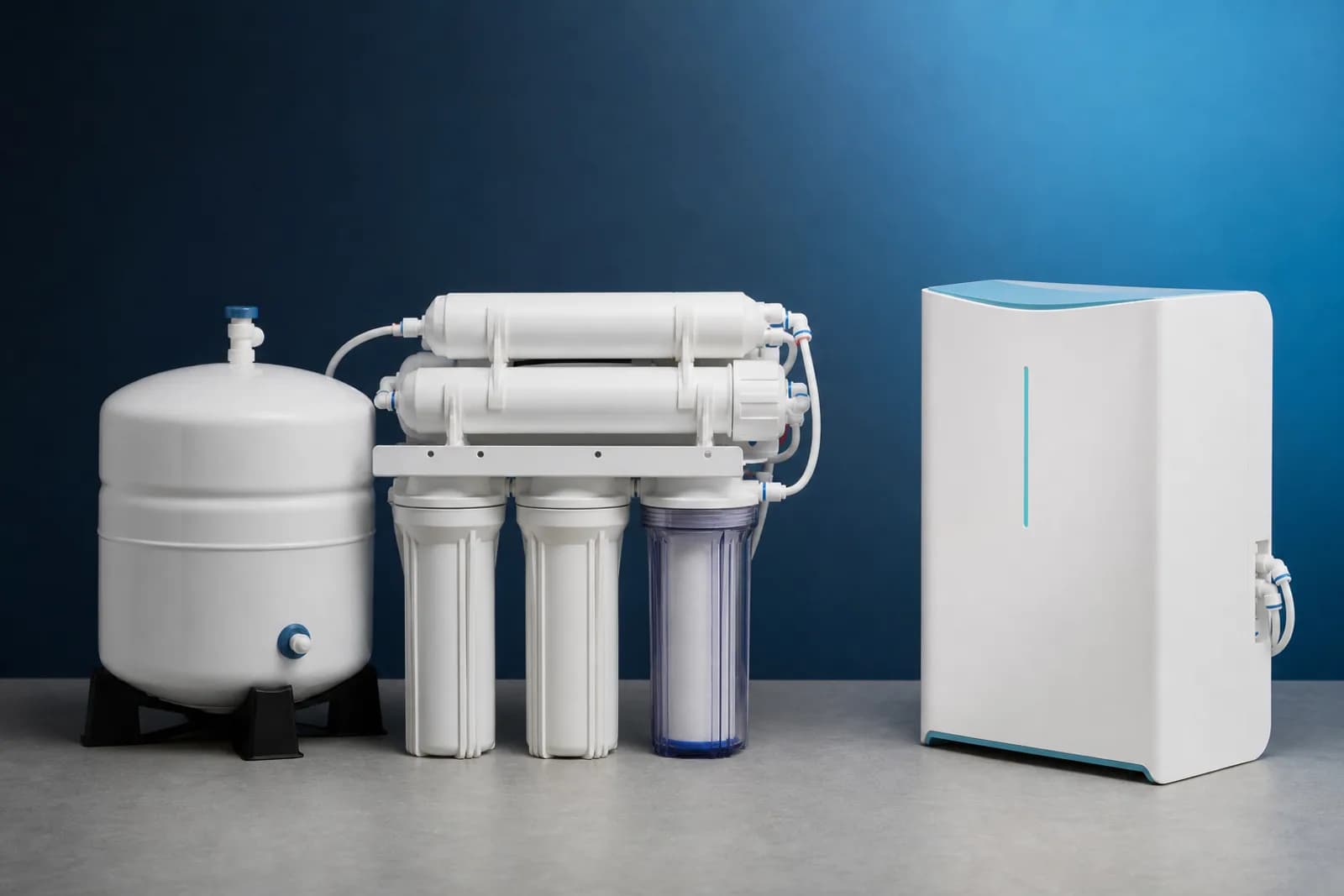
Tanked RO systems (the older, traditional design) work by filling a pressurised storage vessel — typically 3–10 litres usable — during idle periods. The membrane can run slowly because it has time between uses to top up the tank. Rated GPD matters less here than tank size: a 4-litre tank refills at roughly 4 litres per hour on a 100 GPD membrane, so back-to-back morning use by a family of five can drain it faster than it refills. The system eventually "catches up" during the day when no one draws, but the experience at peak times can be a trickle.
Tankless RO systems work differently. Without a storage tank, the membrane and booster pump produce water on demand in real time, so flow rate at the faucet is set directly by membrane throughput. GPD becomes a number you feel at the tap.
What GPD means at the tap is best read directly from the spec sheet. Truliva's UR-Q3626, rated at 600 GPD, delivers a constant 1.5 L/min at the faucet; the UR-S61096H, rated at 1000 GPD, delivers 2.66 L/min; the 1200 GPD UR-A61290 delivers 3 L/min. These are real measured outputs, not theoretical conversions. The difference is tangible in daily use: at 600 GPD a 1.5-litre kettle fills in one minute; at 1000 GPD the same fill takes about 34 seconds.
For most households of two to five people, 600 GPD handles daily drinking and basic cooking without strain. The higher-GPD units justify their step-up in households that cook at volume, run the tap frequently at full draw, or where two people drawing simultaneously would notice a restricted flow.
Sizing by household scenario
Two people, light cooking, mostly drinking: 600 GPD is comfortable. The UR-Q3626's 1.5 L/min constant flow handles back-to-back glasses and occasional kettle fills without hesitation. Daily consumption of 8–10 litres sits far below even a conservatively derated output.
Family of four, active kitchen: 600 GPD remains workable, but 800–1000 GPD provides headroom for simultaneous draws — one person filling a pot while another fills a water bottle. The UR-S61096H at 1000 GPD delivers 2.66 L/min, which noticeably reduces wait time when cooking volume peaks.
Family of five or more, or shared with domestic staff: 1000–1200 GPD is worth the step up. At 1200 GPD, 3 L/min at the faucet puts it close to standard tap flow, which means the RO faucet never feels restricted.
Air galon replacement: Many Indonesian households rely on galon refill jugs (19 litres) as their primary drinking water source, restocking every few days. A 19-litre galon typically costs Rp 5,000–20,000 depending on brand, supplier, and city — a wide range that shifts with inflation and local competition. At four to five galons per month for a household, annual spend can run in the range of Rp 1,000,000–2,000,000 (illustrative arithmetic based on those price and consumption assumptions; actual costs vary). A properly sized under-sink RO eliminates that recurring expense; the breakeven point against the unit price will depend on local galon pricing and how much the household currently spends.
Feed-water TDS and its effect on sizing
Higher source TDS means the membrane works harder and effective output falls. PDAM supply in most Indonesian cities typically runs 100–400 ppm after treatment — a practical generalisation; actual readings vary by city, season, and treatment plant. Coastal areas with saltwater intrusion, or households on sumur bor (borehole wells) in areas of high mineral content, can see TDS above 500 ppm. At those levels, membrane output drops and the wastewater-to-product ratio worsens.
If your source water is above 500 ppm, the practical rule is to size up one step. A household that would be comfortable on 600 GPD at 300 ppm source TDS should consider 800–1000 GPD at 600–800 ppm, to maintain equivalent flow and recovery rate. Measuring your TDS before purchase is a 5-minute task with an inexpensive TDS pen; most water filter retailers in Jakarta and Surabaya will test your water for free.
Water efficiency: don't ignore the reject ratio
Every litre of purified water a tankless RO produces also sends some water to drain as concentrate. Modern systems have improved this considerably. The UR-S61096H is rated at 80% water efficiency, meaning for every 5 litres drawn from the mains, 4 litres reach the glass and 1 litre goes to drain. Older designs with 25–33% recovery would waste 2–3 litres per litre produced — a meaningful cost on a metered PDAM connection.
Where water tariffs are higher or supply is intermittent — a real concern in parts of outer Jakarta and many second-tier cities — water efficiency is a specification worth comparing, not a marketing footnote. A higher-GPD unit at 80% efficiency sends less water to drain per litre produced than a lower-GPD system running at 40% recovery, for the same daily output volume.
The practical decision
For most Indonesian households the sizing decision comes down to two questions: how many people draw water at the same time during peak morning use, and what flow rate feels acceptable when cooking.
A family of four replacing an air galon habit will be well served by 600 GPD in most cases. Step up to 1000 GPD if the kitchen regularly sees simultaneous draws, or if source TDS is high, supply pressure is unreliable, or the household has five or more regular users.
The worst outcome is choosing a tanked system because the unit price is lower, then finding it delivers a thin trickle at 7 a.m. when three family members want water at once. A tankless system at the right GPD solves that permanently — and the flow rate on the spec sheet tells you exactly what to expect before you buy.
Not sure which system fits your water?
Aright Marketing Indonesia can assess your supply and recommend the right Truliva system for your home or business in Indonesia.