How to Choose a Water Purifier for an Indonesian Home
Start from your water source, then match the technology. A practical decision framework for piped, groundwater, and refill households across Indonesia.
The right purifier is decided by your water, not by the brochure. A family on coastal groundwater with a brackish taste needs a different machine from an apartment on metered PDAM supply, and a borehole household with iron-stained sinks needs something different again. Get the source right first, and every other decision becomes simpler.
Start from your water source
Before comparing models, find out what you are actually treating.
- Piped supply (PDAM). Often reasonable at the plant, but it can pick up sediment and bacteria through ageing, intermittent pipes. The main jobs are removing particles, killing microorganisms, and improving taste.
- Groundwater or borehole. Highly variable. Shallow urban wells near septic systems carry bacteria; coastal wells carry salt from saltwater intrusion; many wells carry iron and manganese that stain fixtures. High dissolved solids point toward reverse osmosis.
- Refill gallon (air galon). Already treated, but quality depends on the depot's last maintenance. A point-of-use filter at home gives you a second barrier you control.
A TDS meter costs little and tells you the dissolved-solids load in seconds. Combine that one number with a look at colour, smell, and how your sinks stain, and you have enough to choose well.
The four common types
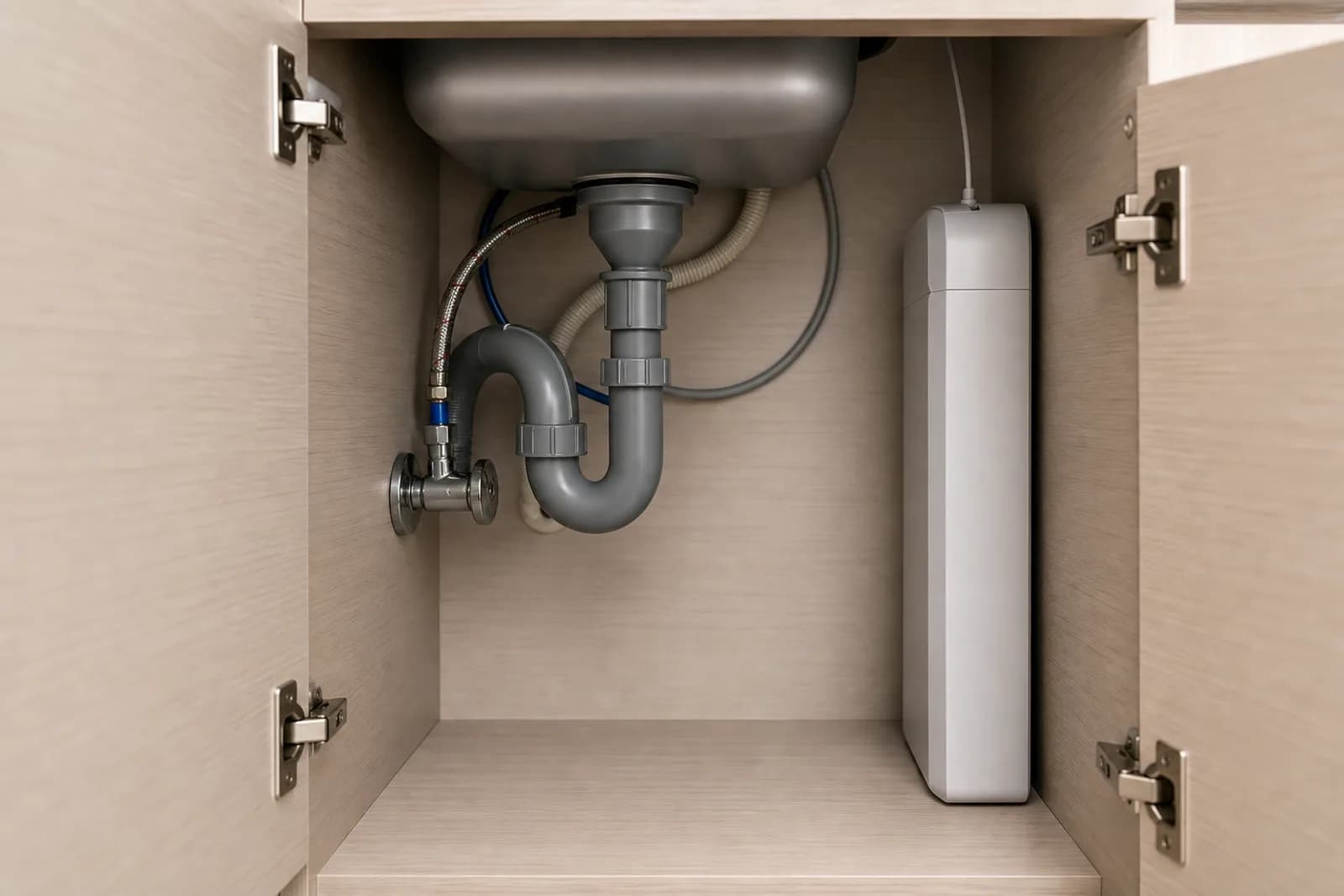
Under-sink RO. A reverse-osmosis membrane forces water through pores fine enough to block dissolved salts, heavy metals, and microorganisms. It is the most thorough barrier and the right answer for high-TDS or brackish water. It needs a drain connection, usually a small storage tank, and on most designs a pump and power. Truliva RO systems run a 7-layer sequence — folding PP, front activated carbon, PP, RO membrane, non-woven, post carbon, and UV — and remove up to 99.9% of 104 substances.
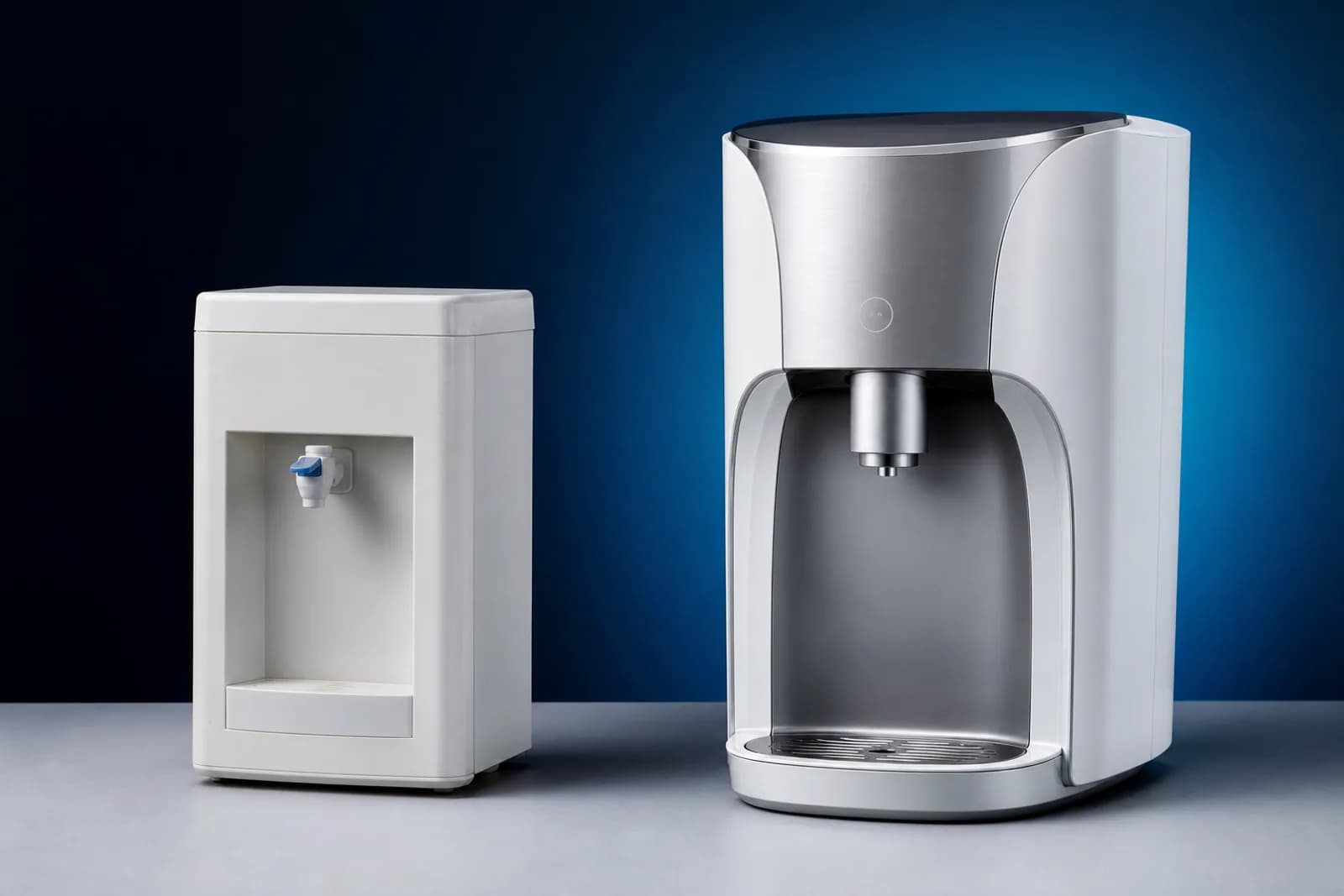
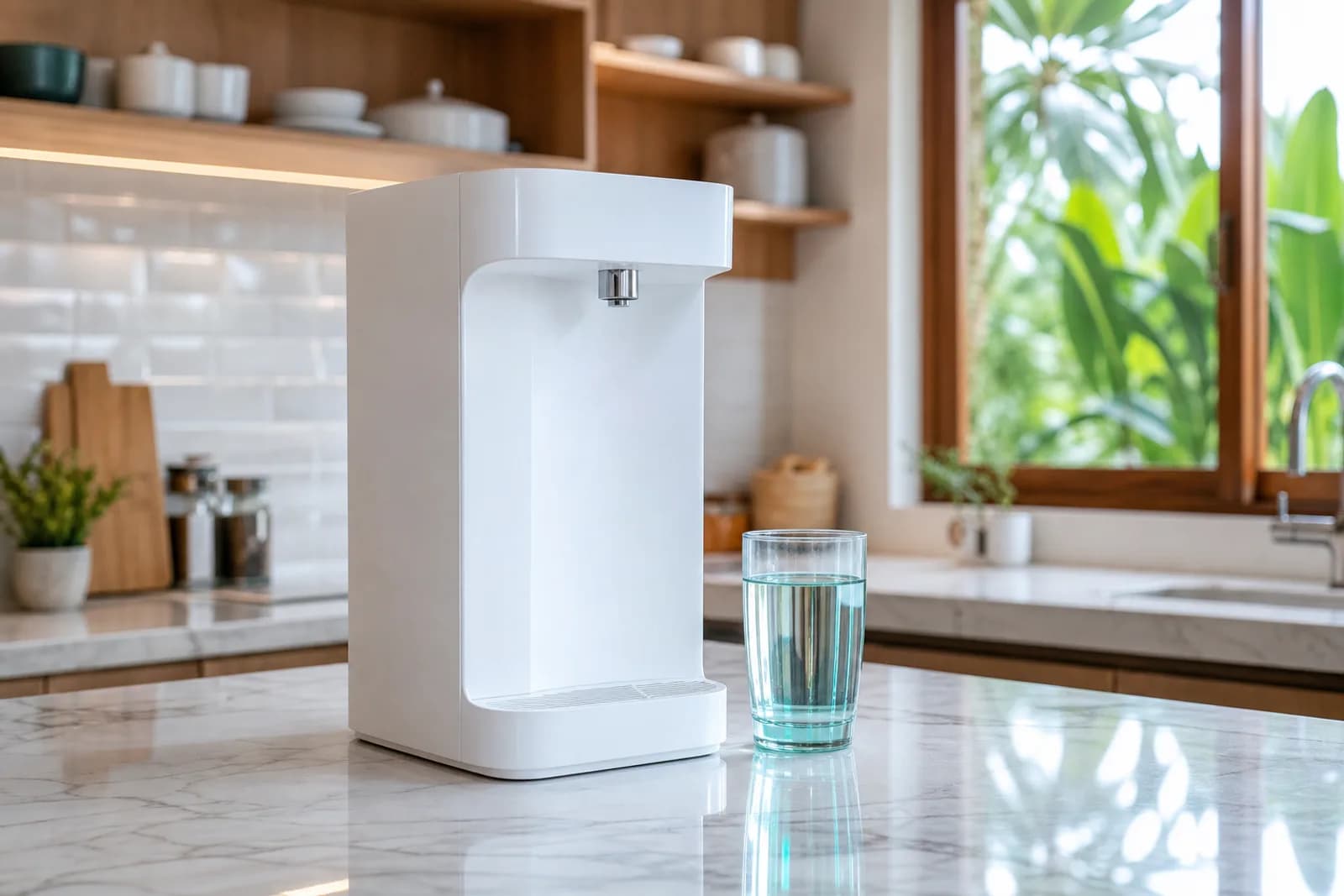
Countertop RO. The same membrane technology in a portable housing that sits on the worktop. No plumbing or drilling, which suits renters and small kitchens. The trade-off is a larger footprint on the counter and a tank you sometimes refill by hand, depending on the model.
Ultrafiltration (UF). A membrane with larger pores than RO. It blocks bacteria, protozoa, and particles but lets dissolved minerals pass straight through. UF needs no electricity and no drain on gravity-fed designs, which makes it simple and cheap to run. It is a strong fit for reasonably clean piped water where you want to keep natural minerals and only need a microbiological and particle barrier.
Pitcher filters. A jug with a carbon cartridge. It improves taste and chlorine but does not remove bacteria or dissolved solids reliably. Treat it as a taste upgrade, not a safety device, especially with groundwater.
Flow rate and family size
Flow rate is how fast treated water comes out; capacity is how much the system can produce over a day, often quoted in GPD (gallons per day).
- A household of two to four people is comfortable with a flow around 1.5–3 litres per minute, which is the range Truliva systems deliver.
- Larger families, or homes that cook and entertain heavily, are better served by higher-output systems. Truliva models span roughly 600 to 1200 GPD.
- If several taps draw at once, or you fill large pots often, lean toward higher flow and capacity rather than the cheapest unit that technically fits.
A system that is too slow becomes the bottleneck of your kitchen. Size up before you size down.
Installation reality
This is where good choices fall apart, so check it before you buy.
- Renting? Avoid permanent drilling. A countertop RO or a gravity UF unit moves with you and needs no landlord approval.
- Own your home with cabinet space? An under-sink RO is tidy and out of sight. Measure the cabinet — the unit, the tank, and the filter clearances all need room.
- RO needs a drain. Reverse osmosis produces a reject stream that has to go somewhere, usually tapped into the sink waste. No drainage access means RO is harder to fit, and that constraint alone can decide the technology.
- Power. Most RO systems with a pump need a nearby socket. UF gravity systems do not.
Running costs, honestly
The purchase price is only part of the cost. Cartridges are consumable and must be replaced on schedule.
- Truliva cartridges are rated for roughly 4,000 to 9,000 litres of service life depending on the stage and model.
- RO membranes last longest; sediment and carbon stages are replaced more often. Premium Truliva models use 8-year long-life RO membranes, which lowers the cost of the most expensive cartridge over time.
- In Indonesia's heat and with heavy use, real-world life sits at the shorter end of any quoted range. Budget for filters as an ongoing cost, the way you would for any appliance.
A cheap machine with expensive or short-lived cartridges can cost more over five years than a better unit. Compare the running cost, not just the sticker.
What to ignore in marketing
- "Alkaline" and "mineral" claims as a health cure. They change taste, not your health outcomes. Choose on filtration performance first.
- TDS as a quality score. A low TDS reading after RO is expected; it is not proof the water is "better" in every sense. RO simply removes dissolved solids, minerals included.
- Stage counts as a headline. Seven stages that each do a job beat ten stages that pad the spec sheet. Ask what each stage removes.
A simple decision path
- Measure your TDS and look at your water.
- High TDS, brackish, or borehole water → RO. Clean piped water, want minerals → UF.
- Renting or no drain → countertop RO or gravity UF. Own the home with cabinet space and a drain → under-sink RO.
- Size flow and GPD to your household, then up one notch if usage is heavy.
- Compare five-year cartridge cost before signing.
Pick the source, match the barrier, check that it physically fits your kitchen and your tenancy. Do that, and the machine will quietly do its job for years.
Not sure which system fits your water?
Aright Marketing Indonesia can assess your supply and recommend the right Truliva system for your home or business in Indonesia.