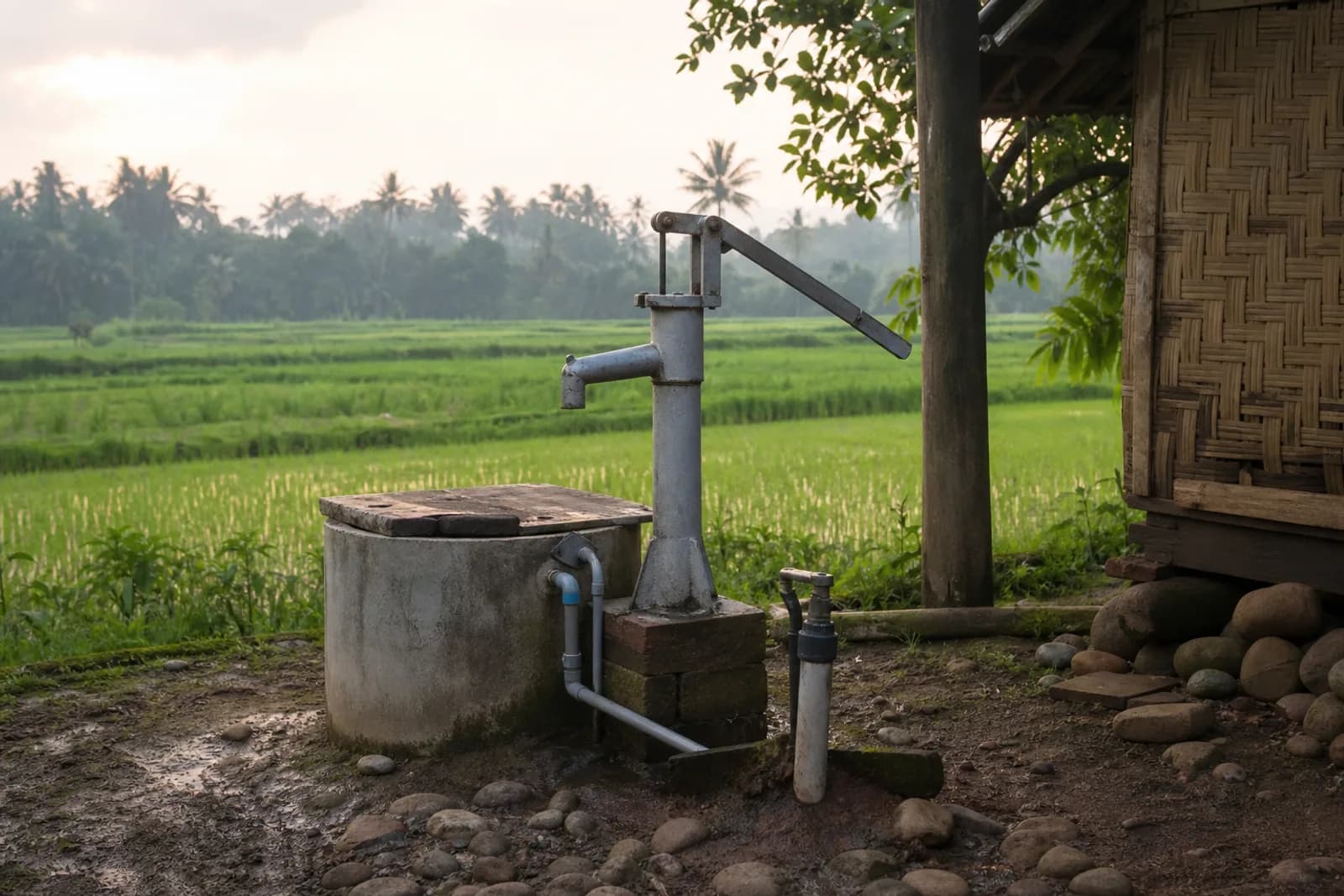
Saltwater Intrusion in North Jakarta: Why Coastal Groundwater Needs RO
Saltwater intrusion has made brackish groundwater the norm across coastal North Jakarta. Understand why it happens, how to measure TDS in your sumur bor, and why reverse osmosis is the only household technology that removes dissolved salt.
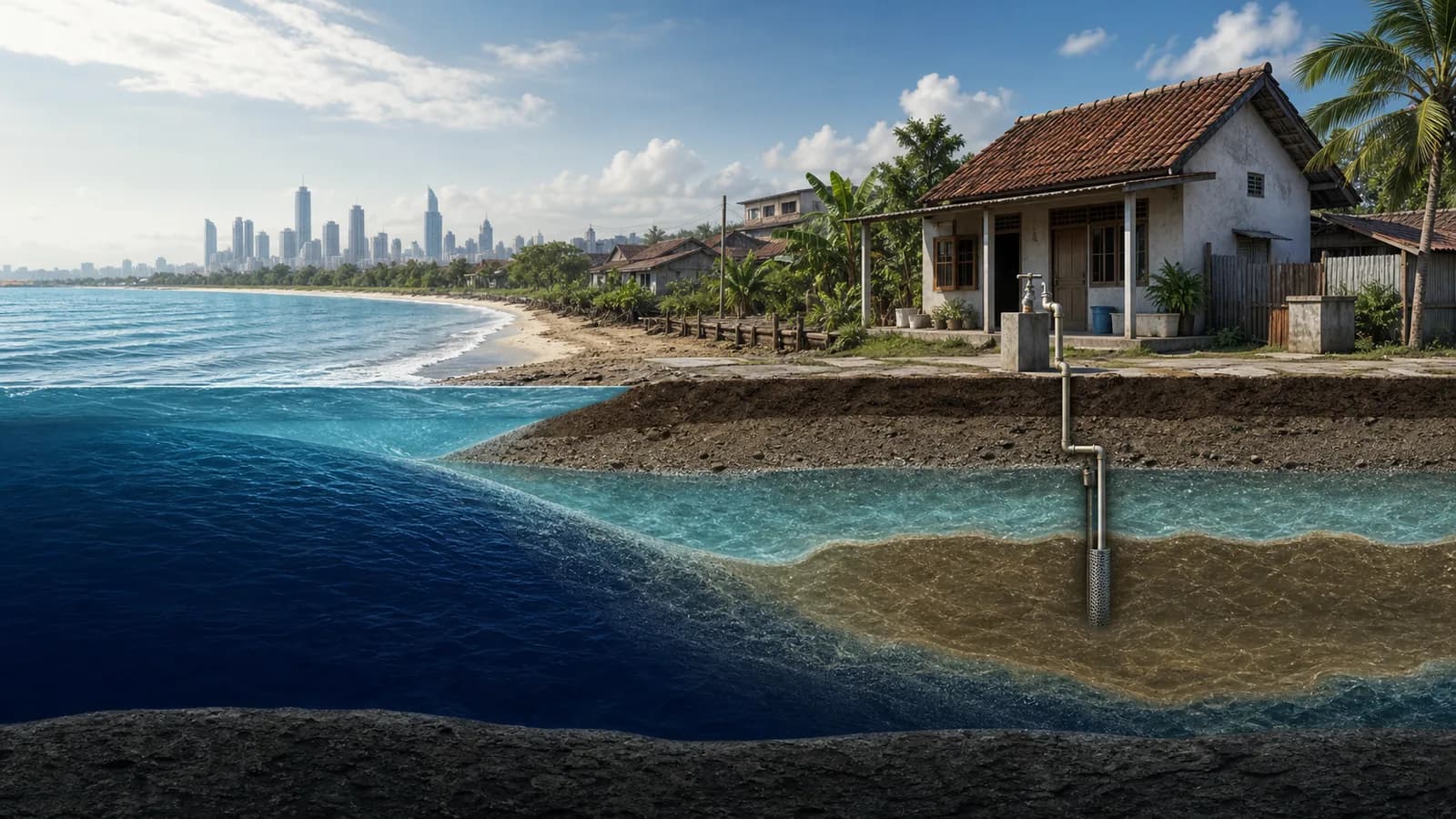
North Jakarta sits below sea level across much of its coastline, and the groundwater beneath it reflects that geography. Decades of unchecked borehole extraction have drawn the saltwater front kilometres inland, leaving sumur bor across Penjaringan, Pluit, Muara Baru, and Pademangan with dissolved solids far above any safe drinking threshold. For residents in these areas, understanding what is in their groundwater is not an academic exercise.
How saltwater gets into coastal aquifers
Freshwater and seawater co-exist beneath coastal land in a natural balance. Fresh groundwater, being lighter, floats above a denser saltwater wedge that extends inland from the coast. As long as the freshwater table is replenished by rain and the borehole extraction rate stays within the aquifer's recharge capacity, that boundary holds.
North Jakarta broke that equilibrium decades ago. The city's rapid urbanisation paved over the land surface, cutting off natural rainwater infiltration. At the same time, borehole drilling accelerated: PDAM piped supply in coastal North Jakarta has historically been unreliable or inaccessible in informal settlements, so households and small businesses drilled their own sumur bor. With millions of people extracting groundwater faster than rain could replace it, the freshwater table dropped. The saltwater wedge below advanced landward to fill the vacuum.
The process is now largely self-reinforcing. Land subsidence — Jakarta's coastal districts have sunk at commonly reported rates of several centimetres per year, and some areas are documented as having subsided more than three metres over recent decades — continues to lower the land surface. That in turn allows tidal seawater to infiltrate soil and reach the aquifer more directly during floods and king tides. The problem is structural, not seasonal.
What brackish groundwater actually contains
"Brackish" describes water that is saltier than freshwater but less salty than seawater. In the context of North Jakarta's sumur bor, this typically means the water tests high in sodium and chloride — the main components of seawater that have migrated inland — along with whatever the natural and anthropogenic geology contributes: iron, manganese, and in areas near old industrial sites, heavy metals.
A TDS (total dissolved solids) meter gives the fastest field indicator. Normal drinking water sits below 500 mg/L (ppm). PDAM piped supply in Jakarta typically reads somewhere in the 100–300 ppm range. Shallow sumur bor in coastal North Jakarta commonly return readings in the 1,000–3,000 ppm range; in the most severely intruded areas near the coast, readings above 5,000 ppm are not unusual. That is approaching the salinity of brackish estuaries.
The problem is not just taste — though distinctly saline water is plainly unpalatable. At elevated sodium chloride concentrations, water contributes meaningfully to sodium intake, which matters for people managing blood pressure. Chloride at high concentrations is also corrosive to copper plumbing. And because the ionic load triggers scale formation on heating elements, appliances fed with hard brackish water deteriorate faster.
Why ordinary filters cannot fix it
The salt in brackish water is dissolved — it exists as sodium and chloride ions in solution, not as particles or turbidity. Mechanical filtration, no matter how fine, cannot remove dissolved ions. A sediment filter, an activated carbon block, or a hollow-fibre ultrafiltration membrane will all let sodium and chloride pass straight through.
UF membranes, with pore sizes around 0.01–0.1 microns, are excellent at removing bacteria, viruses, and suspended particles. But dissolved salts are molecular in scale — roughly 0.0003 microns — far smaller than any UF pore. If a supplier claims their UF or carbon filter can reduce salinity in a borehole, that claim is not supportable.
The same limitation applies to air galon refill stations, which are a common fallback in areas where PDAM is unreliable. The quality of galon refill water depends entirely on what treatment the depot uses. Many depot operators use simple sediment and carbon filtration, which produces water that tastes better but may still carry dissolved ions from the source. A TDS reading at the filling station is worth checking before assuming the water is low in dissolved solids.
Why RO is the only household technology that works here
Reverse osmosis operates on a fundamentally different physical principle. Instead of filtering particles, the RO membrane — a thin-film composite with pores around 0.0001 microns — uses applied pressure to force water molecules through while excluding dissolved ions. Sodium and chloride, being charged particles that are large relative to the pore, are rejected. The purified water passes through to a product line; the concentrated saline reject exits to drain.
Across a well-maintained membrane, RO commonly achieves 95–99% rejection of dissolved salts. Feed water at 2,000 ppm TDS will typically yield product water in the range of 20–100 ppm — well within acceptable drinking-water limits. This is why RO is the standard technology for desalination plants at industrial scale, and why compact domestic RO systems are the only household option that addresses the brackish groundwater problem in coastal North Jakarta.
Two practical points for borehole users follow directly from the physics. First, the higher the source TDS, the higher the ratio of reject water to product water. A domestic system processing 2,000 ppm feed will send more water to drain than one treating 300 ppm PDAM supply — that is the physical consequence of having more dissolved material to concentrate and flush away. Modern tankless designs with permeate pumps can reach 50–75% recovery at moderate TDS levels, but at very high salinity the reject fraction rises. Second, high-TDS borehole feed puts greater load on the pre-filter stages and the membrane. Pre-filter cartridge life shortens, and regular membrane flush cycles matter more for longevity.
Choosing a system for coastal conditions
For a household in North Jakarta running on sumur bor with TDS above 500 ppm, the decision framework is straightforward: RO is necessary; the question is format.
Under-sink RO systems are the most practical choice for the kitchen — they connect directly to the mains or a borehole pump line, sit out of sight, and deliver water continuously at a dedicated faucet. The UR-Q3626 is a four-stage, 600 GPD under-sink unit with a slim 105 mm-wide body and 99.9% removal rate — a practical starting point for first-time RO buyers in price-sensitive settings. For households that want instant hot water alongside RO purification, the UR-S61096H runs seven filtration layers with a 1000 GPD output and a 3-second instant-hot faucet, covering both drinking and cooking water needs from one under-sink installation.
For renters or households that cannot modify the plumbing, a counter-top RO requires no installation beyond a power socket. These units process source water in their own reservoir rather than plumbing into the borehole line — practical for low-volume daily use, though the water source still needs to be carried to the unit.
What matters most for coastal borehole conditions is that the system chosen is genuinely RO-based and not marketed as RO when it is primarily a UF or carbon system. The distinction is not always obvious in retail advertising. The test: ask for the membrane rejection specification. A legitimate RO membrane will state a salt rejection percentage, typically 95% or higher against a standard sodium chloride test solution.
Measuring your own water first
None of this requires guessing. A handheld TDS meter costs around Rp 50,000–150,000 at electronics shops or online marketplaces and gives an immediate reading of dissolved solids in your borehole or PDAM supply. Anything above 500 ppm is worth treating seriously; anything above 1,000 ppm makes RO not optional but necessary for safe daily drinking.
If your borehole reading is high and your neighbours' readings are similar, that confirms a systemic aquifer problem rather than a localised contamination event. In that scenario, no amount of boiling improves the water — boiling concentrates dissolved salts further. The only paths to low-TDS drinking water are a properly functioning RO system, or verified low-TDS water from an external supply.
What individual households can actually do
Jakarta's groundwater crisis is a city-scale infrastructure problem. The government has introduced restrictions on deep borehole extraction in many North Jakarta districts, and the long-term interaction between land reclamation projects and aquifer recharge is still being studied. What residents can do in the meantime is understand the specific water quality problem at their address, measure it accurately, and choose treatment technology that addresses dissolved ionic load — not technology that addresses turbidity and taste while leaving the underlying salinity untouched.
In coastal North Jakarta, that means RO. The physics leave no room for a cheaper shortcut.
Not sure which system fits your water?
Aright Marketing Indonesia can assess your supply and recommend the right Truliva system for your home or business in Indonesia.