RO vs UF: Which Filtration Is Right for You
Reverse osmosis and ultrafiltration differ by pore size and what they let through. Here is the real mechanical difference and how to choose by your water source.
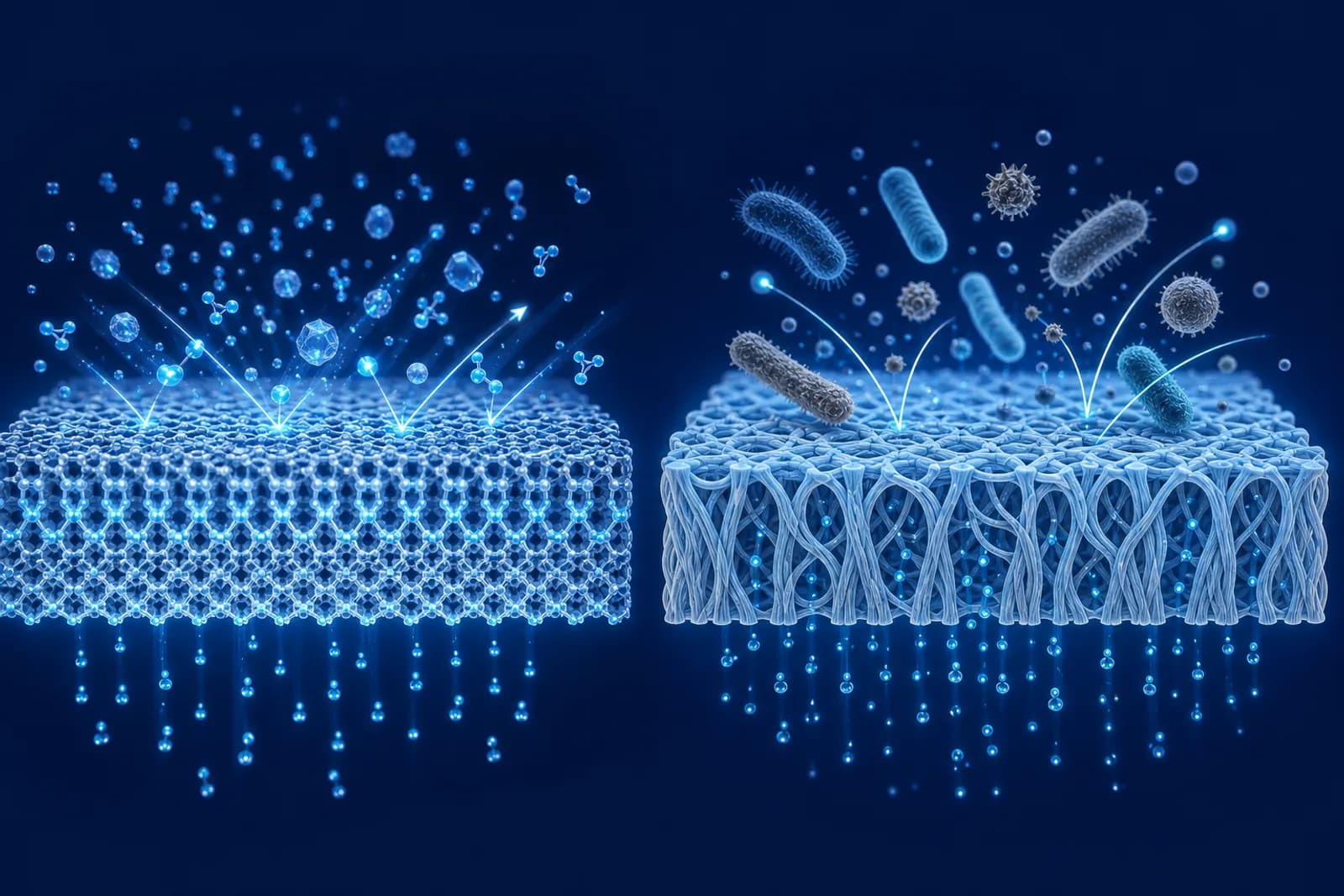
The difference between RO and UF comes down to one number: the size of the membrane pore. Reverse osmosis blocks dissolved solids; ultrafiltration does not. Everything else — minerals, wastewater, power, taste — follows from that single fact. Once you understand it, choosing between them stops being a marketing question and becomes a question about your water.
The mechanical difference
A membrane is a barrier with very small holes. Water passes; anything larger than the holes is held back.
- Ultrafiltration (UF) uses pores in the order of 0.01 micron. That is fine enough to stop bacteria, protozoa, cysts, and suspended particles. It is far too coarse to stop dissolved salts and minerals, which are individual ions roughly a thousand times smaller. So they pass straight through.
- Reverse osmosis (RO) uses a membrane with pores around 0.0001 micron — about a hundred times tighter. At that scale, dissolved solids are blocked too: salts, heavy metals, fluoride, and most dissolved contaminants are rejected along with microorganisms.
That is the whole story in one line. UF is a sieve for things you can think of as particles. RO is a barrier even for things dissolved into the water itself.
What each one does to your water
UF keeps minerals. Because dissolved ions pass through, water that leaves a UF system still contains its calcium, magnesium, and other natural minerals, and its TDS reading barely changes. You get microbiologically clean water that tastes close to the source.
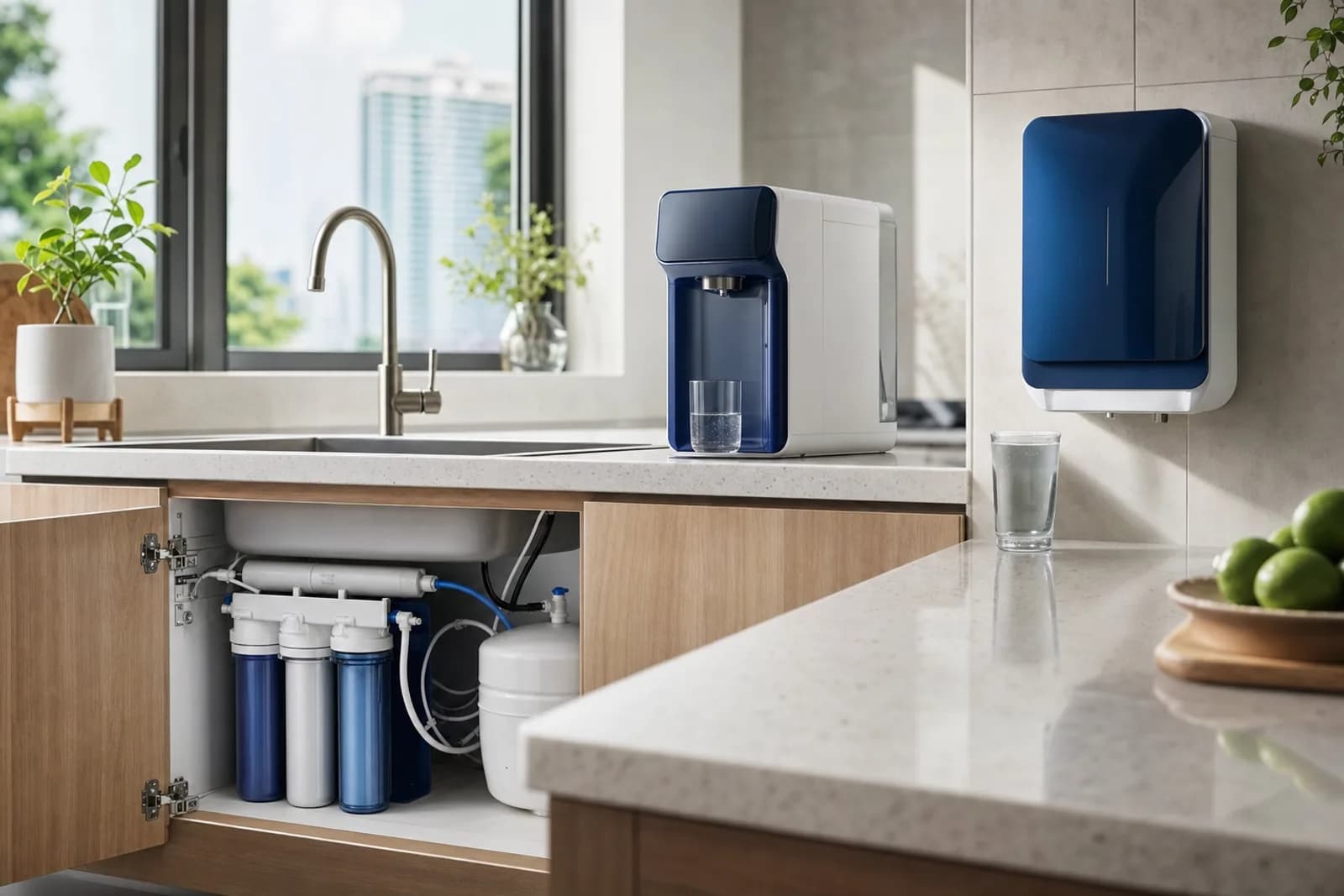
RO strips dissolved solids. RO removes the dissolved load, minerals included. The water comes out with a low TDS reading. Truliva RO systems remove up to 99.9% of 104 substances through a 7-layer sequence — folding PP, front activated carbon, PP, RO membrane, non-woven, post carbon, and UV.
Neither outcome is automatically "better." Removing dissolved solids is exactly what you want with salty or contaminated water, and exactly what you do not need when the water is already clean and you value the minerals.
Wastewater, power, and pressure
These practical costs separate the two as much as performance does.
- Reject water. Forcing water through an RO membrane leaves a concentrated reject stream that goes to drain. There is always some wastewater; modern designs reduce it, but it does not disappear. UF produces essentially none on normal operation, flushing only when you clean it.
- Power and pump. Pushing water through RO's tight membrane needs pressure. Most domestic RO systems use an electric booster pump and a power socket. Gravity-fed UF can run with no electricity at all.
- Drain connection. RO needs a drain for its reject stream. UF generally does not. If your kitchen has no drainage access, that constraint can decide the matter on its own.
- Storage. RO produces water slowly, so it usually fills a small tank you draw from. UF often runs on demand.
When RO wins
Choose RO when the water carries a dissolved load that UF cannot touch:
- Coastal groundwater with saltwater intrusion and a brackish taste.
- Borehole water high in TDS, heavy metals, or nitrates.
- Any supply where you want the most thorough barrier and are willing to accept some wastewater and a power connection to get it.
If your TDS meter reads high, RO is the honest answer. No sieve with larger pores will bring that number down.
When UF wins
Choose UF when the threat is microbiological and particulate, not dissolved:
- Reasonably clean PDAM piped supply where the worry is bacteria and sediment entering through old pipes.
- Households that want to keep natural minerals and the taste that comes with them.
- Kitchens with no drain or no power, or renters who want a simple, low-maintenance unit.
UF gives you a strong safety barrier against the organisms that cause immediate illness, without wastewater and without electricity. For clean piped water, that is often all you need.
A decision logic by source
- Measure your TDS first. It is the single most useful number here.
- High TDS, brackish, or borehole water → RO. Only RO removes dissolved solids.
- Clean piped water, low-to-moderate TDS, want minerals → UF.
- No drain or no power → UF, unless high TDS forces RO, in which case plan the installation around a drain and socket.
- Unsure, or water quality swings between seasons → RO for the wider safety margin.
Truliva builds both: RO systems for the heaviest dissolved loads, and UF systems that keep minerals for cleaner supplies. The technology is not in competition — it is matched to the water. Test your source, read the TDS, and let the result point you to the membrane your water actually needs.
Not sure which system fits your water?
Aright Marketing Indonesia can assess your supply and recommend the right Truliva system for your home or business in Indonesia.