The Long-Life RO Membrane: What 8 Years Without Replacement Actually Means
Most RO membranes need replacing every 2–3 years. The UR-S61096H's 8-year rated membrane changes the maintenance maths significantly — here is what that means in practice, in Rupiah, and in Jakarta's water conditions.
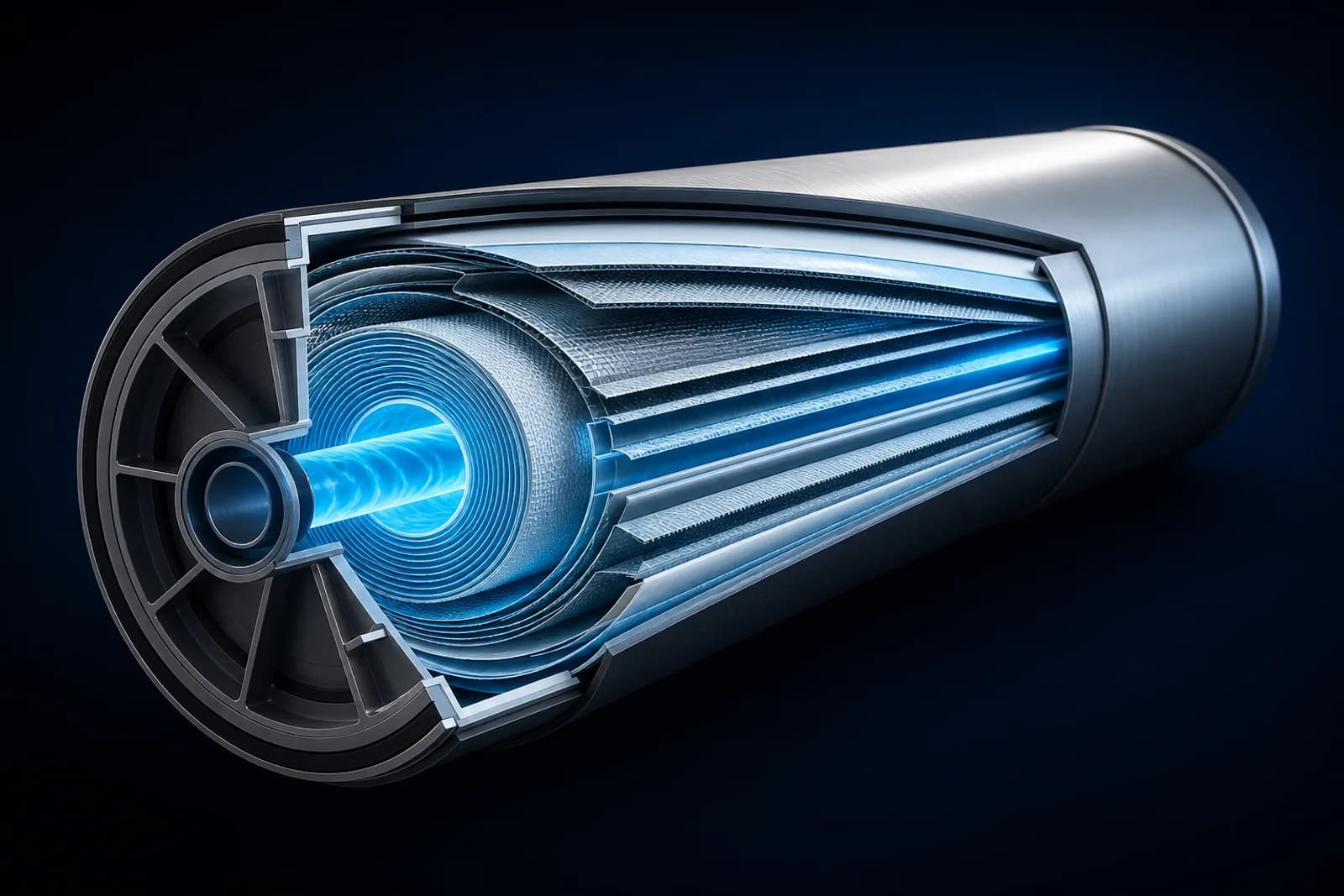
The RO membrane is the most expensive single component in a home purifier to replace. It is also the component buyers think about least when comparing machines at the point of purchase — and then think about a great deal when the service reminder arrives two years later.
For a Jakarta household on a mixed PDAM and sumur bor supply, that reminder arrives with two attached problems: cost and logistics. What does the membrane cost, who installs it, and will a technician actually come out this week? The UR-S61096H carries an 8-year rated membrane alongside an anti-fouling flush system. This article explains what that rating means structurally, why it is achievable in Indonesian conditions when the machine is maintained correctly, and what the difference looks like in Rupiah over the life of the system.
Why most RO membranes last 2–3 years
A standard domestic RO membrane — typically a thin-film composite polyamide element — wears out through three overlapping mechanisms.
The first is oxidative degradation. PDAM supply in Jakarta is chlorinated at source, which is necessary for safe distribution but corrosive to the active polyamide layer over time. If the carbon pre-filter stage — the stage that removes residual chlorine before the feed water reaches the membrane — is overdue for replacement, chlorine breakthrough begins attacking the membrane's polymer bonds. This is cumulative and irreversible, and is the primary reason membranes on city PDAM supply fail ahead of schedule.
The second is particulate fouling. Fine sediment, rust from old distribution pipes, and silt from post-outage flow accumulate on the feed surface of the membrane, forming a biofilm layer that restricts permeate flow and raises operating pressure. Borehole (sumur bor) supply, common in peri-urban Jakarta and many suburban districts, carries significantly higher suspended solids than treated PDAM water, accelerating this process.
The third is mineral scaling. In areas with hard groundwater — or where coastal saltwater intrusion pushes dissolved-solids concentrations higher — calcium carbonate and other salts precipitate on the membrane surface as the reject stream becomes increasingly concentrated. Once scale has crystallised, it is not recoverable at home.
These three processes are the reason a conventional domestic membrane has a commonly cited service life of two to three years. The membrane is doing hard work in a chemically and physically aggressive environment.
What an 8-year rated membrane requires
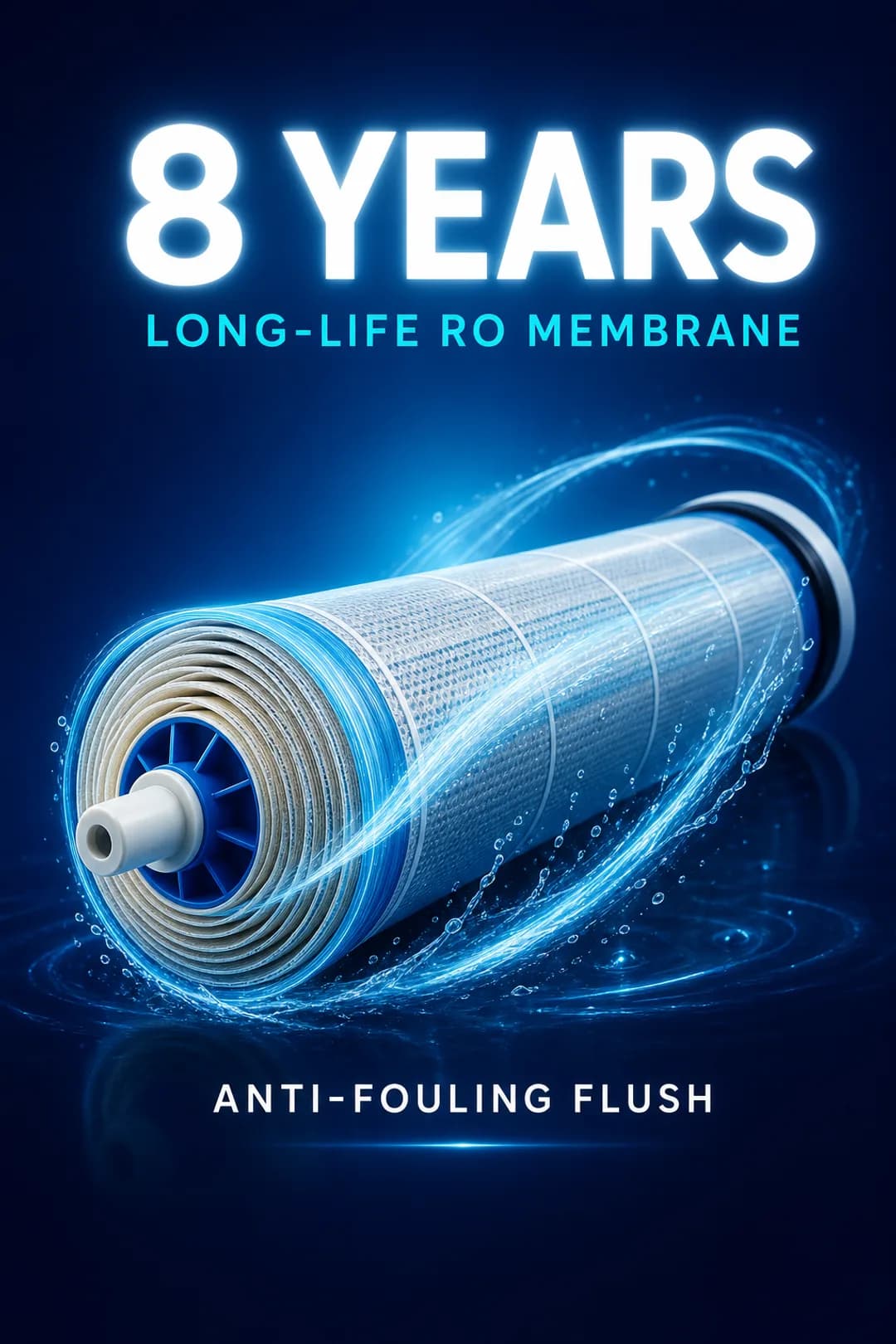
The 8-year rating on the UR-S61096H membrane is not a property of the membrane element alone — it is a system rating that depends on the machine being maintained as a whole.
The anti-fouling auto-flush is the mechanism that makes the extended life achievable. At the end of each purification cycle, the system runs a short high-velocity flush across the feed surface of the membrane. This sweeps accumulated particulates off the surface before they can compact into a consolidated fouling layer. The effect is analogous to rinsing a filter under pressure rather than letting debris dry and harden onto it. Over months and years, this prevents the gradual surface accumulation that typically degrades flow rate and rejection on a standard machine.
The pre-filter stages — sediment PP and activated carbon CTO — must still be replaced on their own schedule, typically every 6–12 months depending on source water quality and daily usage. These are the upstream protection that keeps chlorine and particulates away from the membrane. The 8-year membrane rating assumes those stages are being kept fresh. Skip the pre-filter changes, and chlorine breakthrough and particulate load accelerate membrane wear exactly as they would on any other system.
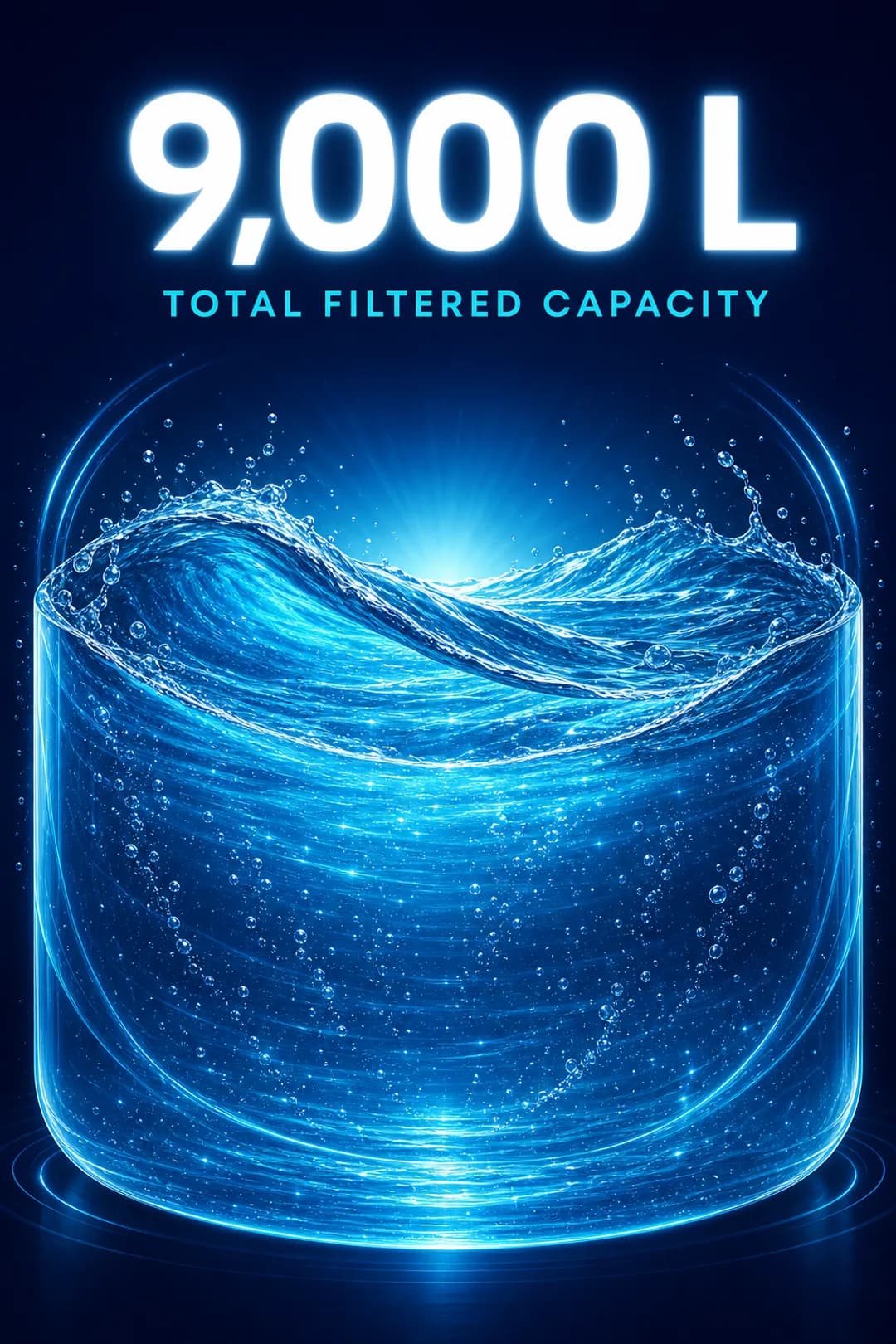
The 9,000-litre total capacity figure provides a second check. A household drawing an average of three to four litres per day — drinking water, cooking, and topping up — reaches approximately 1,100 to 1,400 litres per year. At that rate, 9,000 litres corresponds to a six-to-eight-year throughput window. A larger household using six to eight litres daily reaches the litre capacity in roughly four to five years. Knowing your daily draw gives you the more honest figure for your specific situation.
The cost comparison: 8 years, in Rupiah
The maintenance cost objection is one of the most common reasons Indonesian buyers hesitate before an RO purchase. The maths below uses illustrative figures — actual prices vary by supplier, city, and time — but the structure of the comparison is accurate.
Conventional RO: membrane replaced every 2 years over an 8-year period
A standard domestic RO membrane, sourced locally in Jakarta, commonly runs in the range of Rp 300,000–600,000 for the membrane element itself, depending on brand and specification. Add a service call — a technician visit in Jakarta typically runs Rp 100,000–250,000 for labour, excluding parts — and a single membrane replacement event costs approximately Rp 400,000–850,000 in total. Over eight years, with three replacement events (at years 2, 4, and 6), the indicative total is Rp 1,200,000–2,550,000 for membrane replacements alone.
Prices here are indicative examples to show the shape of the saving — they are not a quote; ask Aright Marketing Indonesia for current pricing.
Pre-filter cartridges — sediment and carbon stages — require replacement on both systems. These costs are broadly comparable and do not disappear on the long-life system; they should not be counted as a saving attributable to the membrane.
UR-S61096H: one membrane over an 8-year period
One replacement event at year eight, if required at all, versus three on a conventional schedule. The indicative saving on membrane cost and service calls across the eight-year window is roughly Rp 800,000–1,700,000 — before accounting for the time cost of sourcing parts and scheduling technician visits, which in Jakarta carries its own friction.
The point the maths makes is structural: the difference between one replacement and three, each with an associated service call, is meaningful over a machine's working life.
The logistics problem in Jakarta
Cost is only part of the objection. The other part is sourcing.
Jakarta has serviceable coverage for common RO consumables, but replacement membranes for less-distributed brands can be difficult to find at short notice. A buyer who discovers their membrane is failing on a Friday afternoon may wait a week or longer for a replacement to arrive if the distributor does not hold stock locally. During that period the system continues running, either with a degraded membrane or bypassed — neither is the intended outcome.
An 8-year replacement interval reduces this friction to roughly one event per machine lifetime, rather than three. The pre-filter cartridges, which need attention every 6–12 months, are the routine consumable; the membrane becomes the exception rather than the rule. For a household that wants to own an RO system without having the membrane supply chain as a recurring concern, that is a real operational difference.
What this does not mean
The 8-year rating applies to the membrane element. The other stages still require attention.
The sediment PP pre-filter and the activated carbon CTO stage should be replaced every 6–12 months, adjusted for water quality and usage — Jakarta conditions, with higher sediment loads in groundwater areas and the residual chlorine load in PDAM supply, tend to push these toward the shorter end of the range. The post-carbon polishing stage requires replacement at around 12 months. These are non-negotiable: a neglected pre-filter stage is the single most common cause of premature membrane failure, regardless of the membrane's rated life.
The UR-S61096H is not a zero-maintenance system. It is a system where the most expensive and logistically difficult maintenance event — membrane replacement — is rated to occur once across the machine's expected service life, rather than three or four times. Understanding that distinction matters before purchase.
For a fuller picture of how RO membrane degradation actually develops, and the specific symptoms to watch for, see Reading the Signs: How to Know Your RO Membrane Is Fouling. For standard replacement intervals across all filter stages in an Indonesian context, see When to Replace Your Water Filter Cartridges.
Matching the machine to Jakarta's water
Jakarta's supply varies considerably by district and building age. Newer apartments on PDAM supply tend to have lower sediment loads and more consistent chlorine levels; older buildings with aged internal plumbing can introduce rust and particulates between the mains and the tap. Households drawing from a borehole face a different challenge: higher TDS, variable mineral content, and in northern coastal districts, the increasing influence of saltwater intrusion pushing chloride concentrations up.
The anti-fouling flush is well-matched to the sediment and particulate challenge common across both supply types. The 7-layer filtration sequence — which pre-treats the feed water through sediment and carbon stages before it reaches the membrane — addresses the chlorine and organic load from PDAM supply. Neither protection removes the need for pre-filter maintenance, but together they create the conditions under which an 8-year membrane rating is achievable rather than theoretical.
For a household that has weighed the purchase and wants to understand the full value proposition of this system — not just filtration performance but the total cost of ownership over time — the membrane rating is one of the more substantive differentiators on the UR-S61096H specification sheet.
Not sure which system fits your water?
Aright Marketing Indonesia can assess your supply and recommend the right Truliva system for your home or business in Indonesia.