Multi-Stage Filtration Explained: What Each Stage Does and Why the Order Matters
No single medium removes every contaminant — multi-stage systems chain sediment, activated carbon, membrane, and post-treatment stages because each targets what the previous stage cannot, and the sequence is not arbitrary.

No single filter medium removes every contaminant class in water. Suspended particles, residual chlorine, dissolved heavy metals, and microorganisms each require a different removal mechanism — which is why serious water purifiers chain multiple stages together rather than relying on one. Understanding what each stage targets, and why the order is not arbitrary, is the most useful thing you can know before choosing or maintaining a purification system.
The logic behind chaining stages
A multi-stage system is a series of specialists, not a series of redundancies. Each stage handles a threat that the previous one either cannot address or would be damaged by if exposed to directly. Remove a stage from the middle and you do not merely lose that layer of protection — you also remove the protection it was providing to every stage downstream.
The specific stages in any given system depend on the technology at its core. Systems built around an RO membrane have different pre-treatment requirements from those using UF, because the membranes are vulnerable to different things. The underlying principle is consistent: coarse removal first, then progressive refinement, then final polishing.
Stage 1 — Sediment filtration
What it removes: suspended particles — sand, silt, rust flakes, fine grit, sediment dislodged from aging pipes.
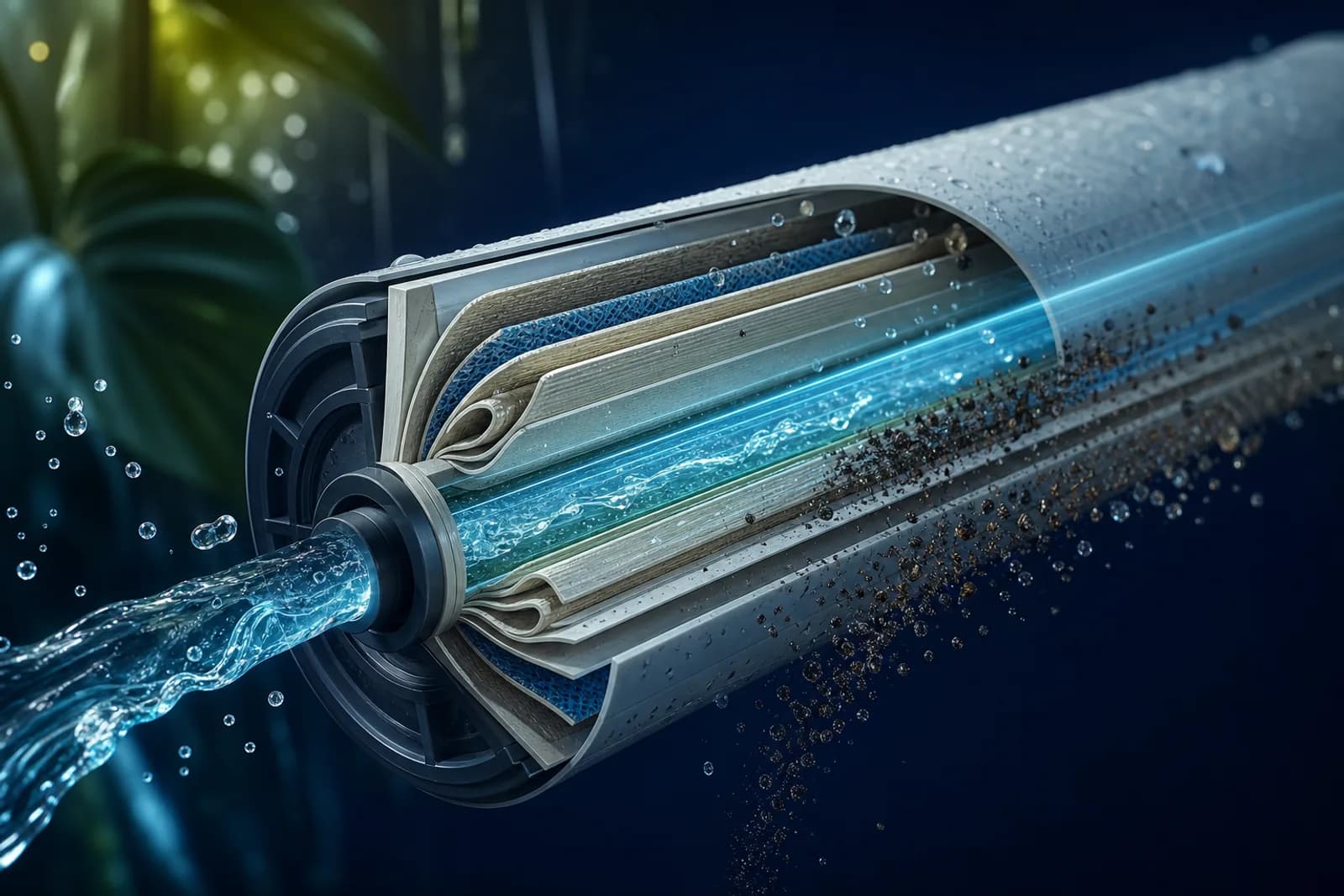
A polypropylene (PP) spun-fibre cartridge is the most common medium for this stage. The fibres are wound into a cylinder with graduated density: coarser toward the outside, finer at the core. Water passes inward through these layers, and particles too large to pass through are trapped in the outer zone. Pore ratings are commonly 5 microns for pre-membrane stages, though ratings of 1–10 microns are available depending on the source water's sediment load.
This stage is first for a practical reason: sediment physically abrades and clogs finer media downstream. A carbon block exposed to silty water becomes fouled quickly and loses adsorption capacity. An RO or UF membrane exposed to suspended particles scores and degrades. The PP stage is essentially a sacrifice cartridge — it takes the abrasive load so the more expensive media behind it do not.
In Indonesia, homes drawing on sumur bor (drilled borehole) water or living in buildings with old galvanised iron piping are likely to see this cartridge discolour noticeably within weeks. PDAM piped water in major cities is generally lower in sediment, though supply disruptions can temporarily spike turbidity. Either way, this stage is non-optional.
Stage 2 — Activated carbon (pre-carbon)
What it removes: chlorine, chloramines, dissolved organic compounds, taste and odour compounds.
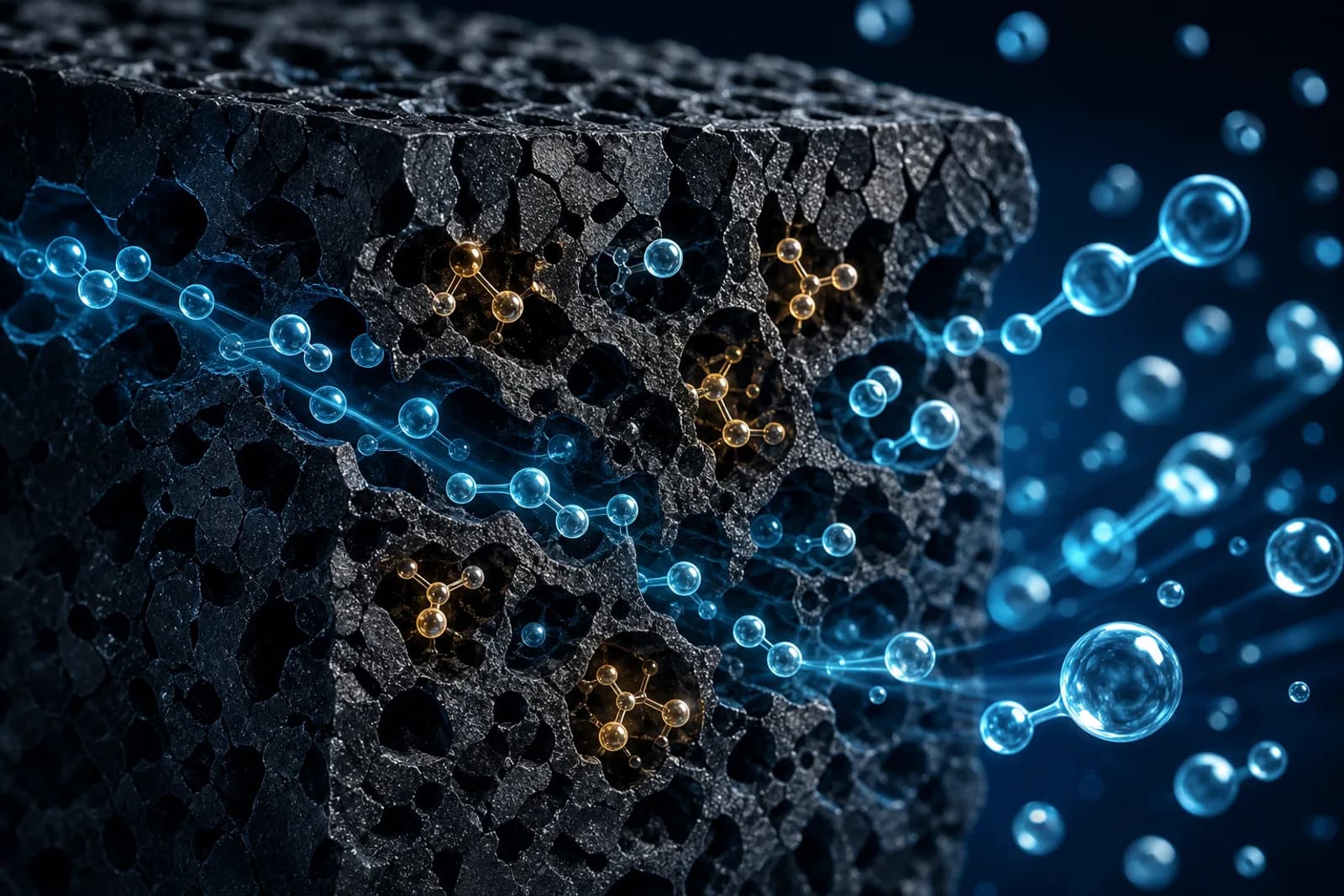
Activated carbon works by adsorption, not filtration. Carbon is processed at high temperature in a low-oxygen environment to create an enormous internal pore structure — a single gram of good-quality activated carbon commonly has a surface area of 500–1500 m² by BET measurement. Contaminant molecules passing through the water encounter this surface, bond to it, and are held. The water moves on; the contaminants stay behind.
The distinction between granular activated carbon (GAC) and carbon block matters here. GAC consists of loose granules that water channels around, which limits contact time and can allow channelling. Carbon block binds the granules into a compressed cylinder; water is forced through the whole structure and has longer, more uniform contact with the carbon surface. Carbon block is the stronger performer for both chlorine removal and dissolved organic reduction.
This stage is critical as a membrane protector in chlorinated municipal supplies. PDAM water across Indonesian cities carries residual free chlorine as part of the distribution disinfection process — Permenkes 492/2010 sets a maximum residual chlorine of 5 mg/L for piped supply, and actual tap-end concentrations vary by district, pipe length, and day. Whatever the local reading, the thin-film composite (TFC) polyamide material used in most RO membranes degrades on contact with chlorine. Without the carbon stage stripping it out first, a membrane that should last two to three years can be damaged in months.
For systems without a membrane — for example, those using only carbon and UF, which is a reasonable configuration for lower-TDS PDAM supply — the pre-carbon stage is still doing the heavy lifting on taste and organics.
Stage 3 — Fine pre-filter (second pass)
What it removes: residual fine particles and organics that passed the first two stages.
Some systems insert a second sediment or carbon pass between the pre-carbon and the membrane. This may be a tighter PP cartridge (1 micron) or a second carbon block. Its purpose is to reduce the load arriving at the membrane, particularly in source waters with higher organic content or where the main pre-filter has a shorter service life relative to how hard the water is being worked.
Not every system includes this. Whether it is worth the added cost and cartridge-replacement frequency depends on source water quality. For homes on borehole water with high turbidity, or in areas where the water has a persistent odour suggesting high dissolved organics, it adds a real margin of safety for the membrane. On cleaner PDAM supply, many systems function reliably with the standard two pre-stages.
Stage 4 — The main membrane (RO or UF)
What it removes: dissolved salts, heavy metals, and most contaminants (RO); bacteria, protozoa, and fine particles down to approximately 0.01–0.02 microns (UF).
The membrane is where the defining removal happens, and the two technologies operate by fundamentally different mechanisms.
Reverse osmosis (RO) forces pressurised water through a semi-permeable membrane with pores around 0.0001 microns — tight enough to reject dissolved ions: lead, arsenic, nitrates, fluoride, sodium, and most organic molecules with molecular weight above roughly 200 daltons. The pre-stages exist largely to protect this membrane from being fouled or degraded before it can do this work. RO produces a concentrate (reject stream) sent to drain, and purified permeate on the product side.
Ultrafiltration (UF) operates on hollow fibre membranes with pore sizes around 0.01–0.02 microns — large enough to pass dissolved minerals but small enough to physically block bacteria, viruses (in better-specified membranes), and colloidal particles. UF does not require a booster pump and produces no wastewater. It retains the mineral character of the source water, which can be an advantage when source TDS is already moderate and the main concern is microbiological safety rather than dissolved-solids reduction.
The choice between the two turns on what your source water actually contains. This is a separate subject covered in detail elsewhere in the Water Library — but the point here is that the downstream stages are designed to complement whichever membrane is at the core.
Stage 5 — Post-carbon (polishing)
What it removes: off-tastes and residual odours from the storage tank or distribution path.
In systems with a pressurised storage tank — the standard configuration for most domestic RO units — water sits in the tank between production and use. Tanks are lined with a food-grade bladder, and the water generally remains clean, but it can pick up a faint flat or plastic note over time, particularly if it sits for days between uses.
The post-carbon stage is positioned just before the tap. It is a smaller carbon block whose sole job is polishing: removing any trace taste compounds that accumulated in storage, leaving the output clean and neutral. This stage is not protecting a membrane downstream, so it sees only already-purified water — its service life is typically longer than the pre-carbon stage, and it does not need to handle chlorine.
For tankless systems, where water is produced on demand and passes directly to the tap without storage, the post-carbon cartridge still earns its place. It smooths out any variation in the permeate character and is the last checkpoint before the water is consumed.
Stage 6 — UV disinfection (optional)
What it removes: live bacteria and viruses through ultraviolet irradiation.
A UV lamp emits light at approximately 254 nanometres — the wavelength that penetrates microbial cell walls and disrupts DNA, preventing replication. The lamp is housed in a stainless chamber through which water flows. UV adds no chemicals and leaves no residue in the water.
UV is the redundancy layer for microbiological risk. An RO membrane physically blocks bacteria and viruses, but a microscopic defect, a compromised O-ring, or a membrane at the end of its service life can allow small microbiological breaches. UV catches what gets through. For households where the source water has a history of E. coli or coliform contamination — a documented issue in some groundwater supplies and in poorly maintained air galon refill stations — UV is a meaningful addition, not a luxury.
The lamp itself requires periodic replacement. Running a UV lamp with a spent bulb provides false security: the housing is in place, the pump is running, but no disinfection is occurring. Residential low-pressure mercury UV lamps are typically rated at around 8,000–9,000 hours, though rated life varies by manufacturer and lamp wattage — annual replacement is the standard service guideline for most domestic units.
Why the order cannot be reversed
The sequence described above — sediment first, carbon second, membrane third, polishing last — is not convention. It is cause and effect.
Putting carbon before sediment would expose the carbon block to the full abrasive particle load, compressing the carbon bed and shortening its service life drastically. Putting the membrane before carbon would expose the membrane to chlorine. Putting the polishing stage before the membrane would mean it is processing raw water rather than purified permeate, burning through its capacity in days rather than months.
Each stage creates the conditions that allow the next stage to function correctly. The system works as a system.
What this means for maintenance
The service lives of the individual stages are unequal, and they are calibrated to the load each stage bears. Pre-sediment cartridges in hard-working borehole installations may need replacement every one to three months. Pre-carbon and post-carbon cartridges typically run three to six months. Membranes, protected by the stages in front of them, commonly last one to two years for UF and two to three years for RO under normal conditions. UV lamps are on an annual schedule.
Deferring any one stage beyond its service life does not just reduce that stage's performance — it accelerates degradation of everything downstream. A spent pre-carbon cartridge passes chlorine to the membrane; a clogged sediment filter drops feed pressure and forces the pump to compensate. The stages are interdependent in failure as well as in operation.
Maintaining a multi-stage system is simpler than it sounds, but it requires knowing which stage has which interval and actually following through. The cartridges are not expensive relative to the membrane they protect.
How the stages fit together
Multi-stage filtration works because it chains mechanisms: physical barrier first, adsorption second, molecular-level rejection or microbial-level barrier at the core, then polishing and optional disinfection at the end. Each stage is designed for a specific contaminant class and creates the conditions for the next one to perform at its rated capacity. Skipping or deferring any one of them is not a cost saving — it is a risk transferred to every stage downstream.
Not sure which system fits your water?
Aright Marketing Indonesia can assess your supply and recommend the right Truliva system for your home or business in Indonesia.