Activated Carbon in Water Filters: How Adsorption Works
Activated carbon removes chlorine, taste, odour, and organic compounds through adsorption — not filtration. Understand the chemistry, the difference between GAC and carbon block, and where carbon fits in a multi-stage system.

Activated carbon does not strain contaminants out of water the way a sediment filter does. It pulls them in. That distinction — adsorption rather than mechanical filtration — is why a carbon filter removes dissolved chlorine, taste compounds, and organic chemicals that a membrane with much smaller pores simply lets pass. Understanding the mechanism explains why carbon appears in almost every domestic water purifier, and why the form it takes — granular or block — determines how well it performs.
What adsorption actually means
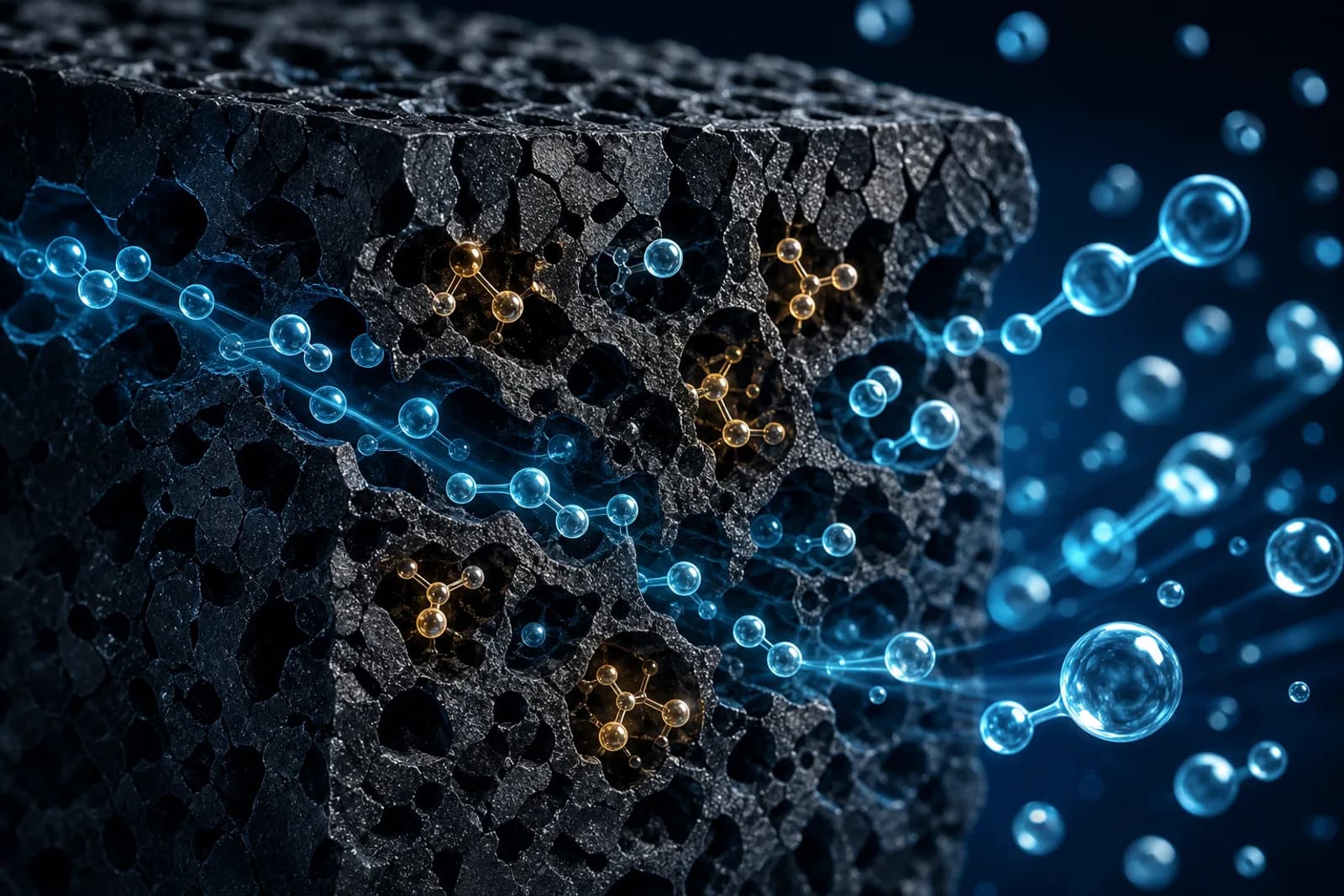
Adsorption (not absorption) is a surface process. When water flows past activated carbon, certain dissolved molecules stick to the carbon's surface rather than continuing with the flow. The driving forces are van der Waals interactions and pore geometry: nonpolar organic molecules are held by weak but cumulative attractions to the carbon surface, and the labyrinthine pore structure maximises the chance of contact. Those molecules bind to the surface and stay there until the carbon is either regenerated or replaced.
Carbon is not removing particles. It removes dissolved compounds by binding them. A carbon filter that looks visually clean may be chemically exhausted — every binding site occupied — while a sediment filter becomes visually dirty as it loads. This is one reason carbon cartridges have replacement schedules that are time-based and volume-based, not visual.
Why the surface area matters
Activated carbon starts as organic material — most commonly coconut shell or coal — heated to high temperatures in a low-oxygen atmosphere. This process, called activation, burns away volatile compounds and opens an internal pore structure of extraordinary complexity. A single gram typically carries hundreds to over a thousand square metres of internal surface area, depending on source material and activation process — orders of magnitude that matter more than any precise figure. A surface area roughly comparable to a football pitch packed into a teaspoon is the usual illustration.
That internal surface is what makes carbon effective at trace-level removal. Contaminants present in parts per million or parts per billion encounter an enormous number of binding sites as water moves through the carbon bed, which is why carbon performs in the concentration ranges typical of PDAM piped supply or borehole water, not just in laboratory conditions.
What activated carbon removes
Carbon excels at a specific category of contaminants:
- Free chlorine and chloramines — the disinfectants added to PDAM water. Chlorine does not simply adsorb; it reacts chemically with carbon (the accepted mechanism is chemical reduction: Cl₂ + C → CO₂ + HCl). This makes chlorine removal one of the fastest and most reliable things carbon does. Chloramines require longer contact time but are handled well by quality carbon block.
- Taste and odour compounds — earthy, musty, or chemical tastes typically come from geosmin, 2-methylisoborneol (MIB), and volatile organic compounds, all of which carbon captures efficiently.
- Chlorination byproducts — trihalomethanes (THMs) and haloacetic acids (HAAs) form when chlorine reacts with organic matter in source water. Both classes are well-adsorbed by carbon.
- Many organic chemicals — pesticides, herbicides, and industrial solvents that occasionally appear in groundwater or surface-water sources. Adsorption efficiency varies by compound and carbon grade.
What carbon does not remove well:
- Dissolved minerals and hardness — calcium, magnesium, and sodium are not attracted to carbon's surface. Carbon has no effect on TDS.
- Heavy metals — standard activated carbon has limited effectiveness on dissolved lead, arsenic, or cadmium. Impregnated specialist carbons exist for some metals, but plain carbon is not the tool for heavy-metal removal.
- Bacteria and viruses — carbon is not a reliable microbiological barrier. A saturated bed can harbour bacterial growth when water sits stagnant, which is precisely why carbon is never the final safety stage in a multi-stage system.
- Nitrates — dissolved nitrates from agricultural runoff or septic contamination in borehole water are not adsorbed by standard carbon.
GAC versus carbon block: the practical difference
Activated carbon comes in two main physical forms in domestic purifiers.
Granular Activated Carbon (GAC) consists of loose carbon particles packed into a housing. Water flows around the granules, adsorbing as it contacts granule surfaces. Because the particles are loose, water can find a path of least resistance through gaps in the bed — a phenomenon called channelling. The result is good flow rate but inconsistent contact: some water bypasses full exposure to the carbon. GAC is commonly used in pre-filter positions where throughput matters more than exhaustive removal.
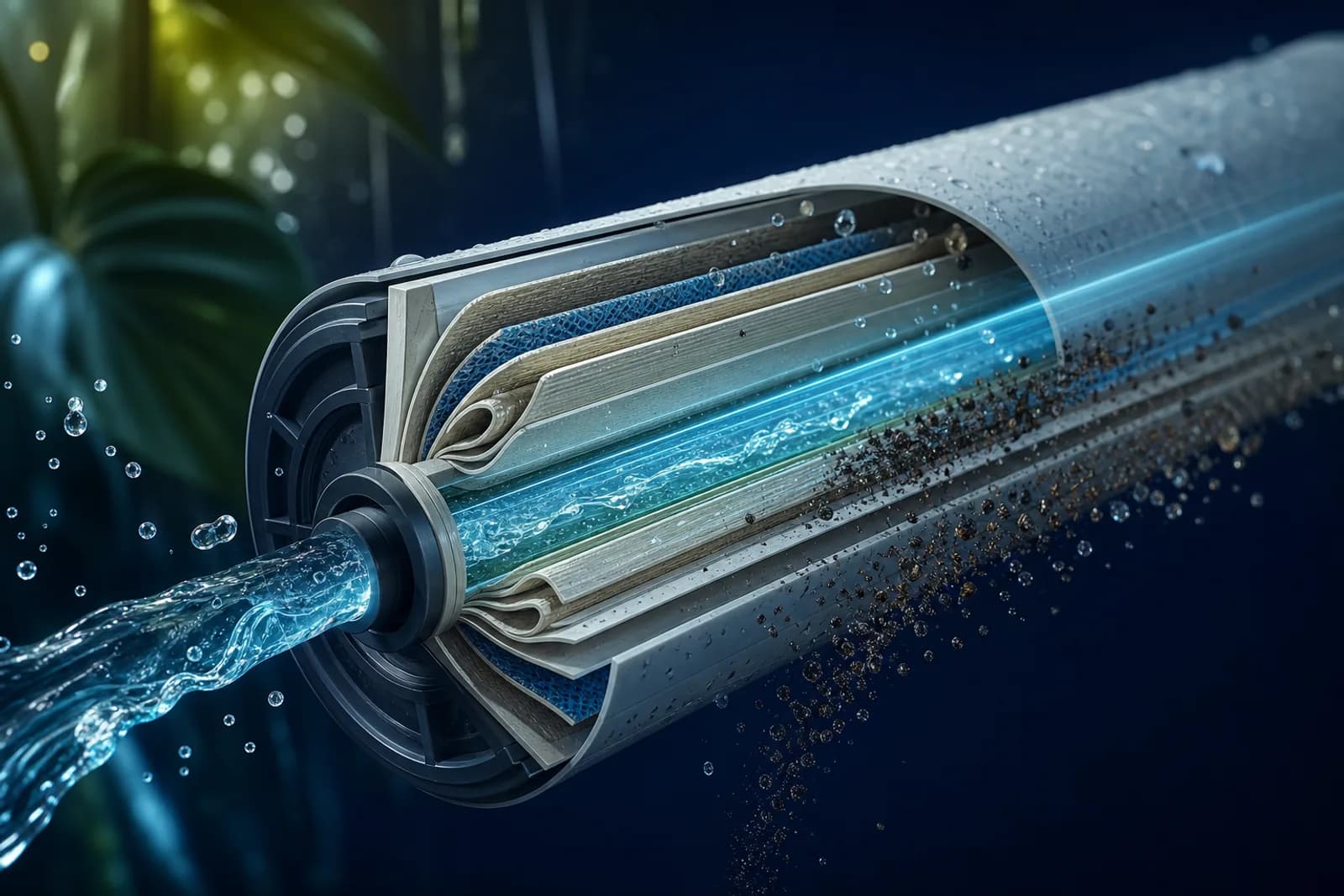
Carbon block is activated carbon ground to fine powder and compressed with a binder into a solid cylinder. Water is forced through the block itself, passing through the carbon matrix with no option to channel around it. Contact is more consistent, and a well-made block also acts as a mechanical filter — its compressed structure can intercept particles down to sub-micron sizes depending on block density. Carbon block outperforms GAC for chloramine removal, THMs, and organic compounds precisely because contact time is controlled.
The tradeoffs are flow rate and cost. Carbon block has higher resistance to flow, so filtration is slower unless a pump is present. It is also generally more expensive per unit than GAC. In a multi-stage system you will often see GAC upstream for bulk chlorine removal and a carbon block downstream for fine polishing — each format working to its strength.
Carbon's role in a multi-stage system
Carbon almost always appears alongside other technologies rather than alone, and its position in the sequence matters.
In an RO system, carbon serves two distinct purposes. The pre-carbon stage — positioned after the sediment pre-filter, before the membrane — removes chlorine and chloramines, because these compounds degrade the polyamide material RO membranes are made from. PDAM water in Indonesian cities carries residual chlorine as a standard disinfectant, necessary for safe distribution but damaging to the membrane over time. The pre-carbon stage is, in effect, protecting the most expensive component in the system.
The post-carbon stage, after the membrane and storage tank, is a polishing step. Water sitting in a pressurised tank can pick up a slight off-taste or odour. Post-carbon addresses this at the point of dispense, leaving the water clean and neutral at the tap.
In a UF (ultrafiltration) system without RO, carbon plays a complementary role. UF blocks bacteria and particles but does not reduce dissolved organics or chlorine. A carbon stage paired with UF delivers the taste and odour improvement that UF alone cannot provide, while UF handles the microbiological work that carbon cannot.
A standalone carbon filter — without any membrane — treats taste, odour, and organics but provides no microbiological protection. In Indonesia, where sumur bor (borehole) water may be bacteriologically unsafe, a carbon-only filter is not an adequate primary barrier. Where PDAM supply is reliably chlorinated and therefore microbiologically treated, a carbon filter meaningfully improves the drinking experience by removing the taste and smell of that same disinfectant.
Carbon capacity and service life
Every gram of activated carbon has a finite number of binding sites. Once occupied, the carbon is exhausted and compounds begin to break through — or, in some conditions, desorb, releasing previously captured molecules back into the water as temperature or pH shifts. An exhausted carbon filter can briefly produce water that tastes worse than unfiltered.
How quickly carbon exhausts depends on the incoming contaminant load. Water with high chlorine, high organic content, or both depletes a cartridge faster than cleaner feed water. Air galon refill water in Indonesia is sometimes drawn from PDAM supply with varying treatment quality across depots, and high organic load from surface-water sources can accelerate exhaustion faster than a simple calendar schedule accounts for.
As a rule of thumb, most domestic carbon cartridges are rated for roughly 3,000 to 10,000 litres — a wide range that reflects both form (carbon block typically lasts longer per unit volume than GAC in comparable conditions) and incoming water quality. A household drawing 10 litres of filtered water per day might replace a mid-range cartridge every one to three years. That estimate shifts substantially if the feed water is heavily chlorinated or organically loaded. Manufacturers' service lives are derived from standardised test water, not local Indonesian conditions.
The practical takeaway
Activated carbon solves a specific problem very well: dissolved chlorine, taste, odour, and organic compounds that most other filter types ignore. It does this through adsorption — binding contaminants to its surface rather than straining them out — and its effectiveness depends on surface area, contact time, and remaining capacity.
For Indonesian conditions, carbon earns its place in any purifier processing PDAM supply, where chlorine removal is the first priority, and in any system designed to improve palatability when the source is microbiologically safe but organically loaded. What it cannot do is substitute for a membrane when the goal is removing bacteria, dissolved salts, or heavy metals. Positioned correctly in the right system, activated carbon is one of the most reliably effective materials in domestic water treatment.
Not sure which system fits your water?
Aright Marketing Indonesia can assess your supply and recommend the right Truliva system for your home or business in Indonesia.