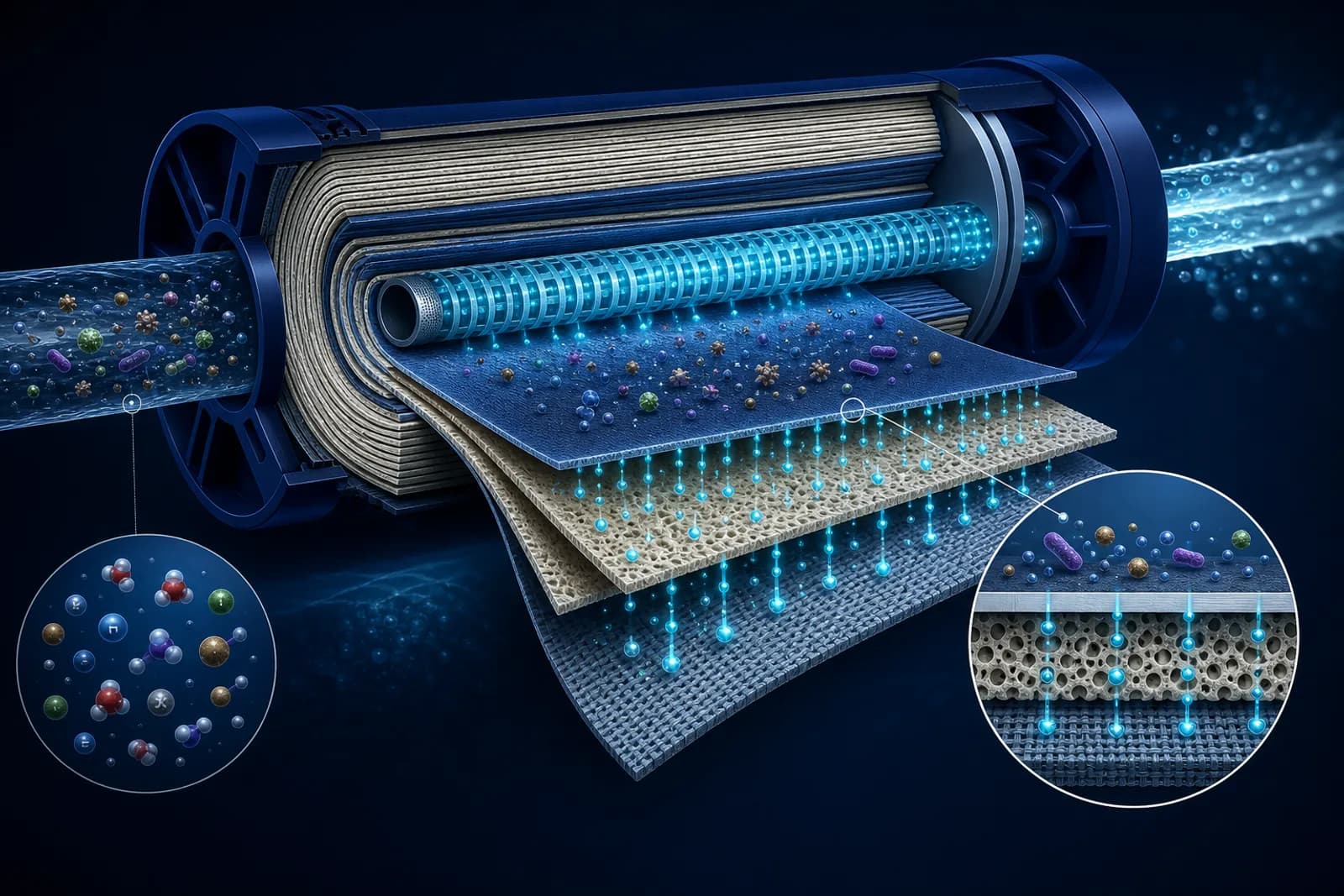
How Reverse Osmosis Works
Reverse osmosis forces water through a membrane with pores tight enough to block dissolved ions. Here is the full sequence — membrane physics, the filtration stages, wastewater, and remineralisation — explained clearly.
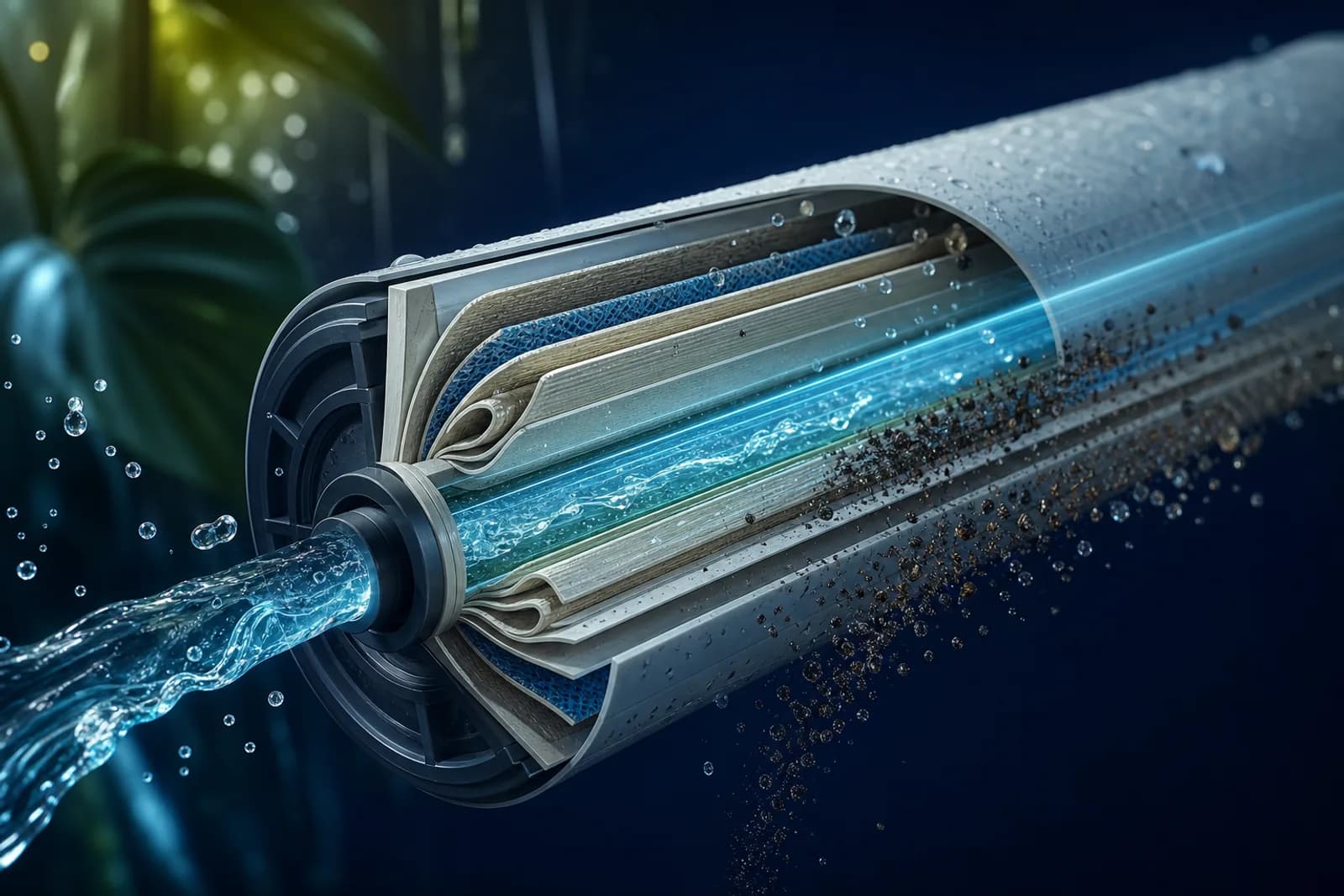
Reverse osmosis is, at its heart, a membrane with extremely small pores. Water molecules pass through; almost everything dissolved in the water does not. That single mechanical fact explains why RO can turn brackish groundwater into clean drinking water, why it sends some water to drain in the process, and why a remineralising stage is sometimes added at the end. The physics are not complicated once you follow the water from inlet to glass.
What "reverse" osmosis means
Osmosis is a natural phenomenon. When two solutions of different concentrations sit on opposite sides of a semi-permeable membrane, water migrates on its own from the dilute side to the concentrated side, trying to equalise. Left alone, this would pull water from your clean feed into the contaminated side — the opposite of useful.
Reverse osmosis defeats this by applying mechanical pressure, usually from an electric pump, greater than the natural osmotic pressure of the source water. The pressure pushes water from the concentrated side — your raw tap or groundwater feed — through the membrane toward the clean side. The dissolved contaminants cannot fit through the pores, so they are left behind in a concentrated stream that flows to drain.
The membrane does not work by attracting contaminants. It works by exclusion: pores roughly 0.0001 micron across, tight enough that dissolved salts, heavy metals, fluoride, and most organic molecules cannot pass. Water molecules are small enough to squeeze through. Almost nothing else is.
What the RO membrane rejects
The membrane handles dissolved load — the ions and molecules that a TDS meter detects but a UF membrane lets straight through. Across a well-maintained RO membrane, rejection commonly includes:
- Dissolved salts — sodium, chloride, sulphates, nitrates
- Heavy metals — lead, arsenic, cadmium, mercury
- Hardness minerals — calcium and magnesium (the beneficial ones too)
- Fluoride
- Most organic compounds with molecular weights above roughly 200 daltons
- Bacteria and viruses — though the pre-stages handle most of these before the membrane ever sees them
What RO does not remove well: dissolved gases such as carbon dioxide, and certain very small organic molecules below its rejection threshold. This is one reason the multi-stage system around the membrane matters as much as the membrane itself.
The multi-stage path: each stage explained
A domestic RO system is not just a membrane. It is a sequence of stages that protect the membrane, let it do its job, and then polish the output. A typical arrangement runs as follows.
Stage 1 — PP sediment filter. A polypropylene spun-fibre cartridge with pores commonly in the 5-micron range. It captures sand, rust, silt, and suspended particles before they reach the membrane. Without it, sediment would clog and score the membrane surface, drastically shortening its life.
Stage 2 — Pre-carbon (activated carbon block). Carbon has an enormous internal surface area and adsorbs chlorine, chloramines, and dissolved organics. This stage matters because chlorine attacks and degrades the polyamide material the membrane is made from. PDAM-treated water in Indonesian cities typically carries residual chlorine as a disinfectant, so this stage strips it out before it can reach the membrane.
Stage 3 — Second PP or carbon pass. Some systems add another sediment or carbon stage here for fine polishing of the feed, catching anything the first two stages let through.
Stage 4 — RO membrane. This is where dissolved solids are rejected. Pressurised water meets the membrane surface; purified permeate passes through to the product side; concentrated reject water exits to drain. The membrane is typically a thin-film composite (TFC) wound into a spiral to pack a large surface area into a small cartridge.
Stage 5 — Post-carbon (polishing carbon). After the membrane, water usually sits in a pressurised storage tank before use. The post-carbon stage removes any off-tastes or residual odours picked up in the tank, leaving the water clean and neutral at the tap.
Stage 6 — Optional UV lamp. Some systems add a UV lamp after the membrane and post-carbon stages. UV inactivates any bacteria or viruses that found a path through, giving an extra microbiological safety layer. It adds no chemicals and leaves no residue.
Not every system follows this exact configuration — a 5-stage and a 7-stage unit differ mainly in how many pre- and post-carbon passes they include — but the core logic is always the same: clean the feed, let the membrane work, polish the output.
Pressure and the pump
PDAM piped supply in most Indonesian cities delivers water at around 0.1–0.3 MPa, roughly 1–3 bar. RO membranes typically need 0.3–0.5 MPa to operate well. Where feed pressure is already adequate, some tankless RO designs can run without an extra pump. Most domestic systems, though, include a small electric booster pump that raises feed pressure into the required range and holds output steady despite fluctuations in the mains.
Without enough pressure, water either stops flowing or trickles through so slowly that the reject ratio becomes impractical. Pressure is not optional — it is what makes the "reverse" in reverse osmosis physically possible.
Wastewater: where it comes from, and how much
Every RO system produces two streams: permeate, the clean output, and concentrate, the reject. The concentrate carries everything the membrane held back, flushed to drain continuously during operation.
The split between the two is described as the recovery rate. Older domestic designs might recover only 25–33% of the feed as product water, sending two to three litres to drain for every litre produced. Modern designs have improved this considerably — many current tankless units reach 50–75% recovery, and some go higher with a permeate pump.
In practical terms: a household drinking and cooking with four litres of RO water a day on a 50% recovery system sends roughly four litres to drain over the same period. That is a real cost worth acknowledging. It is also the physical consequence of the rejection process working correctly — a membrane that rejected nothing would make no concentrate, but it would also be doing nothing useful.
The concentrate itself is not toxic. It is simply more concentrated tap water, safe to send into the household waste line, which is the standard installation arrangement.
Remineralisation: why and when
Because the RO membrane removes dissolved minerals along with everything else, the product water has a low TDS, commonly below 50 ppm. Some people find this taste too flat next to mineral water. Very low-TDS water can also sit slightly acidic — pH around 6–6.5 — because it lacks the buffering carbonate minerals that keep ordinary water nearer neutral.
Neither point is a health emergency. For most people, the great majority of dietary calcium and magnesium comes from food; water contributes a modest fraction in a typical diet. But if taste or pH matters to you, a remineralising post-stage addresses both. These cartridges usually contain calcite or maifanite mineral media that dissolve small amounts of calcium and magnesium carbonate back into the water, raising TDS a little, nudging pH toward neutral, and adding a rounder flavour.
Remineralisation is a preference option, not a requirement. RO water at low TDS is safe to drink without it. But for households used to the mineral character of bottled water, the extra stage narrows the gap.
What RO cannot do
Understanding the limits matters as much as understanding the capability.
- RO does not fully replace disinfection. The membrane blocks bacteria and viruses mechanically, but a breach, a pinhole, or an aged membrane can let microorganisms pass. A final UV stage is the redundancy for this.
- RO does not remove dissolved gases efficiently. Carbon dioxide passes through freely, and very low molecular weight volatile organics may pass at varying rates.
- RO does not run without electricity. The booster pump needs power, which matters where supply is unreliable.
- RO is not self-maintaining. Pre-filter cartridges and the membrane have service lives. A neglected pre-stage sends chlorine or sediment into the membrane and degrades it faster. Replacement schedules exist for a reason.
Is RO the right choice for your water?
The answer depends on your source. For PDAM piped supply at moderate TDS, the main threats are microbiological, and those can be handled by UF, which keeps the minerals and produces no wastewater. For borehole water, coastal groundwater with saltwater intrusion, or any supply where TDS is high or heavy metals are suspected, RO is the only common household technology that removes the dissolved load. Measuring your TDS is the fastest way to find out which category you are in.
RO is thorough, not excessive — but it is also more infrastructure than you need if the problem it solves is not present in your water.
The takeaway
Reverse osmosis works by applying pressure to push water through a membrane tight enough to exclude dissolved ions. The pre-stages protect the membrane from chlorine and sediment; the membrane removes the dissolved load; the post-stages polish the output. Some water leaves as concentrate, an unavoidable consequence of the rejection process. Remineralisation is an optional final step for taste and pH, not a correction of a health deficiency. Used on the right water source and maintained on schedule, RO is one of the most thorough household water-treatment methods available.
Not sure which system fits your water?
Aright Marketing Indonesia can assess your supply and recommend the right Truliva system for your home or business in Indonesia.