Is Jakarta Tap Water Safe to Drink?
Jakarta's PDAM water is treated at the plant, but almost no one drinks it from the tap. Here is where the supply fails, why groundwater is no safer, and what treatment fixes it.

Jakarta's PDAM water leaves the treatment plant meeting Indonesia's national drinking-water standards. It rarely arrives at your glass in that same condition. The gap between those two facts is where the risk lives, and it explains why almost no one in the city drinks straight from the tap.
How the supply system works
Jakarta's piped water is run by two operators, one covering the western half of the city and one the east. Raw water is drawn mainly from the Citarum and Ciliwung river systems, treated with conventional processes — coagulation, sedimentation, filtration, and chlorination — and then pushed into the distribution network. The treated output is generally acceptable. The network is the problem.
Jakarta's pipes are old in places and have been patched and extended for decades, so the network carries a mix of ageing cast-iron mains, newer polymer sections, and connections of varying quality. Two consequences follow. First, a large share of treated water is lost to leaks before it reaches buildings — a figure official reports have long acknowledged as stubbornly high. Second, every leak is also a way in. When supply pressure drops at night or during an interruption, flow can reverse and draw soil water, and whatever is dissolved in it, back into the pipe.
Apartment blocks and older shophouses add another layer. Most multi-storey buildings hold water in elevated tanks to maintain pressure, and those tanks — often fibreglass or concrete — are cleaned on no fixed schedule. Water that was adequately chlorinated at the main loses its disinfectant residual sitting in a warm roof tank, which gives bacteria room to recover.
The groundwater problem beneath the city
About half of Jakarta still draws on groundwater from shallow pumped wells, either instead of PDAM supply or alongside it. This water reaches the tap untreated, and its risks are different in character.
Jakarta sits on a coastal plain where the water table has been drawn down for decades. Land subsidence — the city is widely reported as among the fastest-sinking major cities in the world — is a direct result, and it makes water quality worse in two ways at once. As the land sinks, saltwater from the bay pushes further inland, and the low-lying districts of North Jakarta show brackish groundwater a long way from the coast. TDS readings well into four figures are commonly reported there, and some wells come in far higher.
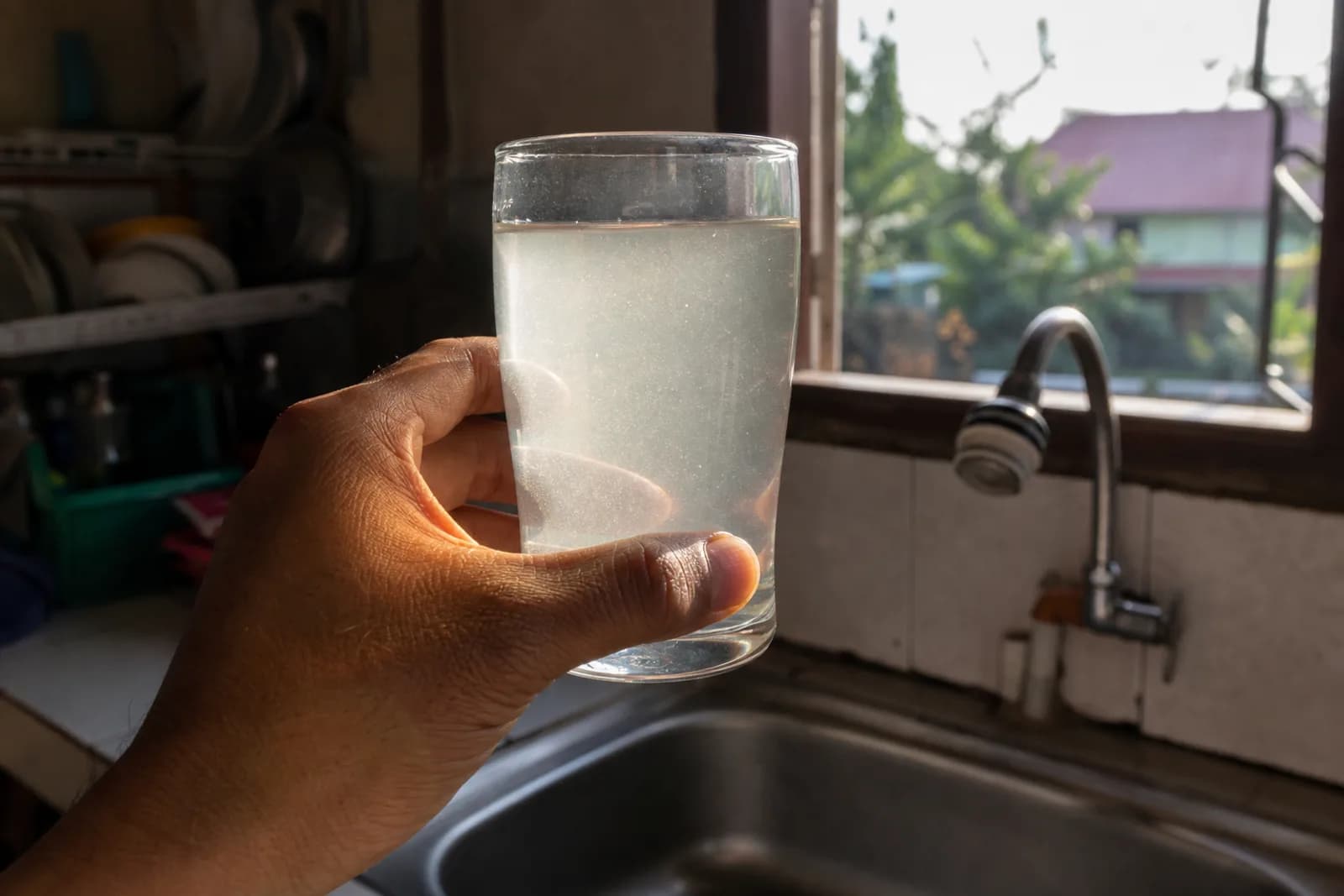
Away from the coast, in dense neighbourhoods, the more common groundwater problem is biological. Jakarta still relies heavily on septic tanks rather than sewered drainage, and in crowded kampung settings the distance between a septic system and a well is often well under what is recommended. E. coli and other faecal coliforms are commonly reported in shallow well water across the city. This contamination is invisible — the water can look perfectly clear — so boiling is the minimum response, not a complete answer to every hazard.
Iron and manganese from the underlying geology turn up frequently as well. Both stain fixtures and laundry a rust or brown colour and give the water a metallic taste at higher concentrations.
What locals actually do
Most Jakarta households run a layered system. PDAM water or groundwater passes through a basic sediment filter for bathing and washing. For cooking and drinking, the default for most of the population is refill galon — the 19-litre polycarbonate jugs from a depot or delivery service — or bottled water. Boiling serves as the backstop, especially in households without a purifier.
None of these is a complete solution. Refill depots vary in how carefully they are maintained: a filter left past its service life can harbour bacteria, and a jug that is not properly sanitised between fills undoes the treatment it was meant to provide. Bottled water is reliable but expensive at family volumes, and the plastic it generates at Jakarta household scale adds up quickly.
The treatment that actually addresses the risk
The practical starting point is to match the treatment to the source.
For PDAM piped supply in a building with a storage tank, the main concerns are bacterial regrowth once the residual chlorine is spent, sediment from intermittent supply, and any contamination entering between the main and the tank. A sediment pre-filter, an ultrafiltration (UF) or reverse-osmosis (RO) membrane as a microbiological barrier, and an activated-carbon stage for chlorine residual and taste cover the main routes. UF is enough where dissolved-solid levels are moderate; RO is the stronger choice where the TDS reading is elevated or the source is uncertain.
For shallow groundwater in a coastal or dense urban area, the requirement is more demanding. High TDS from saltwater intrusion needs RO — no other common household technology lowers dissolved solids. Biological contamination also needs a membrane barrier, not carbon alone. A pre-filter for sediment and iron protects the membrane and extends its service life.
For households that combine both sources — PDAM when it flows, a well when it does not — the system has to be sized for the worse of the two inputs, because quality shifts depending on which source is feeding the tap.
Boiling kills bacteria and viruses but does nothing for dissolved metals, salts, chlorine by-products, or sediment. It is a useful backstop and far better than nothing, but it is not full treatment.
A practical first step
Before committing to a system, a basic check takes ten minutes. A TDS meter tells you your starting dissolved-solids load. Colour, smell, and how fast fittings stain are all readable signs. If PDAM supply is intermittent in your area, treat any single reading as potentially rosier than the worst case — a daytime sample will not show what happens when the pipes empty and refill overnight. For serious groundwater concerns, especially in North Jakarta, near the coast, or in dense residential areas, a proper water test for coliforms and heavy metals gives you a real picture rather than a guess.
Jakarta's water problems are structural, and a tap filter will not solve them. But a filter chosen to match your actual source and maintained on schedule produces water that is genuinely safe to drink. That is achievable in any home in the city today.
Not sure which system fits your water?
Aright Marketing Indonesia can assess your supply and recommend the right Truliva system for your home or business in Indonesia.