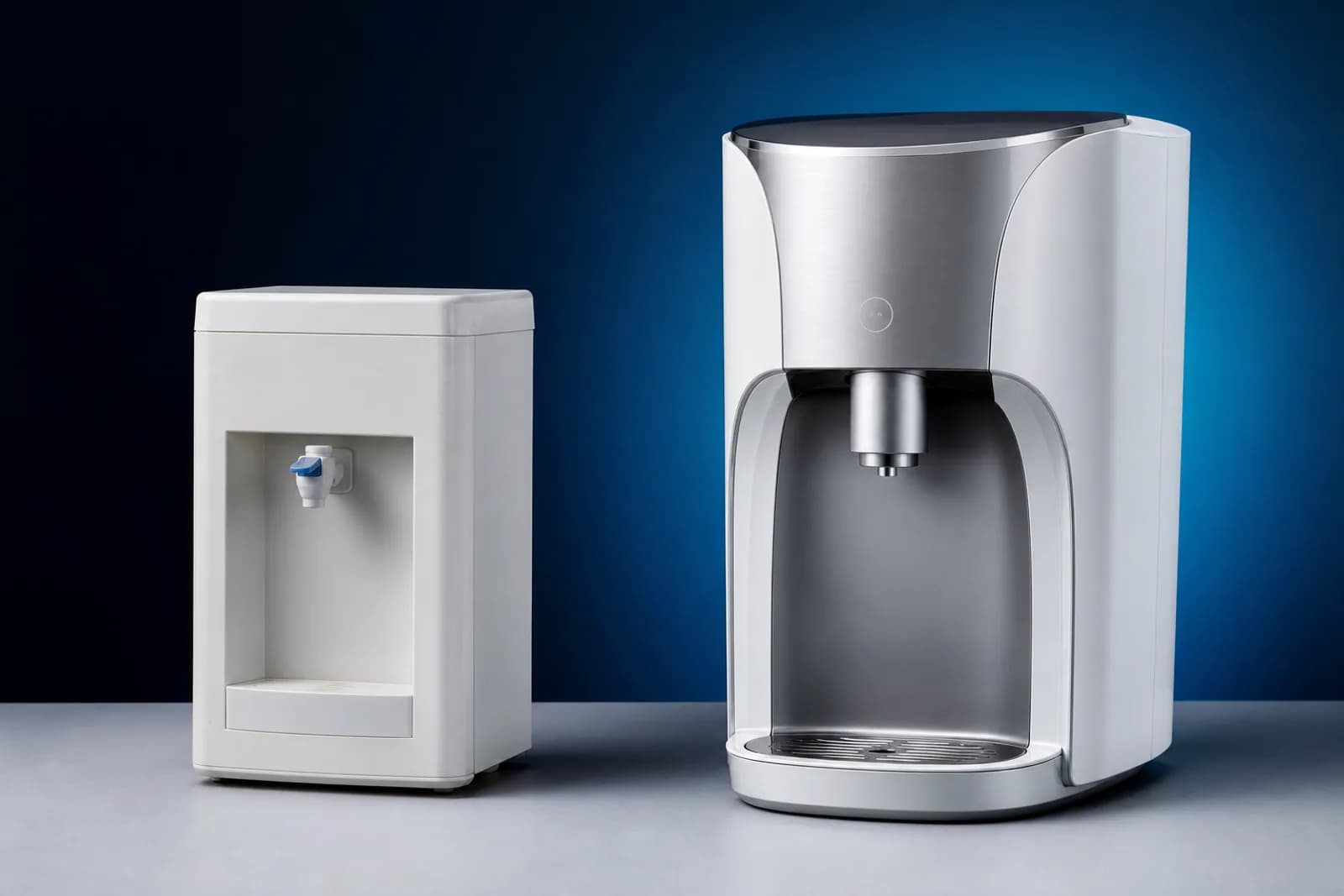
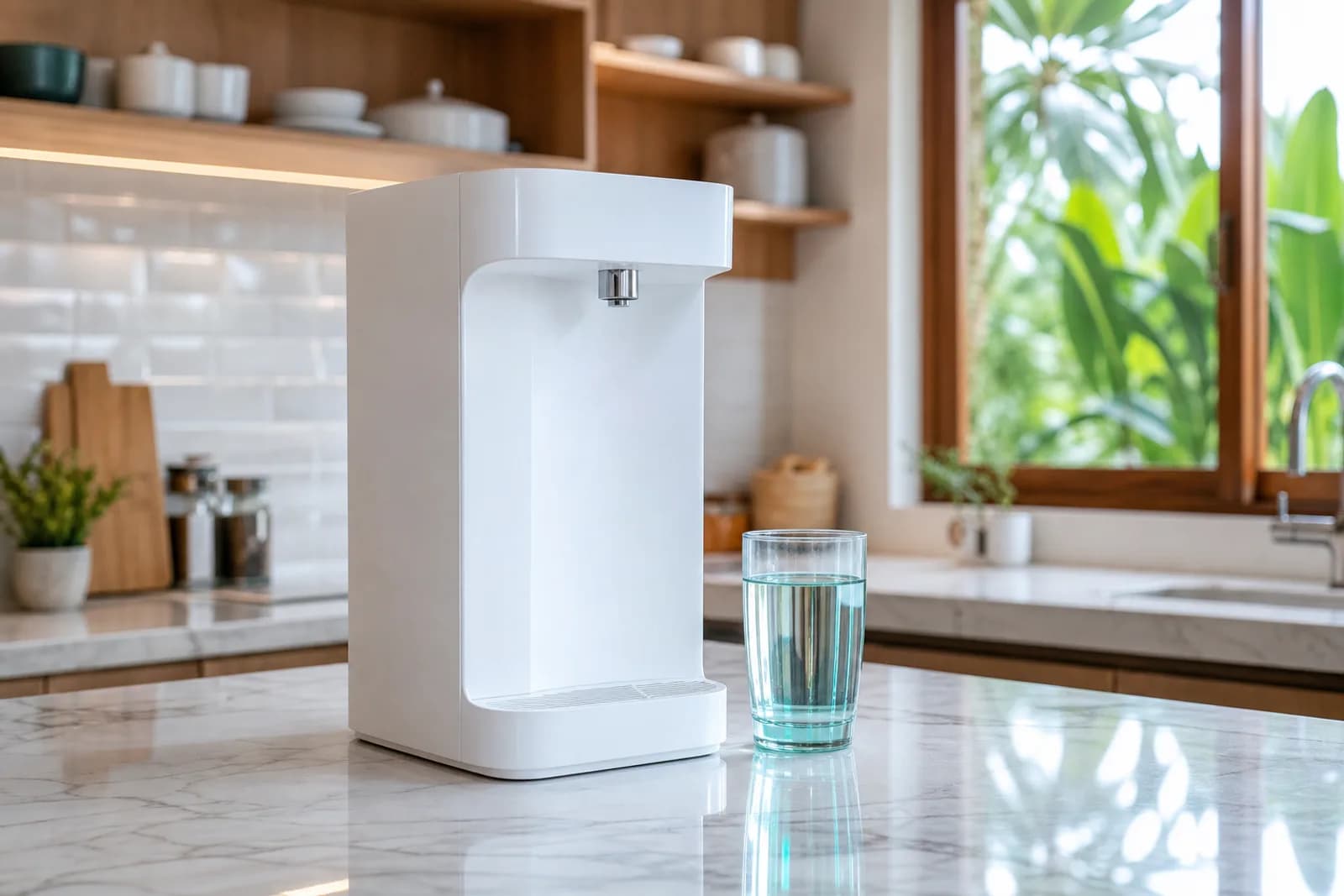
Filter Pitcher vs Installed Purifier: An Honest Decision Guide
A gravity filter pitcher and an installed RO or UF system solve different problems. Here is what each one actually does — and how to pick the right starting point.

A gravity filter pitcher and an installed purifier are not two versions of the same thing — they solve different problems at different price points. Treating them as interchangeable is how people overpay for one or underprotect with the other.
What a gravity filter pitcher actually does
The typical pitcher filter uses two mechanisms: activated carbon and, commonly, an ion-exchange resin.
Activated carbon works by adsorption. As water flows slowly through the carbon bed, chlorine, chloramine, and the organic compounds responsible for much of tap water's taste and odour bind to the carbon surface and stay there. The result is water that tastes noticeably cleaner — less of the chemical edge that PDAM-treated water often has.
Ion-exchange resin, where present, swaps calcium and magnesium ions for sodium or hydrogen ions. This reduces hardness and the minerals that form scale. Water feels softer, and TDS drops slightly — though not dramatically.
Both processes are gravity-fed. You fill the top reservoir, water seeps through the cartridge at its own pace, and the treated water collects in the lower jug. No power socket, no plumbing, no installation at all.
For everyday use in a city apartment on PDAM supply, that combination produces a real improvement in taste and smell from very little infrastructure.
What a filter pitcher does not do
This is the more important half of the question.
Dissolved salts and TDS. Activated carbon removes organic compounds; it does not pull dissolved salts, nitrates, or heavy metals from the water in meaningful quantities. Ion-exchange resin lowers hardness somewhat, but it is not an equivalent of reverse osmosis. If your TDS reading is high — commonly a sign of brackish groundwater or saltwater intrusion, particularly in coastal Jakarta and other low-lying areas — a pitcher will not bring it down. Only an RO membrane does that.
Microbiological risk. Most gravity pitcher cartridges are not rated to remove bacteria or viruses reliably. Some contain antimicrobial carbon treatments that slow bacterial growth inside the cartridge itself, but that is different from a barrier that physically stops pathogens from passing through. If your water source carries a genuine microbiological risk — untreated borehole water, for instance, or a galon depot with questionable maintenance history — a pitcher alone is not a sufficient safeguard. A UF or RO system with a membrane rated to remove bacteria belongs in that situation.
Volume and throughput. A 7.5-litre jug sounds adequate until a family of four is cooking, drinking, and making coffee at the same time. Gravity is slow by nature, so at peak demand a pitcher makes you wait. An installed system runs on line pressure and delivers water on demand.
Where a pitcher fits well
None of the above means a pitcher is a poor product. It is a good product applied to the right problem.
Renters and kost dwellers. If you cannot drill, cannot tap into a drain pipe, and cannot run a power cable behind a cabinet, an installed purifier is simply not an option without landlord approval. A pitcher needs no permission and moves with you.
A step up from air galon. Many households rely on air galon refill delivery for drinking water. A pitcher is a reasonable intermediate step: you fill it from the tap, gain the taste and chlorine improvement, and drop the dependency on timely delivery and the depot's hygiene. It is not equivalent to a home purifier, but it beats the galon routine on both convenience and consistency.
Small kitchens with no counter or cabinet space. Countertop and under-sink systems both require real estate. A pitcher lives in the fridge.
Households on genuinely clean piped water. In areas where PDAM supply is consistent and well-maintained, the threat profile is mainly taste and occasional sediment, not microbiological or dissolved-solid contamination. A pitcher addresses that threat at low cost.
Where an installed purifier is the honest answer
Choose RO or UF when the threat exceeds what carbon and resin can handle.
- High TDS or brackish water — borehole water, coastal groundwater, or wells near agricultural land — needs an RO membrane. No pitcher addresses this.
- Genuine microbiological risk — any scenario where the source water may carry bacteria or protozoa — needs a UF or RO barrier.
- A large household with continuous demand. Families of four or more filling pots, kettles, and baby bottles throughout the day will find gravity throughput limiting very quickly.
- Commercial or office settings. Volume alone disqualifies a pitcher.
The deciding question is not whether the water tastes acceptable, but what is actually in it. A TDS meter is cheap and tells you within seconds whether dissolved solids are elevated. If they are, the decision is made for you.
Ongoing cost and cartridge reality
Both options have running costs, and the gap is smaller than it first appears.
A pitcher cartridge is rated for a fixed volume — typically around 100 to 200 litres, depending on the brand and model — after which the carbon is saturated and the ion-exchange resin is spent. For a household using 3 to 4 litres a day for drinking and cooking, that is roughly one to two months per cartridge. Each cartridge is cheap on its own, but the frequency adds up. (Treat these figures as illustrative; check the rated capacity printed on the cartridge you actually buy.)
An installed system's cartridges cost more per unit but are rated for far higher volumes — often several thousand litres — and the RO membrane itself usually lasts years before replacement. Over a two- to three-year horizon, the gap between a well-matched installed system and a heavily used pitcher is often smaller than the upfront prices suggest. Calculate the per-litre cost, not the sticker price.
The Truliva GS-Q5112
For a no-install entry point, Truliva makes the GS-Q5112: a 7.5-litre gravity pitcher with a four-layer cartridge that softens water and reduces chlorine, with no plumbing or power connection. It is built for renters, small apartments, and kost situations where a permanent installation is not practical. At 100 litres of rated cartridge capacity, it is honest about what it is — a genuine taste and softness improvement, not a substitute for a membrane when your water source demands one.
If you need the full contaminant barrier — dissolved salts, heavy metals, bacteria — that is the job of an installed RO or UF system, not a pitcher. The GS-Q5112 is for the case where installation is off the table and better taste is the goal.
The bottom line
A pitcher makes clean piped water taste better, reduces hardness, and asks almost nothing of you in return — no tools, no landlord approval, no power bill. It is a sensible first step or a practical constraint-driven choice.
It is not, however, a substitute for an installed RO or UF system when your water carries a real dissolved-solid or microbiological load. The carbon and resin in a pitcher cartridge have a ceiling, and a TDS test will tell you whether your water sits above or below it.
Test your source. If the number is low and the supply is clean piped water, a quality pitcher covers your needs well. If the number is elevated, or the source is a borehole, a membrane-based system is the honest recommendation.
Not sure which system fits your water?
Aright Marketing Indonesia can assess your supply and recommend the right Truliva system for your home or business in Indonesia.