Do You Need a Water Softener? Signs of Hard Water and When It Makes Sense
Scale on appliances, stiff laundry, dry skin after showering — these are the signs your water is too hard. Learn how to test for hardness, what Indonesian sources typically read, and when a whole-house softener is worth the investment.
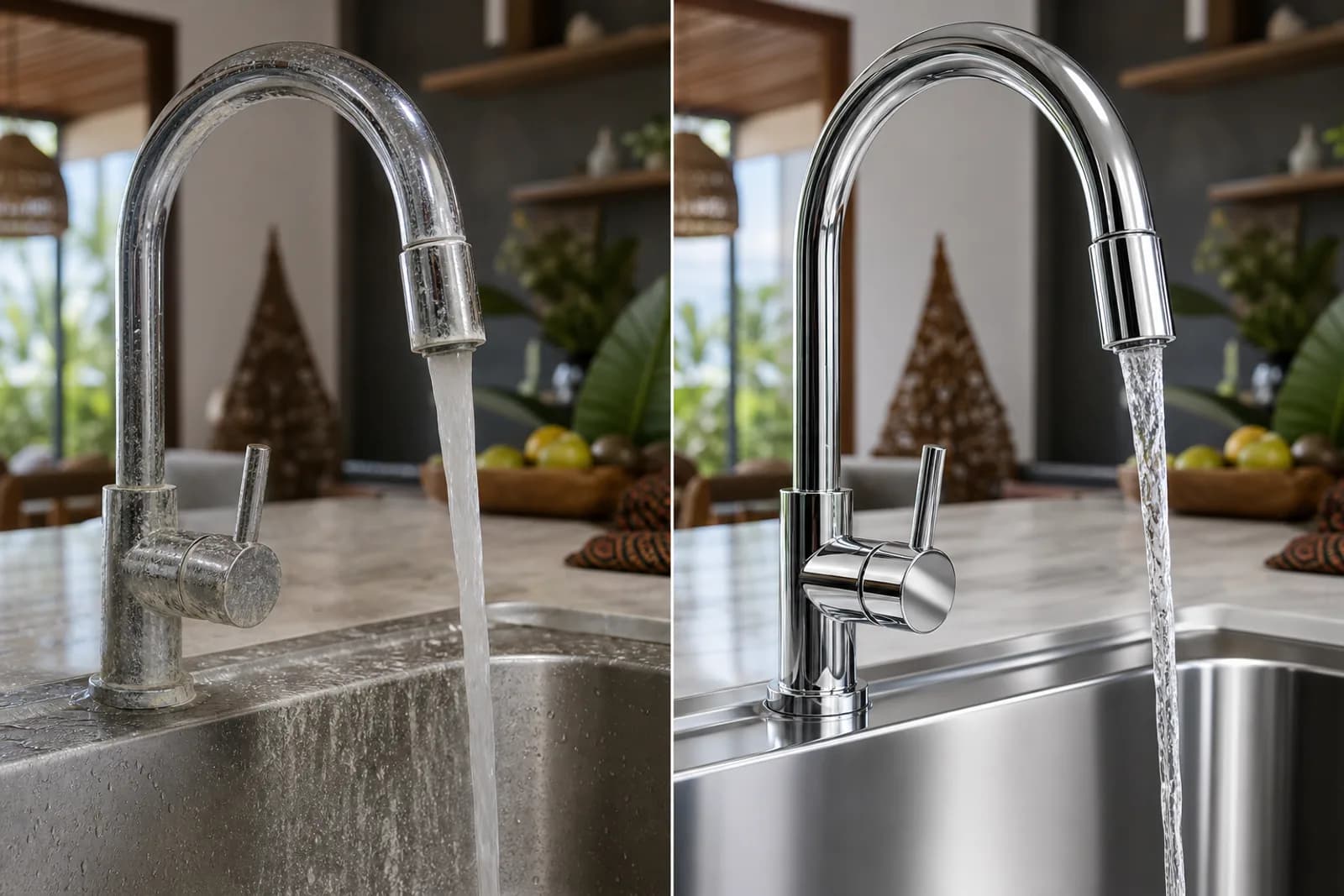
Hard water does not make you sick, but it does wear things down quietly — limescale in the kettle, stiff towels, a water heater that works harder than it should. Whether your supply comes from PDAM pipes or a borehole (sumur bor), hardness varies significantly by region and source, and in many parts of Indonesia it is high enough to cause real costs. Before buying a softener, confirm you actually have a hardness problem and understand what softening can and cannot fix.
What makes water hard
Hardness measures dissolved calcium and magnesium ions in water. These minerals dissolve naturally as groundwater moves through limestone and sedimentary rock, so deeper borehole supplies tend to run harder than surface-fed PDAM systems — though not always. The standard unit is milligrams per litre (mg/L), equivalent to parts per million (ppm). A widely used classification:
- Below 60 ppm — soft
- 60–120 ppm — moderately hard
- 120–180 ppm — hard
- Above 180 ppm — very hard
These are reference points, not precise cut-offs. At 80 ppm you may notice nothing; at 250 ppm the problems are usually obvious without a test.
Signs your water is too hard
You do not need a laboratory result to suspect hardness. Look for these indicators.
White chalky deposits on taps and showerheads. Calcium carbonate precipitates when water evaporates, leaving a hard white or greyish crust. If fittings need descaling every few weeks, the hardness is almost certainly above 150 ppm.
Scale inside kettles and water heaters. Scale conducts heat poorly — a commonly cited engineering estimate is that 1 mm of scale adds roughly 7–10% to heating energy consumption, though the exact figure varies with scale composition and heater design. In a gas water heater running daily, that inefficiency accumulates across a year.
Soap that will not lather. Calcium and magnesium ions react with soap to form an insoluble curd instead of foam. Needing significantly more shampoo or body wash than the label suggests is a recognisable sign.
Stiff or scratchy laundry. Calcium deposits in fabric fibres during washing, making towels rough and reducing absorbency. Colours can also appear duller after repeated washes.
Dry or itchy skin after showering. Hard water leaves a faint soap residue on skin that can irritate or dry it out — particularly noticeable if the problem appears or worsens when you move to a different address or water source.
Early appliance failures. Washing machines, dishwashers, and water heaters in hard-water conditions tend to develop faults before their rated service life. Heating elements and inlet valves are the first components affected.
How to confirm it: testing your water
The signs above are suggestive, not conclusive. A TDS (total dissolved solids) meter is a useful first check — high TDS often correlates with high hardness in groundwater, though it captures all dissolved solids, not just calcium and magnesium. For a definitive figure, a hardness test kit or a laboratory water test returns a result in ppm or mg/L of calcium carbonate.
In Jakarta and other major cities, PDAM publishes annual water quality reports; treated supply is commonly in the moderate range. Borehole water in coastal areas — North Jakarta, parts of Surabaya, Semarang — can be considerably harder and may also show saltwater intrusion, which a softener cannot address (that requires reverse osmosis).
If you are on PDAM supply and hardness tests below 100 ppm, a softener is unlikely to pay for itself. If you are on borehole water above 200 ppm, the case is much stronger.
What a water softener actually does
A household water softener works by ion exchange. The resin tank is loaded with sodium ions. As hard water flows through, calcium and magnesium ions displace the sodium — they bind to the resin, and sodium enters the water. The result is soft water with slightly elevated sodium content and negligible hardness.
The resin is regenerated periodically with a salt solution (brine), which flushes captured calcium and magnesium to drain and reloads the resin. This cycle is the ongoing operating cost: a regular supply of softener salt, sold as coarse granules or tablets.
What softening does not do. A softener does not remove bacteria, viruses, heavy metals, or dissolved organic compounds. It does not lower TDS significantly — it replaces hardness minerals with sodium, so TDS stays roughly the same. For drinking water quality, a point-of-use filter (UF or RO) remains relevant alongside a whole-house softener.
When a softener makes sense in an Indonesian home
A whole-house softener is most justified when all of the following are true: hardness is confirmed above roughly 150 ppm, visible scale and appliance wear are already occurring, and you have multiple water-using appliances worth protecting — washing machine, water heater, shower fittings.
The economic case is appliance longevity and energy efficiency, not health. Soft water extends the service life of heating elements and reduces descaling maintenance. For a home running a gas water heater and a washing machine daily on hard borehole water, the savings can realistically offset the cost of a mid-range softener over time, though actual payback depends on local hardness levels and usage patterns.
A softener is less compelling when supply is already in the moderate range (60–120 ppm), when PDAM water is periodically treated, or when the only concern is drinking water quality — in that case, a point-of-use RO or UF system is more targeted and lower cost.
Matching capacity to household size
Softener capacity is rated in two ways: flow rate (tonnes per hour, T/h) and filter life (total volume before regeneration).
A typical Indonesian family home with four to five people draws roughly 0.5–1.0 T/h during peak morning hours — showers, cooking, the washing machine running. A unit rated at 1–2 T/h provides comfortable headroom without the cost of an oversized commercial system.
The Truliva Whole-House Softener (SS-Q3110i / SS-Q3210i) is designed for this range: 1–2 T/h flow, output hardness under 30 ppm, and a filter life of 5,000–10,000 tonnes before the resin needs replacement. At typical household consumption, that translates to several years between servicing cycles. The unit installs at the point of entry so every tap, shower, and appliance in the house receives softened water. Full specifications at /products/ss-q3210i.
For homes that need central purification alongside softening, Truliva also offers the Whole-House Central Purifier (SC-Q3110i / SC-Q3210i) as a complementary point-of-entry stage.
Installation and running costs
Installation requires a plumber for the main inlet connection and bypass valve — typically one to two hours of labour. The unit needs a drain connection for brine discharge during regeneration.
The main ongoing cost is softener salt. Harder water and higher household volume mean more frequent regeneration cycles. As a rough industry guide, a family of four on moderately hard water might use 5–10 kg of softener salt per month, though consumption varies considerably with actual hardness and usage. Softener salt is available at hardware stores and plumbing suppliers across Indonesia, commonly in 25 kg bags.
Softened water and drinking
Ion exchange adds sodium in proportion to the calcium and magnesium removed. For most households the increase is small and of no concern. People on sodium-restricted diets or households with infants may prefer a dedicated drinking tap that bypasses the softener — a straightforward arrangement for the installing plumber. A point-of-use RO at the kitchen sink will also remove the added sodium along with other dissolved ions.
Making the call
Run a hardness test before committing. Below 120 ppm: address drinking water quality separately with a UF or RO unit and revisit softening only if appliance wear becomes a real problem. Above 180–200 ppm on borehole water, with multiple appliances already showing scale, a whole-house softener is a practical investment — one that pays back through reduced maintenance and longer equipment life rather than any single dramatic improvement. Calcium and magnesium cause the problems; removing them stops those problems from compounding.
Not sure which system fits your water?
Aright Marketing Indonesia can assess your supply and recommend the right Truliva system for your home or business in Indonesia.