Caring for Your Water Purifier During a Long Absence
Stagnant water in an RO tank or membrane can harbour bacteria within days in tropical heat. Here is what to do before and after a mudik trip or extended time away.

Water left standing for a week or more in the storage tank, the tubing, and the membrane housing creates exactly the conditions bacteria prefer: warmth, moisture, and a nutrient supply from any organic matter the filters did not catch. In an Indonesian kitchen, where ambient temperatures commonly sit above 28 °C year-round, that process moves faster than most people expect. Leaving a purifier idle is not the same as switching off a television.
This article covers what to do before you leave, what happens if you do nothing, and how to bring the system back into safe use on return. The exact steps depend on your model, so treat this as a framework rather than a replacement for your unit's manual.
How long is long enough to matter?
A short trip — a weekend away, three or four days — generally requires no special preparation. Modern RO membranes are designed to stay wet and pressurised, and a few days of standing water in a sealed, well-maintained tank poses little practical risk.
Once the absence runs to a week or more, the picture changes. Stagnant water in warm conditions lets bacterial counts climb, and any biofilm already established on tank walls, tubing, or the post-carbon stage gains time to grow. Two weeks is a clear threshold where action on return is warranted. A month or longer — common during the extended mudik season around Lebaran, or for families splitting time between cities — justifies both preparation before leaving and a full flush-and-sanitise on return.
Tankless or point-of-use systems hold far less standing water by design, so the concern is reduced. It is not absent. The membrane and the short internal tube run still need to stay wet.
Before you leave
Trips of one week or less
No special steps beyond your normal routine. Leave the system in its usual operating state: inlet valve open, pump running if it is that type of unit, power on or off per the manufacturer's recommendation. Draining the system for a short absence does more harm than good, as it exposes internal surfaces to air.
Trips of one to four weeks
Turn off the inlet feed valve. This stops fresh water entering the system, and it stops a slow drip from a leaking inlet fitting going unnoticed for weeks. On systems with a separate power supply for the pump or UV lamp, switch off the power too — there is no point running a lamp or motor with no water moving.
Do not drain the membrane to dryness. Many owners get this wrong. RO membranes are composite polymer sheets wound tightly inside a housing, and they are designed to operate permanently wet. Letting one dry out can make the membrane material shrink and delaminate, permanently reducing performance. Leave the water in the housing; the water around it keeps the membrane protected.
If your manual specifically advises draining the pressure tank for absences of this length, follow that guidance. Otherwise, leaving the tank pressurised with the inlet closed is the standard approach.
Trips of four weeks or more
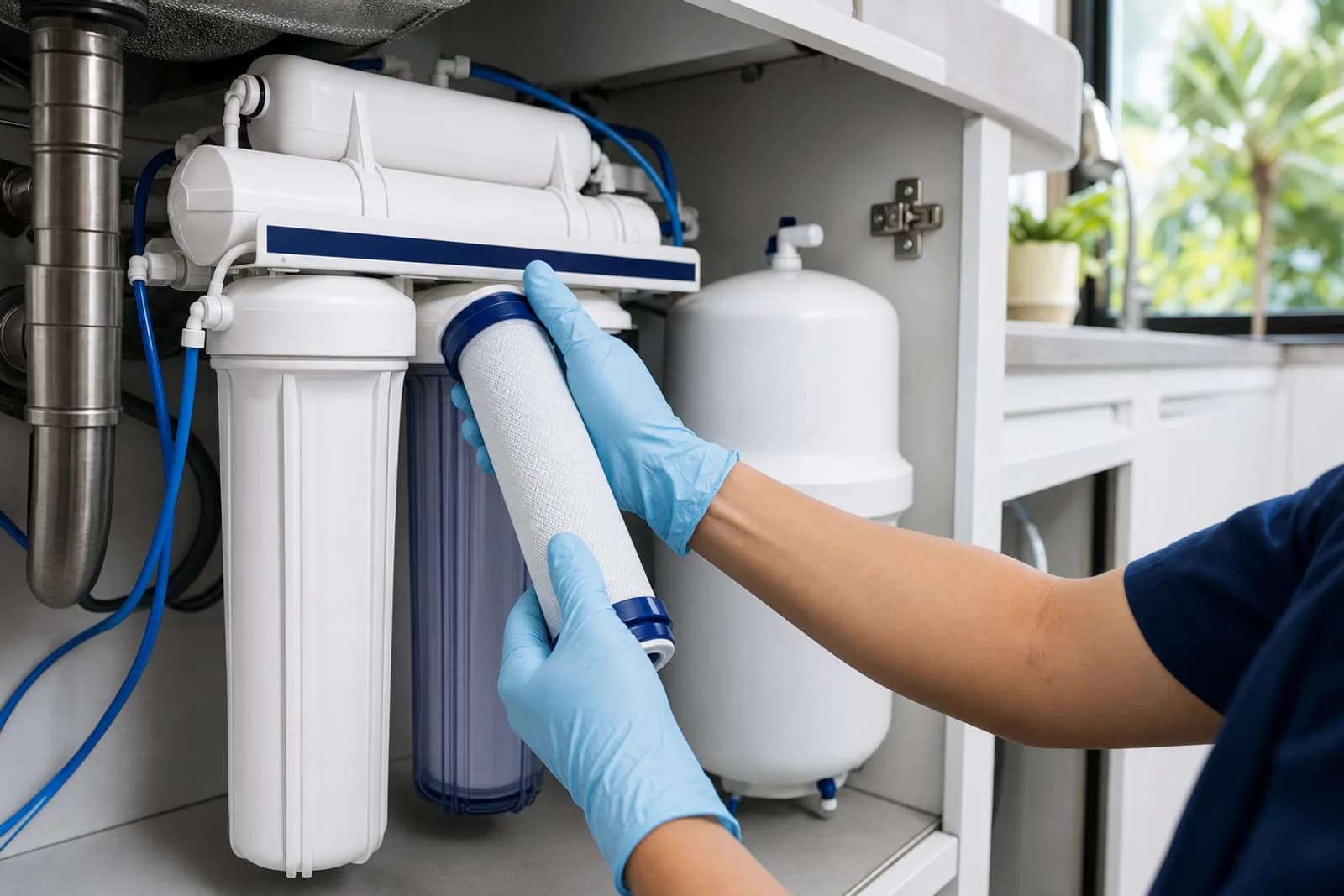
Everything above applies. In addition, check the state of your post-carbon cartridge and how long it has been in service. A heavily used post-carbon stage in warm conditions is a likely growth site for bacteria when water sits against it for a month. If it is already near its service interval, change it before you leave rather than after.
Some installers suggest running the system for ten minutes before you leave, so the tank is full and the water inside is as fresh as possible when you close the valve. That is reasonable, though it makes little material difference in a well-maintained system.
While you are away
Nothing to do. The system is shut off, the membrane is wet, and the tank is sealed. You cannot run checks while travelling, which is exactly why the preparation before leaving matters.
If someone stays in the house or checks in now and then, ask them to confirm no water is dripping from the undersink cabinet. A slow connection leak left for a month causes more damage than any issue with the water inside the system.
On return: the flush
When you return and restore the feed water, do not drink from the tap straight away. Run it first.
Open the inlet valve and let the system pressurise. Then open the product tap and let it run until the tank empties completely, and discard that water. For an absence of one to two weeks, one full tank flush is a reasonable minimum. For longer absences, flush two full tanks before using the water for drinking or cooking.
The flush does two things: it displaces the stagnant standing water with fresh permeate, and it carries any loose biological material out through the tap rather than into your glass. It is not the same as sanitisation — it does not kill biofilm — but for a moderate absence on an otherwise well-maintained system, it is often enough.
On return: when to sanitise
A flush is enough for most absences under two weeks, provided the system was in good condition before you left.
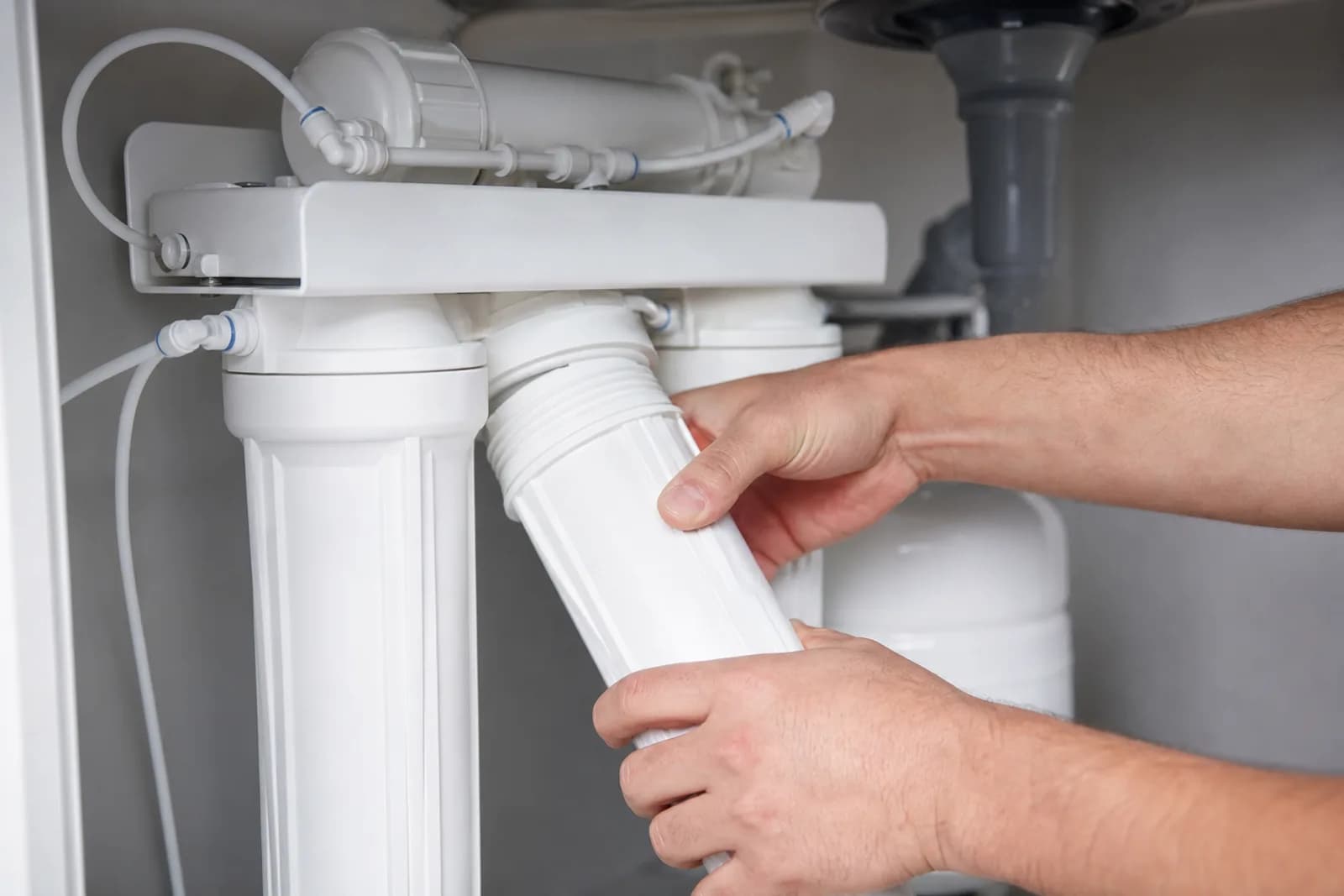
For absences of a month or longer — or for any return where the water has an off taste, a flat or slightly musty smell, or where you notice the post-carbon is well past its service life — sanitise the full system rather than just flushing it. The procedure is covered in detail in How to Sanitise Your RO System. In short, you drain the system, run a food-grade sanitising agent (food-grade hydrogen peroxide is the common choice) through the full internal volume, allow a contact time, then flush thoroughly before reinstalling the membrane and filters.
If the post-carbon was left in place through a long absence and is now past its rated life, replace it before returning the system to service. A spent post-carbon stage adds little protection and can become a contamination point itself.
Checking for leaks after re-pressurisation
A system depressurised for weeks can behave differently once pressure is restored. O-rings and fittings that were borderline before you left may now leak slowly. After opening the inlet valve and letting the system pressurise fully:
- Dry the area under the sink completely, then leave it for thirty minutes.
- Return and check with a dry hand or tissue around every connection point, the bottom of each filter housing, and along the tank lines.
- Any new moisture means tightening the fitting or replacing the O-ring before continuing.
This check is worth doing after any period of disuse, but it matters most when pressure has been off for a long time.
Tankless and instant-heat systems
Tankless RO units and countertop purifiers without a storage reservoir hold far less standing water. The membrane housing and the short internal tube runs are still there, but the volume is a fraction of a standard under-counter tank system. For these units, a shorter flush on return — running the system until flow steadies and taste normalises — is usually enough after a standard holiday absence. For very long absences, check the manufacturer's guidance; some specify a brief sanitisation procedure for the heating chamber and internal surfaces.
A practical summary
| Absence length | Before leaving | On return |
|---|---|---|
| Up to 1 week | Nothing needed | Normal use |
| 1–2 weeks | Close inlet valve, switch off power | Flush 1 full tank, discard |
| 2–4 weeks | Close inlet valve, switch off power | Flush 2 full tanks, check for leaks |
| 4 weeks or more | Close inlet valve, switch off power; replace post-carbon if near end of life | Flush 2 full tanks, sanitise the system, check for leaks |
The membrane stays wet
One point bears repeating: never drain an RO membrane to keep it "safe" during a long absence, unless your manufacturer's documentation specifically tells you to. The standard guidance across the industry is to keep the membrane wet. Drying it out shortens its life and sometimes ends it. The correct resting state is the inlet valve closed with water left inside.
A water purifier is a low-maintenance appliance for most of the year. The mudik season and other long absences are the exception. A few minutes of preparation before you leave, and a patient flush when you return, keep it running reliably. Taste and smell are your most immediate guide on return: if either is off after the initial flush, investigate before resuming normal use.
Not sure which system fits your water?
Aright Marketing Indonesia can assess your supply and recommend the right Truliva system for your home or business in Indonesia.