Bacteria and Viruses: What UF, RO, and UV Actually Remove
Pore size determines what a filter blocks — and mechanism determines what it cannot. This is how UF, RO, and UV each perform against bacteria and viruses: the pore sizes, log-reduction figures, and why stacking technologies closes the gaps.
Most households assume any water purifier removes bacteria. Some do it mechanically, some inactivate rather than remove — and several popular filter types barely touch pathogens at all. The distinction matters particularly in Indonesia, where PDAM piped supply can carry residual bacterial load from ageing distribution networks, and borehole water (sumur bor) draws from aquifers open to surface seepage. The answer depends on pore size, contact time, and which threats your source water actually contains.
Why pore size is the starting point
Waterborne pathogens span a wide size range, and a filter can only block what is physically larger than its pores.
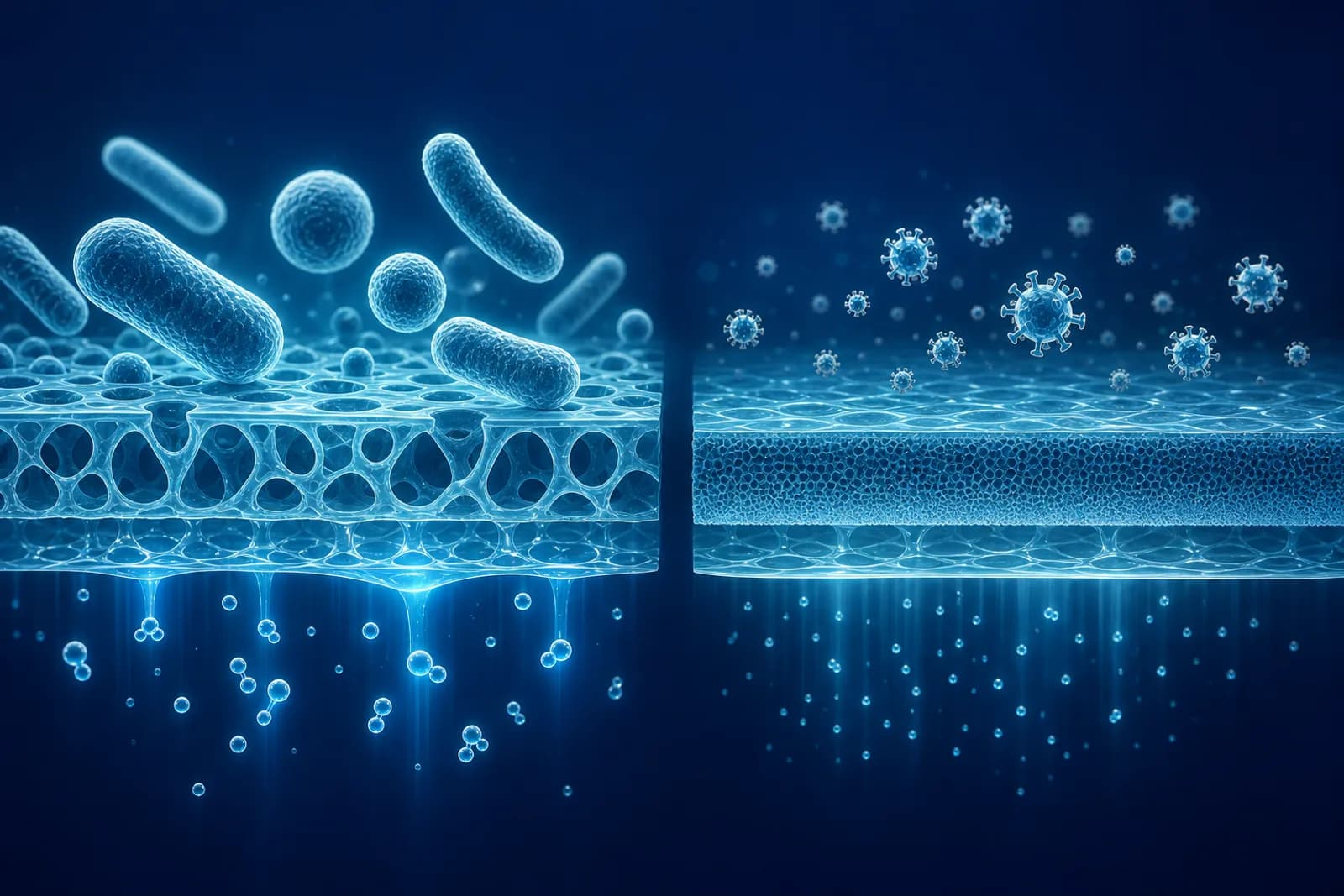
Bacteria are the largest common category. Most waterborne bacterial pathogens — Escherichia coli, Vibrio cholerae (the cholera agent), Salmonella typhi — measure roughly 0.5 to 5 microns in length. A membrane with pores smaller than this will physically exclude them.
Viruses are considerably smaller. Enteric viruses relevant to drinking water — norovirus, hepatitis A, rotavirus — measure approximately 0.02 to 0.1 micron. This is an order of magnitude smaller than most bacteria. A membrane that reliably blocks bacteria may or may not block viruses, depending on where its rated pore size falls.
Protozoan cysts (Giardia, Cryptosporidium) are the largest of the three, ranging from about 3 to 15 microns. They are the easiest to block mechanically — nearly any membrane that handles bacteria handles protozoa as well.
This size hierarchy explains why the three main household technologies — UF, RO, and UV — each occupy a different role.
How performance is measured: log reduction
Before comparing technologies, it helps to understand how removal is expressed. The water treatment industry uses log reduction rather than percentages, because percentages obscure the difference between "almost gone" and "essentially undetectable."
A 1-log reduction means 90% of organisms are removed. A 2-log reduction means 99%. A 4-log reduction — the kind commonly cited for quality UF membranes and UV lamps — means 99.99% of organisms are inactivated or removed. In practical terms: if a water source contains 10,000 E. coli cells per litre (a high contamination level), a 4-log treatment leaves at most one cell per litre. A 6-log treatment, sometimes cited for well-validated RO systems against bacteria, leaves fewer than one cell per hundred litres on average.
These are not marketing numbers — they are the measurement standard used by bodies like the US NSF and the WHO's Guidelines for Drinking-Water Quality. Look for them on specification sheets rather than vague claims like "99% pure."
Ultrafiltration: excellent against bacteria, partial against viruses
A UF membrane typically has pores in the 0.01 to 0.1 micron range. At 0.01 micron (10 nanometres), the membrane sits at the smaller end of the UF range and can physically block many viruses as well as virtually all bacteria. At 0.1 micron, it reliably stops bacteria and protozoa but the virus position is less certain — some viruses at 0.02–0.03 micron will find passages through.
Quality UF membranes — particularly those made from PVDF (polyvinylidene fluoride) and independently validated against NSF/ANSI protocols — commonly demonstrate 4-log or better bacterial reduction. Virus reduction typically falls in the 3- to 4-log range, meaning 99.9% to 99.99% removal — sufficient for most household scenarios on treated PDAM supply, where upstream chlorination has already reduced viral load.
One critical nuance: UF removes pathogens by physical size exclusion. It does not kill anything. Organisms retained on the membrane surface are alive — which is why backwashing, scheduled cartridge replacement, and a disinfecting post-stage matter. In Indonesia's tropical climate, ambient temperatures accelerate microbial growth in stagnant water, so maintenance discipline is not optional.
UF does not remove dissolved contaminants. Heavy metals, dissolved salts, nitrates, and small organic compounds all pass through freely. For PDAM piped supply in cities like Jakarta or Surabaya — where the primary concern is microbiological and the TDS is typically in a manageable range — UF addresses the relevant threat without the infrastructure of RO. For groundwater with dissolved contamination, it does not.
Reverse osmosis: comprehensive removal, with a caveat
An RO membrane operates at 0.0001 micron (0.1 nanometre) — roughly a thousand times tighter than a typical UF membrane. At this scale, bacteria and viruses cannot pass. Bacteria are approximately 5,000 times larger than the membrane pore; viruses are still 200 times larger. The physical barrier is overwhelming.
Validated RO membranes routinely show 6-log reduction for bacteria and 4-log or better for viruses in testing. In practice, a properly functioning RO membrane is one of the most complete microbiological barriers available in a domestic system.
The caveat — and this matters — is that the membrane is only as reliable as its integrity. A pinhole, a failing O-ring at a connection point, or an aged membrane beginning to delaminate can create a bypass path. This is why most multi-stage RO systems include a UV lamp as the final stage: not because the membrane is expected to fail, but because any mechanical barrier benefits from a redundant disinfection layer. A UV stage placed after the RO membrane catches what a membrane breach might miss.
RO also differs from UF in that it removes the water's dissolved mineral content along with pathogens. Calcium and magnesium — the beneficial hardness minerals — are taken out along with everything else. This is the trade-off that remineralisation stages address, and it is a characteristic of the technology rather than a flaw.
UV disinfection: inactivation, not removal
UV works by a completely different mechanism. An ultraviolet lamp emitting at 254 nanometres — the germicidal wavelength — damages the DNA and RNA of microorganisms, preventing them from replicating. An organism that cannot replicate cannot cause infection. The pathogen is not physically removed from the water; it is rendered non-viable.
A correctly sized UV lamp, matched to the flow rate of the system, delivers a UV dose measured in millijoules per square centimetre (mJ/cm²). The commonly accepted benchmark for drinking water treatment is 40 mJ/cm², which achieves 4-log reduction for bacteria and 3- to 4-log reduction for most enteric viruses including rotavirus and adenovirus — the latter being somewhat UV-resistant compared to other viruses.
UV's advantage is that it leaves no chemical residue, does not alter the water's mineral content, and acts almost instantaneously at the point of use. Its limitation is that it requires clear water to work. Turbid water, high iron, or suspended particles scatter the UV light and shield organisms behind them. This is why UV is positioned as a final polishing stage after mechanical filtration has removed turbidity, not as a first-line filter. It is also why the sequence matters: sediment → carbon → membrane → UV, not the reverse.
UV has no effect on dissolved chemicals — heavy metals, nitrates, or pesticides pass through a UV stage unaffected.
How the technologies compare
Microbiological performance, setting dissolved contaminants aside:
| Technology | Bacteria | Viruses | Protozoa/Cysts | Dissolved salts |
|---|---|---|---|---|
| UF membrane (quality) | ≥4-log | 3–4-log (varies by spec) | ≥4-log | Not removed |
| RO membrane | ≥6-log | ≥4-log | ≥6-log | Yes — removed |
| UV (40 mJ/cm²) | 4-log | 3–4-log | Effective on Giardia; limited on Cryptosporidium | Not applicable |
| Activated carbon | Minimal direct effect | Minimal direct effect | None | Adsorbs some organics |
| PP sediment filter | Indirect (removes turbidity only) | None | Partial (larger cysts) | None |
Three points this table doesn't make obvious.
Activated carbon does not reliably remove bacteria or viruses. Carbon is exceptional at adsorbing chlorine, chloramines, taste compounds, and dissolved organic molecules. It is not a microbial barrier. Systems that use only a carbon block as their primary purification stage do not provide meaningful pathogen removal — a common source of confusion when households choose filter pitchers or basic countertop units and assume any filtration equals microbiological safety.
PP sediment filters address turbidity, not pathogens directly. They do reduce the total particle load that membranes or UV stages must handle, which is why they are always positioned upstream. But a sediment filter alone is not a disinfection step.
UV has limited efficacy against Cryptosporidium. This protozoan cyst is notably UV-resistant at standard doses. Mechanical filtration — UF or RO — reliably removes it by size exclusion. Systems relying solely on UV for protozoan control need to confirm the UV dose is sufficient, typically above 40 mJ/cm² to achieve meaningful Cryptosporidium inactivation. For households drawing from surface-influenced groundwater, where Cryptosporidium is a plausible concern, a membrane stage is the more reliable primary barrier.
Why multi-stage systems work
No single stage handles every threat completely. Quality multi-stage systems are designed around this:
Sediment → carbon → UF or RO membrane → UV
Each stage handles what it does best. Sediment removes the turbidity that would clog the membrane or scatter the UV light. Carbon removes chlorine and organics that affect taste and, in the case of RO polyamide membranes, cause degradation. The membrane performs primary pathogen removal by size exclusion. UV provides a final disinfection layer that catches any organisms that found a path through — whether from membrane aging, installation error, or the statistical tail of a pathogen smaller than the rated pore size.
This is the same logic municipal water treatment applies: coagulation, sedimentation, filtration, and disinfection in sequence — not a single step relied on as the sole barrier. Household systems apply the same principle at a smaller scale.
What this means for Indonesia's water sources
Source water type shapes which combination is appropriate.
PDAM piped supply in major Indonesian cities typically arrives chlorinated, with the primary concern being residual bacterial contamination from ageing distribution networks and occasional turbidity from corroding pipes. A well-designed UF system with pre-sediment and carbon stages addresses this profile competently. UV adds further confidence against viruses. TDS is usually low enough that RO's dissolved-ion removal is not required.
Borehole water (sumur bor) is more variable and often higher in risk. Without the upstream treatment that PDAM water receives, groundwater can carry bacterial load from surface infiltration, and in some areas carries elevated iron, manganese, or nitrate. Coastal aquifers face seawater intrusion. For borehole sources, RO is typically the more appropriate primary technology — it handles both the microbiological and the dissolved-contaminant dimension. A UV stage after the RO membrane adds the redundant disinfection layer.
Air galon refill water from a reputable depot uses its own treatment, typically a combination of UF or RO with UV, before filling. The safety gap with galon water tends to be at the distribution end — the container, the handling, and the dispenser — rather than the purification step itself. A household point-of-use system that processes your own water eliminates those downstream contamination vectors.
The takeaway
What a filter removes depends on mechanism, not on the word "filter" appearing on the box. UF provides reliable bacterial removal and strong virus reduction, with performance at the smaller end of the virus range varying by membrane spec. RO provides comprehensive microbiological removal at the cost of dissolved minerals and reject water. UV inactivates bacteria and most viruses at the point of use without altering water chemistry, but requires pre-filtered, turbidity-free water and has limited effect on Cryptosporidium. Activated carbon and sediment filters are not primary pathogen barriers — they are preparatory stages that allow the primary barriers to function properly.
The best-performing household systems combine all three principles in sequence. Every mechanism has blind spots; stacking them closes the gaps.
Not sure which system fits your water?
Aright Marketing Indonesia can assess your supply and recommend the right Truliva system for your home or business in Indonesia.