Waterborne Illness in Indonesia: Causes, Transmission, and Prevention
Waterborne illness is a leading driver of acute diarrhoea in Indonesia. This article identifies the common pathogens, explains how they reach drinking water through PDAM networks, boreholes, and air galon, and shows exactly where point-of-use treatment breaks the transmission chain.
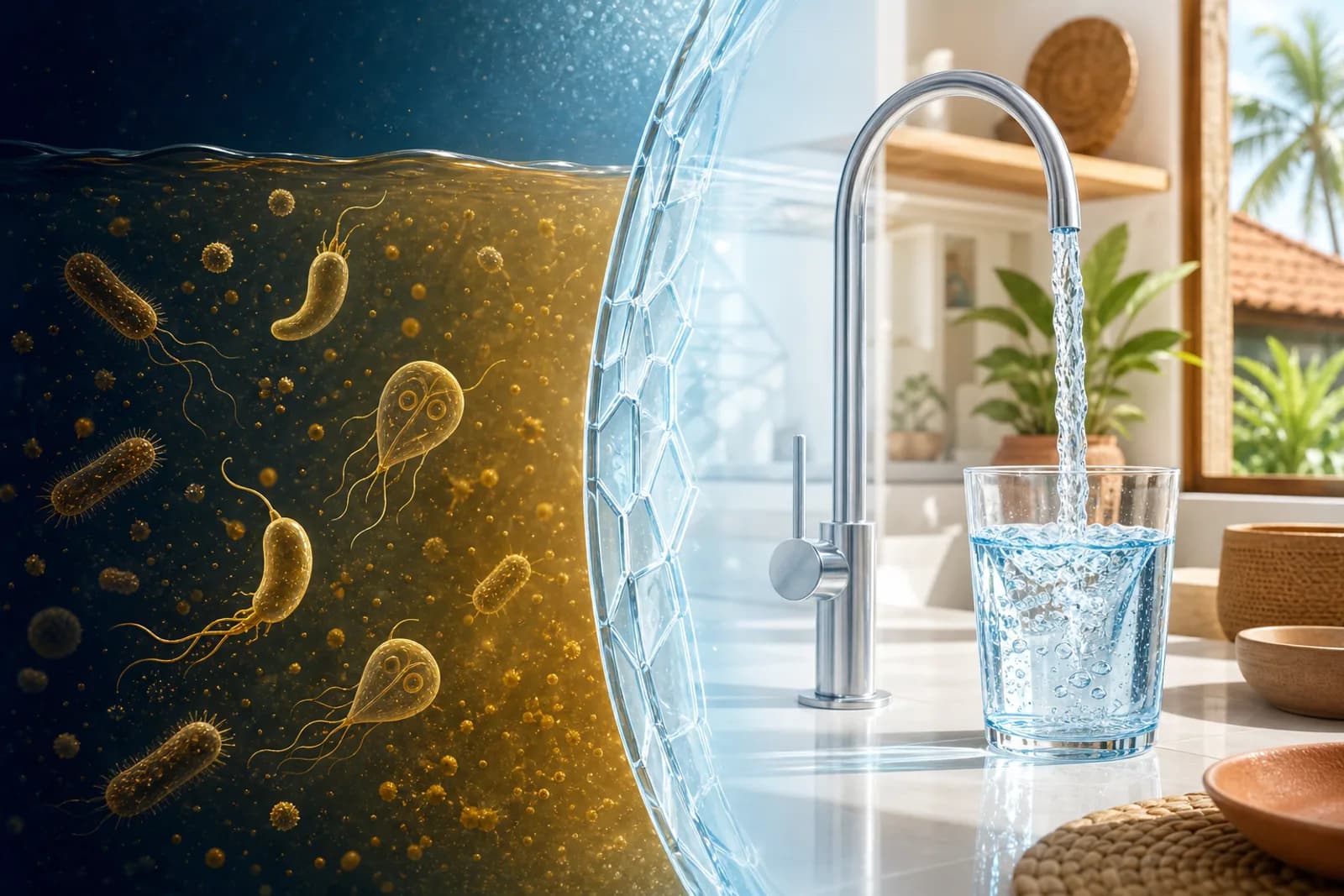
Contaminated drinking water is a primary vehicle for the pathogens behind Indonesia's diarrhoeal disease burden — the leading cause of childhood hospitalisation across the country. The organisms involved are not exotic. They are present wherever human and animal waste contacts water supplies, which in a country where groundwater and ageing distribution networks serve tens of millions of households describes a large part of the country. Understanding how pathogens travel from source to stomach, and where treatment interrupts that journey, is practical knowledge.
The main organisms responsible
Waterborne illness is not caused by a single pathogen. Several organisms share the contaminated-water route, produce overlapping symptoms, and require different treatment thresholds to remove. The ones most commonly associated with contaminated drinking water in tropical low- and middle-income settings include:
Escherichia coli (pathogenic strains). Most E. coli in the gut are harmless commensals, but pathogenic strains — enterotoxigenic E. coli (ETEC) in particular — produce toxins that trigger profuse watery diarrhoea. ETEC is a recognised cause of traveller's diarrhoea and acute diarrhoeal episodes in children under five across tropical countries. At 1–2 microns, it is one of the larger waterborne pathogens and one of the more tractable for membrane filtration.
Vibrio cholerae. The agent of cholera is still present in parts of Indonesia; outbreaks are periodically reported in areas with compromised sanitation. Cholera causes rapid fluid loss and can be fatal within hours in severe untreated cases. V. cholerae survives in aquatic environments and enters water supplies through faecal contamination. Like other bacteria, it is physically large enough to be removed by ultrafiltration or reverse osmosis.
Salmonella typhi and Salmonella paratyphi. Typhoid and paratyphoid fever differ from simple diarrhoeal illness: the bacteria invade beyond the gut, causing systemic fever, weakness, and — without treatment — serious complications. Indonesia carries a relatively high typhoid burden by regional standards, consistent with WHO burden-of-disease data for Southeast Asia, though surveillance quality varies. Contaminated water and food are the main transmission routes; household point-of-use treatment reduces one side of that equation.
Rotavirus and norovirus. Enteric viruses are why bacterial filtration alone is not the whole answer. Rotavirus is the most common cause of severe gastroenteritis in Indonesian children under five; norovirus causes vomiting-dominant illness across all age groups. Both viruses measure 0.03–0.1 microns — far smaller than bacteria — and pass through filters rated only for bacterial removal. A membrane rated 0.1 micron stops bacteria reliably but sits at the margin for the smallest enteric viruses.
Cryptosporidium and Giardia. These protozoan parasites exist as environmentally robust cysts that contaminate surface water and some groundwater. Cryptosporidium is particularly resistant to chlorine at the concentrations used in municipal treatment, which is why mechanical filtration matters more for this organism than chemical treatment. Both are larger than bacteria (cysts measure 3–15 microns), making them the easiest of the three pathogen categories to block with a properly rated membrane.
How contamination reaches drinking water
The path from faecal source to household cup is rarely direct. It typically involves one or more of the following routes, all present in Indonesian urban and peri-urban settings.
PDAM distribution network contamination. PDAM supply is chlorinated at the treatment plant, but the distribution network — the kilometres of pipe between plant and tap — is a separate matter. Ageing pipes develop cracks and low-pressure zones that allow ground seepage to enter, particularly during maintenance or after flooding. Studies of tap water quality in Indonesian cities have found water meeting microbiological standards at the plant failing to meet them at the tap, because the network reintroduces contamination downstream. Residual chlorine at the far end of a long distribution loop may be too dilute to maintain effective disinfection.
Groundwater (sumur bor) contamination. Bore wells and hand-dug wells are used by a substantial share of the Indonesian population — particularly in peri-urban and rural areas, and by households that supplement or replace PDAM supply. The aquifers these wells tap can be contaminated by seepage from septic tanks, pit latrines, or surface water. The risk correlates with the density of nearby sanitation infrastructure; in densely built kampung settings, the horizontal distance between a septic tank and a drinking-water well can fall well below protective minimums. Borehole water that has never been tested should not be assumed safe.
Air galon refill depots. The air galon model — 19-litre refillable polycarbonate jugs bought from local depots — is the dominant drinking-water source for a large share of Indonesian families. Quality at the depot varies considerably. Reputable operators use UF or RO with UV disinfection; others rely on older or poorly maintained equipment. Beyond the depot itself, even treated water can be recontaminated: jug handling during filling, the jug's condition, and the household dispenser are all re-entry points. Microbiological testing of air galon samples across Indonesian cities has found varying proportions failing standards, with contamination rates reported in the tens of percent in some local surveys — figures that are directionally consistent with independent studies but vary meaningfully by location and methodology.
Flooding. Indonesia's rainy season brings regular inundation in low-lying urban areas, particularly Jakarta and coastal cities. Floodwater carries a concentrated mix of sewage, surface runoff, and groundwater. Inundation of shallow wells, roof catchments, and distribution infrastructure reliably elevates microbiological risk for weeks after the event — not only during it.
Why tropical conditions amplify the risk
Temperature is a direct variable in microbial survival and replication. Most enteric pathogens survive longer and multiply faster at tropical temperatures than in temperate climates. E. coli, under favourable laboratory conditions, can roughly double in population every 20 minutes; in a warm, damp dispenser on a galon jug or in water left sitting on a kitchen counter, numbers that were within safe limits at the point of collection can reach infectious levels within hours. The same dynamic applies to biofilm growth inside distribution pipes and inside purifier housings left uncleaned past their service interval. Indonesia's ambient temperatures remove the thermal brake that naturally slows microbial growth in cooler climates.
What "treated water" actually means
The phrase is common but the substance behind it varies enormously.
Chlorination addresses bacteria and most viruses but not Cryptosporidium. Municipal PDAM treatment uses chlorine as the primary disinfectant. At adequate concentrations and contact time, chlorine achieves high log-reductions for bacteria and many viruses. It is significantly less effective against Cryptosporidium cysts, whose hard outer shell resists chlorine at typical treatment doses. Households relying solely on PDAM-treated water without further point-of-use treatment carry a residual cryptosporidiosis risk — particularly after flooding or during high-turbidity events when cyst loads in source water rise.
Boiling is comprehensive but operationally demanding. Sustained boiling inactivates all the pathogens discussed above. It requires no equipment beyond a heat source and a clean container, and it remains the primary recommendation in emergency and low-resource settings. The practical constraints are fuel cost, the risk of recontamination during storage, and the volume required — typically four to ten litres per person per day for drinking and cooking.
Point-of-use membrane filtration combined with UV is the most complete household approach. A properly maintained UF or RO system with a downstream UV stage addresses the full pathogen spectrum: the membrane removes bacteria and protozoa mechanically (tighter membranes handle viruses as well); the UV stage inactivates anything that passes through or is introduced post-membrane. This combination requires no chemicals and does not depend on residual concentrations holding across an unpredictable distribution network. It treats the water at the point of consumption, where the contamination burden matters.
Treat the water you drink, not the water someone upstream treated
A point worth making explicit: waterborne illness prevention requires treating the water you actually consume, not the water at some upstream stage. The relevant question is not whether PDAM has chlorinated its supply or whether the galon depot claims to use RO — it is whether the water entering your glass has passed through a reliable treatment stage immediately before you drink it.
This is the case for point-of-use treatment over distribution-based trust. PDAM quality, galon depot standards, and groundwater safety are real variables that households cannot directly observe or control. A household treatment system converts a variable you cannot control into one you can — with the caveats that the system must suit your source water, be properly installed, and be maintained on schedule. A neglected RO system with an overdue pre-filter is not meaningfully safer than no system: blocked pre-filters route chlorine and sediment into the membrane, degrading its performance, at which point a multi-stage barrier starts functioning as a single-stage one.
Prevention in practice
A few principles follow directly from the pathogen and transmission picture above.
Match your treatment to your source. PDAM piped water with known TDS in a normal range and no elevated heavy-metal concern can be adequately handled by a UF system plus UV — which retains minerals and produces no reject water. Borehole water from coastal areas (where saltwater intrusion raises TDS) or densely built areas (where septic seepage is likely) warrants RO, which addresses both the dissolved load and the microbiological one. Testing your water before selecting a system is a step many households skip and usually regret.
Treat the entire storage and handling chain, not only the filter. Even excellent point-of-use filtration is undone by recontamination: unwashed hands filling a container, a shared cup used directly at the tap, storage vessels left uncleaned. Children are disproportionately affected by waterborne illness partly because hand-hygiene compliance is harder to maintain consistently. The filter and the hygiene practices around it are both part of the same intervention.
Maintain the system on the schedule it requires. Pre-filters, membranes, and UV lamps have service intervals stated for a reason. In Indonesia's climate, where ambient temperatures accelerate bacterial growth in stagnant water inside the system, the replacement schedule is not a commercial upsell — it is the minimum discipline required to keep the multi-stage barrier effective.
The pathogens behind waterborne illness in Indonesia are known. The transmission routes are documented. The treatment technologies that interrupt those routes exist at domestic scale. What makes the difference is choosing the right system for the actual source water and maintaining it.
Not sure which system fits your water?
Aright Marketing Indonesia can assess your supply and recommend the right Truliva system for your home or business in Indonesia.