Water Purifier Leaking? A Symptom-by-Symptom Troubleshooting Guide
Leaks, continuous drain noise, low flow, bad taste, or cloudy water — each fault has a typical cause and a clear first step. Work through the symptoms before calling a technician.
Most water purifier faults give clear, early signals: a drip under the cabinet, a hiss of running water when no tap is open, a trickle where there used to be a steady stream. Knowing what each signal means lets you fix the common faults quickly — and tells you when to stop and call a technician rather than risk making things worse.
Safety first: depressurise before you touch anything
Before inspecting any fitting, housing, or tube, turn off the inlet supply valve and open a tap to release line pressure. On systems with a pressure tank, close the tank valve too. A fitting that feels hand-tight will push back hard under pressure; releasing it first prevents a drip from becoming a sudden spray. If the system uses a pump, switch off the power at the wall socket before touching any internal component.
1. Water dripping from fittings or tubes
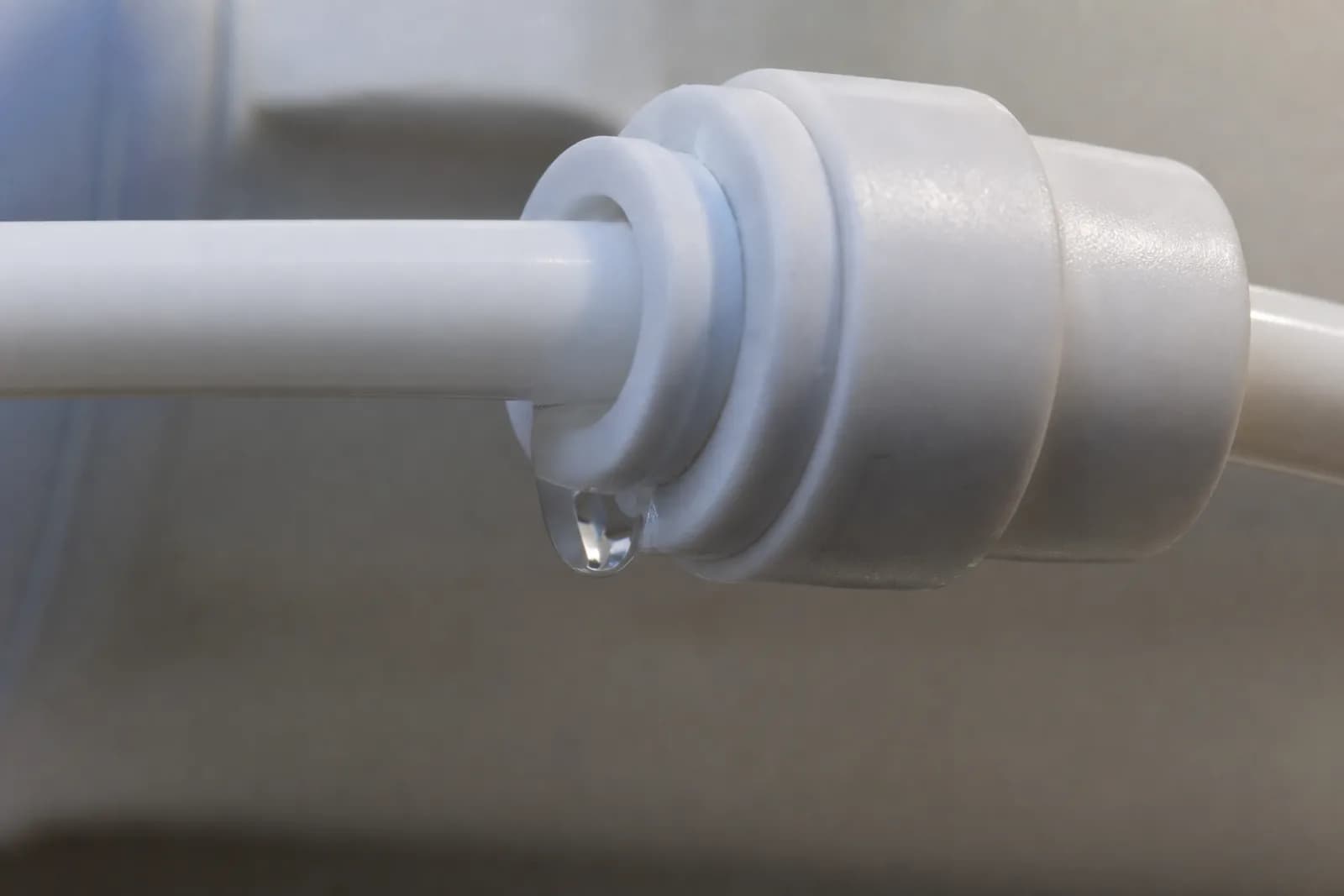
Leaks at tubing connections are the most common fault. RO systems use push-fit quick-connect fittings: you push the tube in until it seats against the inner collet, which grips and seals automatically. Most drips trace back to one of three things.
The tube is not fully seated. Push-fit fittings need a firm push to click the tube past the collet. A tube that went in halfway holds pressure for a while, then weeps. Depressurise, push the tube in firmly until it stops, restore pressure, and observe.
The tube end is cut at an angle or is damaged. The collet can only grip a clean, round end. Depressurise, press the collet ring inward to release the tube, trim 5–10 mm with a sharp straight cut, and re-insert.
The collet or fitting body is worn. Over time, especially after many reconnections, the plastic collet teeth weaken. If re-seating and re-cutting do not stop the drip, replace the fitting. They are inexpensive and sold at most hardware shops; note the tube diameter (commonly 1/4-inch on under-sink RO systems).
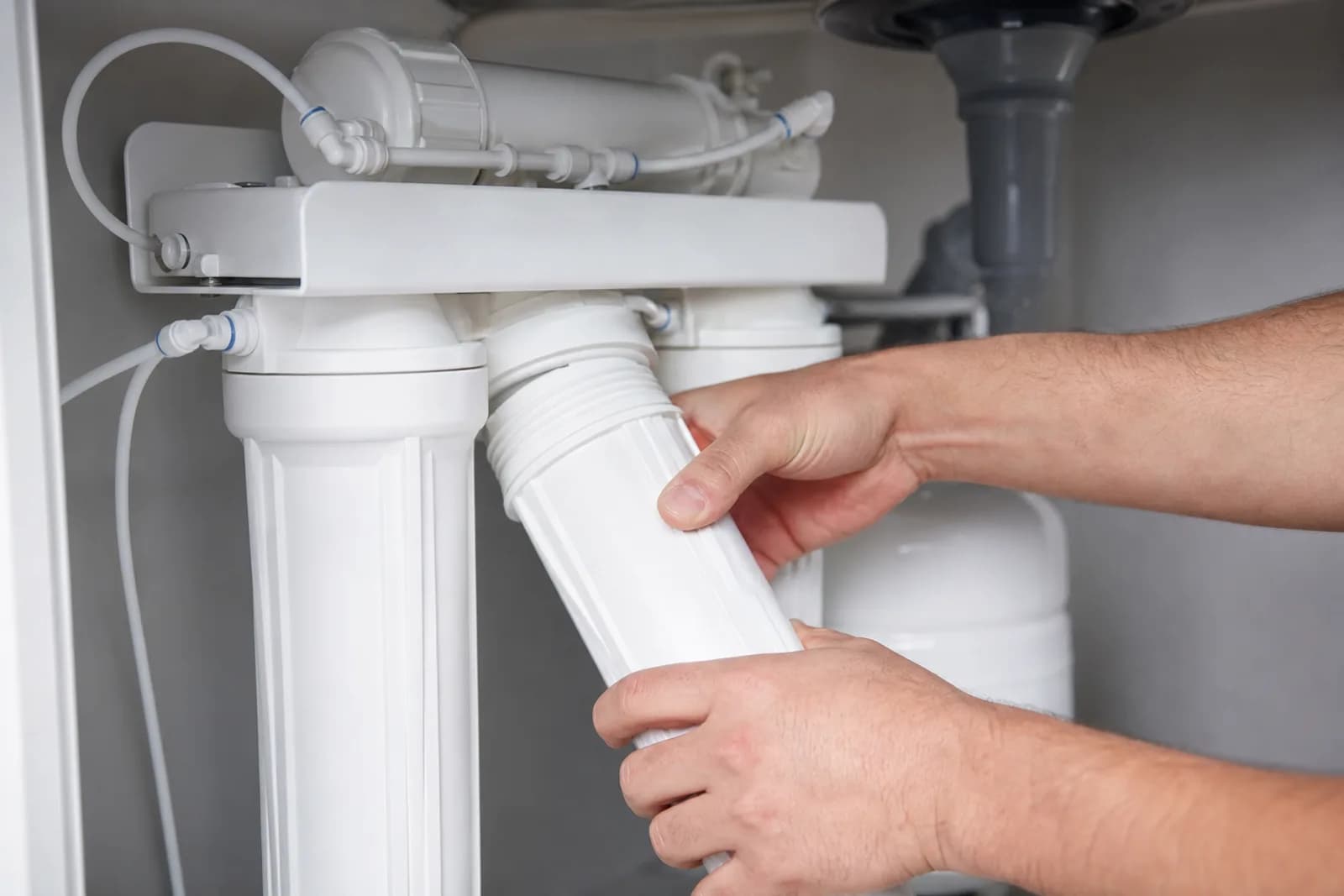
Leak at the filter housing. The threaded housings seal on an O-ring at the head. A drip here usually means the O-ring is dry, pinched, or out of its groove. After depressurising, remove the housing, clean the groove, apply a thin film of silicone grease (not petroleum jelly), and reassemble. Tighten hand-snug, then no more than a quarter-turn with the housing wrench — over-tightening distorts the O-ring and causes the very leak you are trying to fix. Replace the O-ring if it is split or permanently flattened.
A cracked housing body is less common but happens after a knock or repeated over-tightening. A crack will not seal: replace the housing and stop using the system until you do.
2. Continuous drain noise — water running to waste without stopping
In normal operation you will hear water draining during production: the membrane rejects a portion of the water to flush away concentrated impurities. That drain flow should stop soon after the pressure tank fills and the system shuts off.
If drain water runs continuously — even hours after no one has drawn water — the shut-off mechanism has failed. Two causes are common.
Failed auto shut-off valve (ASO valve). The ASO valve senses when the tank is full and cuts inlet flow to the membrane, stopping the drain. A failed one stays open, feeding the membrane indefinitely. Test roughly by closing the tank valve: if drain flow stops, the ASO valve is suspect. It is a standard serviceable part.
Failed check valve. The check valve stops processed water flowing back from the tank toward the membrane. If it fails open, tank pressure bleeds back, confuses the shut-off signal, and keeps production running. Replacing either valve means disassembling the membrane manifold — a job for a technician.
Aged membrane. As a membrane ages its rejection efficiency drops and it may demand more flow, increasing drain waste. If the system is past its service interval (commonly two to three years), mention this when you call.
3. Noisy or constantly running pump
Under-sink RO systems with a booster pump cycle: the pump runs during production, then stops when the tank is full. Constant running almost always means the pressure tank is not building pressure correctly.
The tank holds an internal bladder pre-charged with air. When that charge drops, the tank never reaches its shut-off pressure, so the pump never stops. Top up the air through the Schrader valve on the tank base — the same type as a bicycle tyre. Target pressure is typically 0.07–0.14 MPa (roughly 10–20 PSI) with the tank empty of water; check your system documentation for the exact figure. If the tank loses its charge repeatedly, the bladder has failed and the tank needs replacing.
Grinding, rattling, or a high-pitched whine can indicate pump wear or a restricted inlet line. Low PDAM supply pressure during peak demand hours makes the pump work harder and louder. Confirm the inlet valve is fully open before concluding the pump itself is at fault.
4. No water or very low flow from the tap
Low output is almost always one of four things: a clogged filter stage, insufficient inlet pressure, a depleted pressure tank, or a failing membrane.
Clogged pre-filters. The sediment and carbon stages before the membrane are the first to restrict flow as they load up. If you cannot remember the last cartridge change, start here. Replace the pre-filter stages and test flow again before investigating further.
Low inlet pressure. PDAM supply pressure varies considerably in Indonesia, and low-rise buildings can see weak pressure during peak hours. A booster pump compensates up to a point, but a partially closed inlet valve, a kinked tube, or a blocked whole-house pre-filter can starve it. Check the inlet path first.
Depleted tank. If flow is strong for the first few litres then drops to nearly nothing, the pressure tank may be empty or undercharged. Use the Schrader valve check from the previous section.
Degraded membrane. A membrane past its service life produces less output. If pre-filters are fresh and inlet pressure is normal but output stays poor on a system more than two to three years old, the membrane is a likely cause.
5. Bad taste or odour returning
Treated water that develops a chlorine taste, a flat or stale smell, or any off-note it lacked when new is signalling an exhausted or compromised filter stage.
Exhausted post-carbon stage. The post-carbon stage is the final polish before the tap. It handles water that is already purified — a smaller organic load — but still has a finite life, and it is frequently the stage owners defer. Commonly replaced every 12 months, it is the first thing to change when taste returns.
Exhausted front carbon. If the post-carbon is fresh but taste issues persist, the pre-membrane carbon stage may be overwhelmed, letting chlorine or organic compounds pass through to the membrane. This also accelerates membrane fouling.
Biofilm. A purifier left unused for several weeks, or run on badly overdue pre-filters, can develop a biofilm inside the housings and tubing. If cartridge replacement does not clear the taste after a few days, the system likely needs a full sanitisation. Have a technician handle this the first time so the flush and rinse procedure is done correctly.
6. Milky or cloudy water
Newly installed or recently serviced purifiers commonly produce slightly milky water for the first day or two. This is dissolved air trapped in the filter media during installation; under pressure change it forms fine bubbles that give the water a white cast. Fill a glass and let it stand — the cloudiness clears from the bottom up as the bubbles rise. The water is harmless.
If cloudiness persists beyond the first few days, or appears in a long-running system, investigate further. A ruptured RO membrane can let unfiltered water mix with product water; a TDS reading notably higher than normal would support this. Have a technician check any long-running system that stays cloudy on standing before you use it again.
When to stop and call a technician
Most of the above checks are safe for a careful, non-specialist owner. Stop and call a service technician when:
- A leak persists after you have correctly re-seated tubes and re-fitted O-rings.
- The pump runs continuously after you have confirmed tank air charge is correct.
- Any electrical component — the transformer, pump wiring, UV lamp socket — shows moisture or damage.
- You have replaced cartridges and the taste or cloudiness problem remains after a week.
- Any housing body is cracked or structurally damaged.
Trying to disassemble the pump, modify the membrane manifold, or work around electrical components without the right tools and knowledge usually causes more damage than it prevents.
Keeping faults from recurring
Most of the faults above trace to cartridges left past their service life or fittings never checked after installation. A twice-yearly hand-check of every connection — system pressurised, with a torch — catches most leaks before they become a wet cabinet. Keep the cartridge schedule current and the pressure and flow stress on every other component stays low. A well-maintained purifier gives little to troubleshoot; the problems in this guide are almost always deferred attention, not bad luck.
Not sure which system fits your water?
Aright Marketing Indonesia can assess your supply and recommend the right Truliva system for your home or business in Indonesia.